More than 56 healthcare projects with a value of more than USD 33 billion are under way in the Gulf states, according to Zawya Projects data gleaned by alifarabia.com.
Along with education, healthcare has emerged as a key pillar of the Gulf states' program to improve the standard of living of their citizens.
The strong focus on healthcare has led to the development of massive infrastructure projects such as the USD 5.3 billion King Abdullah Medical City in Saudi Arabia, USD 4 billion Sheikh Khalifa Medical City in the UAE, the USD 2.3 billion Sidra Medical and Research Centre in Qatar and the USD 1.6 billion Jaber Ahmed Al Jaber Al Sabah Hospital in Kuwait.
In all, at least 12 projects with a value of around USD 1 billion or more are under way in the Gulf, according to Zawya Projects data, highlighting the scale of development in the region.
EY, formerly known as Ernst & Young, expect the GCC's healthcare spending to rise 11.4% at a compounded annual growth rate of 11.4% from now to 2015.
"The healthcare industry is driven by positive growth prospects and increased purchasing power," said Andrea Longhi, MENA advisory healthcare leader, EY in a report. "The growing demand for healthcare services coupled with regulatory changes and emphasis on quality healthcare makes the GCC an important destination for both domestic and international investors. Healthcare spending in the region has witnessed significant growth over the past few years and we expect the growth to continue in the future with the higher incidence of lifestyle diseases and an increasing amount of GCC governments enforcing mandatory medical insurance."
While the Gulf states have made rapid progress in expanding healthcare services across the population, they are nowhere near the levels of their global peers, especially the high-income countries.
The Gulf's healthcare spending stands at around 4%, compared to 18% in the United States, 5.4% in China and 11.8% in Germany.
SAUDI OPPORTUNITY
As the most populated country in the Gulf, Saudi Arabia offers the greatest opportunity for growth.
Saudi Arabia's 2013 budget allocated SAR 86.5 billion (USD 23.1 billion) to health and social welfare (with SAR 54.35 billion ring-fenced solely for healthcare) -- a 16% increase on the allocation for 2012. The development features funding for 19 new hospitals, in addition to the 102 currently under construction.
"This massive hospital construction program is running into problems, however, and, as the pace of building shows no sign of slackening, these are only likely to worsen over the forecast period. In particular, a shortage of available land has already led to considerable delays with the projects already under way," said the Economist Intelligence Unit.
"The government is also seeking to encourage private-sector involvement. With this in mind, King Abdullah bin Abdel-Aziz al-Saud announced in March 2011 that the limit for loans (provided by the Ministry of Finance) for private hospitals had been raised from SAR 50 million (USD 13 million) to SAR 200 million."
PRIVATE SECTOR
Given the scope of regional healthcare, a number of companies are seeking initial public offerings (IPOs). Reuters reported that Saudi Arabia's Sulaiman Al-Habib Medical Group (HMG) and Almama General Hospitals (AGH) are seeking initial public offers for their shares in 2014. In Oman, Medical Projects also said it was eyeing an IPO.
Meanwhile, National Medical Care Company launched a SAR 364.5 million IPO in Saudi Arabia last year, while UAE-based Al Noor Hospital Groups shunned regional markets to list on the London Stock Exchange.
"With programs such as mandatory insurance, there is an increasing reliance on the private healthcare sector and most well established facilities are focusing to expand rapidly to create capacity for their growing markets," EY said in its report. "One way of doing this is by way of an IPO and raising capital for expansion. The recent IPO of several healthcare facilities have set a precedent and more are to follow in the coming years. Not only this, numerous new facilities are planned in almost all GCC countries."
NCD TO COST GCC USD68BN
Management consultant Booz & Company notes that the non-communicable diseases (NCD) in the Gulf are rising due to rapid population expansion, economic advances and sedentary lifestyles.
"NCDs have become the leading cause of death in the GCC," said Booz in a report. "And, their prevalence - which is at epidemic levels - is undermining the societal gains stemming from economic development. In fact, with current prevalence rates, the total direct and indirect cost of the most common NCDs for the GCC will be close to USD 36 billion in 2013 - one and a half times official healthcare spending."
Booz expects the cost of these diseases to reach USD 68 billion by 2022.
"The economic burden per capita for the different GCC countries in 2013 will range from USD 516 in Saudi Arabia, or 3.6% of non-oil GDP per capita, to USD 2,001 in Qatar, equivalent to 4.1% of non-oil GDP per capita," Booz said.
"By 2022, the total cost per capita will reach USD 758 in Saudi Arabia and USD 2,778 in Qatar. The lowest economic burden will be in Oman, which, in 2022, will have a NCD per capita cost of USD 603. In comparison, in 2011 OECD economies spent USD 3,327 per capita on healthcare."
However, significant challenges continue to hold healthcare back in the region. Apart from land issues in places like Saudi Arabia, shortage of skilled staff and quality physicians, nurses and hospital staffs remain one of the biggest concerns for the region.
"The region will need to invest in training their local talent to help build a larger pool of physicians to cater to the growing demand," said Imad U. Bokhari, MENA transaction advisory services healthcare leader EY, in a report.
s"As the GCC governments continue to invest in healthcare, we should see health expenditure as a percentage of GDP increase in the future. The new healthcare projects will help to attract people to the region as a medical tourism destination. Additionally, establishing research and clinical trial centers will have significant impact on retention of talent."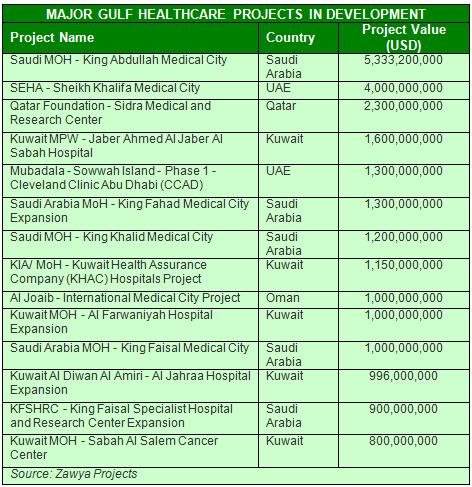
© alifarabia.com 2014