17 December 2013
Gulf banks' operating expenses are rising, leading to a moderation in profit levels, but their long-term outlook is robust.
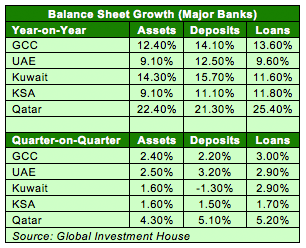
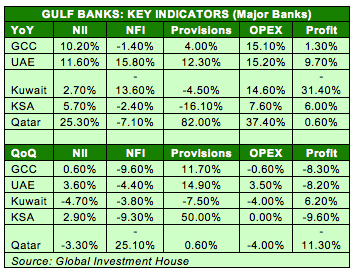
Net profits of major Gulf banks collectively rose by a mere 1.3%, year on year, to USD 4.4 billion in the third quarter, according to Global Investment House. On a year-on-year basis, net profits of banks in the UAE, Saudi Arabia and Qatar increased 9.7%, 6.0%, and 0.6%, respectively, while net profit of Kuwait-based banks fell 31.4%, Global said.
"Due to non-occurrence of one-off gains as compared to the same period last year, non-interest income declined for most of the banks. The segment plunged 1.4% year-on-year in a combined basis; all countries registered a fall in non-interest income, except UAE, which rose 15.8% year-on-year," Global said.
But the solidity of the regional bank industry is unquestioned. Bolstered by support from regional governments, Gulf banks have worked through their post-global crisis issues and have emerged stronger. Business and investor confidence is back in most of the markets and there is strong visibility on the number of projects and financing requirements that are needed to fuel the economy.
Virtually all the Gulf countries are either in the midst of stimulus programs and are expected to raise public spending further, giving the banks the confidence to prepare for strong growth.
In addition, the retreat of many international banks from the Gulf would also allow local banks to capture a greater market share.
Moody's Investors Service says the Gulf banking sector's operating environment is "buoyant".
Moody's expects GCC banks' ratings to remain broadly stable across the region for 2014, with the rating agency's real GDP growth forecasts of between 3% and 5% in 2014 and oil prices remaining above fiscal breakeven levels (with the exception of Bahrain).
"This growth will generate healthy surpluses for the region's governments, which will be channeled into the economy through widespread infrastructure spending, boosting corporate borrowing," said Moody's.
The ratings agency expects the region's credit growth to shoot past 10%, based on strong non-hydrocarbons' sector.
"In addition, the buoyant GCC economies will lead to improving asset quality for the region's banks, hence lower provisioning expenses and higher profits, helping maintain strong capital buffers, despite the robust demand for credit."
OPERATING CHALLENGES
Despite Moody's bullish outlook, regional banks are facing some challenges.
"While decline in non-interest income and increase in provisions contributed to poor growth in the bottom-line, higher operating expenses (opex) were the chief dampener during the quarter," said Global.
Kuwaiti banks had a dreadful quarter, with Burgan Bank posting a KWD 10 million loss, thanks to a 326% year-on-year growth in provisions. Even stalwart National Bank of Kuwait posted a subdued KWD 70 million profit in the third quarter, compared to KWD 108 million in the previous period (excluding the consolidation with Boubyan Bank).
Meanwhile, Commercial Bank of Kuwait posted nil profitability in Q3, compared to a loss of KWD 12.6 million during the previous quarter.
SAUDI STALWARTS
While the Kuwaiti banks are mirroring the country's economic lethargy, Saudi banks are reflecting the scale of projects under way in the kingdom.
"During the first nine months of 2013, bank credit increased at 10.8% YTD to SAR 118 billion. The strong improvement in lending is fuelled by the rebound in Saudi Arabia's macroeconomic environment and banks' focus on expanding their loan book following the cautious stance in 2009 and 2010 due to asset-quality concerns," said Bank Al Jazira in a recent report.
High fiscal spending and strong improvement in private sector activity were the prime factors fuelling this remarkable growth in the kingdom's GDP and the overall credit demand," the bank said.
"Consequently, the ratio of credit multiplier to real GDP growth surged to 2.5x in 2012 from 0.7x in 2010 and is inching closer to the average of 3.2x recorded during the boom period of 2003-08."
THE EXPO 2020 FACTOR
The UAE banks have led growth this year, and they are buoyed by the World Expo event which will be held in Dubai in 2020.
But before the 2020 boom takes off, Manama-based Securities and Investment Corporation (SICO) expects the UAE banks to embark on a spring cleaning exercise and clear out their impaired loans.
"We believe the roll-out of projects related to Dubai Expo 2020 is likely to commence in 2H15, with bank-lending related to these projects coming through only after 2016," said SICO in a recent report.
"Initial borrowing demand is likely to come from Quasi-Government entities (GREs), followed by large contractors and the hospitality sector, and finally from the SME sector. We also expect retail lending to rise over the period (2016-20)."
With Emirates NBD and National Bank of Abu Dhabi already above their limit of GRE exposure, SICO expects First Gulf Bank and Abu Dhabi Commercial Bank to step up and fund the emirate's state-owned enterprises.
"The focus of NBAD and ENBD will be on large contractors and the hospitality sector, but they will see borrowing demand only from 2017," SICO said.
With visibility on a number of catalysts till at least the end of the decade, regional banks are embarking on a fresh wave of growth. They have emerged stronger from the global financial crisis, and the regulators are also stepping up to ensure that exuberance does not lead to extravagant risk-taking.
Gulf banks' operating expenses are rising, leading to a moderation in profit levels, but their long-term outlook is robust.
Net profits of major Gulf banks collectively rose by a mere 1.3%, year on year, to USD 4.4 billion in the third quarter, according to Global Investment House. On a year-on-year basis, net profits of banks in the UAE, Saudi Arabia and Qatar increased 9.7%, 6.0%, and 0.6%, respectively, while net profit of Kuwait-based banks fell 31.4%, Global said.
"Due to non-occurrence of one-off gains as compared to the same period last year, non-interest income declined for most of the banks. The segment plunged 1.4% year-on-year in a combined basis; all countries registered a fall in non-interest income, except UAE, which rose 15.8% year-on-year," Global said.
But the solidity of the regional bank industry is unquestioned. Bolstered by support from regional governments, Gulf banks have worked through their post-global crisis issues and have emerged stronger. Business and investor confidence is back in most of the markets and there is strong visibility on the number of projects and financing requirements that are needed to fuel the economy.
Virtually all the Gulf countries are either in the midst of stimulus programs and are expected to raise public spending further, giving the banks the confidence to prepare for strong growth.
In addition, the retreat of many international banks from the Gulf would also allow local banks to capture a greater market share.
Moody's Investors Service says the Gulf banking sector's operating environment is "buoyant".
Moody's expects GCC banks' ratings to remain broadly stable across the region for 2014, with the rating agency's real GDP growth forecasts of between 3% and 5% in 2014 and oil prices remaining above fiscal breakeven levels (with the exception of Bahrain).
"This growth will generate healthy surpluses for the region's governments, which will be channeled into the economy through widespread infrastructure spending, boosting corporate borrowing," said Moody's.
The ratings agency expects the region's credit growth to shoot past 10%, based on strong non-hydrocarbons' sector.
"In addition, the buoyant GCC economies will lead to improving asset quality for the region's banks, hence lower provisioning expenses and higher profits, helping maintain strong capital buffers, despite the robust demand for credit."
OPERATING CHALLENGES
Despite Moody's bullish outlook, regional banks are facing some challenges.
"While decline in non-interest income and increase in provisions contributed to poor growth in the bottom-line, higher operating expenses (opex) were the chief dampener during the quarter," said Global.
Kuwaiti banks had a dreadful quarter, with Burgan Bank posting a KWD 10 million loss, thanks to a 326% year-on-year growth in provisions. Even stalwart National Bank of Kuwait posted a subdued KWD 70 million profit in the third quarter, compared to KWD 108 million in the previous period (excluding the consolidation with Boubyan Bank).
Meanwhile, Commercial Bank of Kuwait posted nil profitability in Q3, compared to a loss of KWD 12.6 million during the previous quarter.
SAUDI STALWARTS
While the Kuwaiti banks are mirroring the country's economic lethargy, Saudi banks are reflecting the scale of projects under way in the kingdom.
"During the first nine months of 2013, bank credit increased at 10.8% YTD to SAR 118 billion. The strong improvement in lending is fuelled by the rebound in Saudi Arabia's macroeconomic environment and banks' focus on expanding their loan book following the cautious stance in 2009 and 2010 due to asset-quality concerns," said Bank Al Jazira in a recent report.
High fiscal spending and strong improvement in private sector activity were the prime factors fuelling this remarkable growth in the kingdom's GDP and the overall credit demand," the bank said.
"Consequently, the ratio of credit multiplier to real GDP growth surged to 2.5x in 2012 from 0.7x in 2010 and is inching closer to the average of 3.2x recorded during the boom period of 2003-08."
THE EXPO 2020 FACTOR
The UAE banks have led growth this year, and they are buoyed by the World Expo event which will be held in Dubai in 2020.
But before the 2020 boom takes off, Manama-based Securities and Investment Corporation (SICO) expects the UAE banks to embark on a spring cleaning exercise and clear out their impaired loans.
"We believe the roll-out of projects related to Dubai Expo 2020 is likely to commence in 2H15, with bank-lending related to these projects coming through only after 2016," said SICO in a recent report.
"Initial borrowing demand is likely to come from Quasi-Government entities (GREs), followed by large contractors and the hospitality sector, and finally from the SME sector. We also expect retail lending to rise over the period (2016-20)."
With Emirates NBD and National Bank of Abu Dhabi already above their limit of GRE exposure, SICO expects First Gulf Bank and Abu Dhabi Commercial Bank to step up and fund the emirate's state-owned enterprises.
"The focus of NBAD and ENBD will be on large contractors and the hospitality sector, but they will see borrowing demand only from 2017," SICO said.
With visibility on a number of catalysts till at least the end of the decade, regional banks are embarking on a fresh wave of growth. They have emerged stronger from the global financial crisis, and the regulators are also stepping up to ensure that exuberance does not lead to extravagant risk-taking.
© alifarabia.com 2013