The United Nations (UN) and World Bank launched a USD 1 billion initiative on May 22 in the Great Lakes region in Central and Eastern Africa to foster peace and regional trade.
The region, loosely comprising Burundi, Democratic Republic of Congo (DRC), Kenya, Rwanda, Tanzania and Uganda, connected by Lake Victoria, Tanganyika, Malawi, Alberta and a few others, has seen its fair share of conflicts.
The multilateral initiative aims to make peace a cornerstone of the plan - especially between Rwanda and the DRC - and nourish it to improve cross-border trade, and reduce poverty through greater access to electricity.
Currently, more than 2.7 million people in the region have been displaced due to civil wars, despite significant progress being made by some of the countries that make up the Great Lakes region.
"This funding will help revitalize economic development, create jobs, and improve the lives of people who have suffered for far too long," said World Bank Group president Dr. Jim Yong Kim. "Now the leaders of the Great Lakes region, by restarting economic activity and improving livelihoods in border areas, can boost confidence, build economies, and give new opportunities to millions of people."
Conflict-ridden region
A fresh start is needed for millions of Africans living in the area.
The United Nations Human High Commissioner for Refugees (UNHCR) says the region has been impacted by the conflict in DRC, which has seen more than 20,000 refugees in Rwanda alone.
Indeed, DRC is the weakest link in the Great Lakes area. Despite the re-election of president Joseph Kabila and a parliament majority for his coalition partners, the security situation remains dicey as the M23 - an armed military group - continues its fight with the Congolese army.
"We are deeply concerned about the recent recurrence of violence by the M23. I have urged president Kabila to give appropriate instruction to the FARDC army to strictly abide by the international humanitarian law and protect the lives of the civilian population," said UN secretary-general Ban Ki-Moon at an event in Kinshasa in DRC.
"This is very important. While addressing all these security situations, we have to provide safety and security to the civilian population, particularly women and girls, must be freed of the threat of sexual violence. We must invest in the people who have suffered so much."
The meteoric rise of Raia Mutomboki, a new armed group that emerged from the lowland jungles of the eastern part of the country has brought fresh uncertainty into the proceedings.
"By mid-2012, the Raia Mutomboki spanned an area of approximately 30,000 square kilometers, although it was split into at least four main factions with no clear chains of command," wrote Jason Stearns, in a report for the Rift Valley Institute and Usalama Project.
The UN and World Bank are making a renewed effort to push for peace in the troubled country.
"We have the best chance in many years to bring peace and calm to the region," UN's Ban said in Goma, eastern DRC's main city.
But even as the UN and World Bank officials were holding talks with government officials, an explosion rocked a church, killing three people. An assassination plot to kill president Kabila and overthrow his government was also foiled in May.
"We want to see peace and development throughout the Great Lakes region," the UN secretary-general said, urging the international community to build a world "where all live in security, dignity, proud of who they are, wherever they are."
Rwanda connection
DRC became engulfed in a terrible conflict most recently after Rwandans who had committed the worst atrocities during the 1994 genocide fled to Congo, along with millions of other refugees.
Wars and skirmishes have followed since then and at one point or another no less than seven African states have fought a war in the country.
Rwanda's president Paul Kagame, who has been accused by Western governments of helping the rebel forces in DRC, recently lambasted the UN for not resolving Congo's deep-rooted problem despite having 20,000-strong force on the ground for the past 15 years.
All told, more than 5.4 million people have died in the conflict, which is the biggest death toll of any conflict since the Second World War, according to War Child, a UK charity group. More than one million Congolese people have fled their homes.
"Poverty, lawlessness [and] the lack of infrastructure are the ideal breeding ground for warlords to exploit the local population and the vast mineral resources," the charity said. "The violence is so endemic that it's all that a generation of young men know. Very few have been to school and there is no economy even if they were qualified for jobs in it."
Weighing down the region
While some of the countries within the Great Lakes region are progressing well, others like Uganda, DRC and Burundi are struggling. Even the promising ones such as Kenya, Tanzania and Rwanda have high levels of poverty and poor access to electricity.
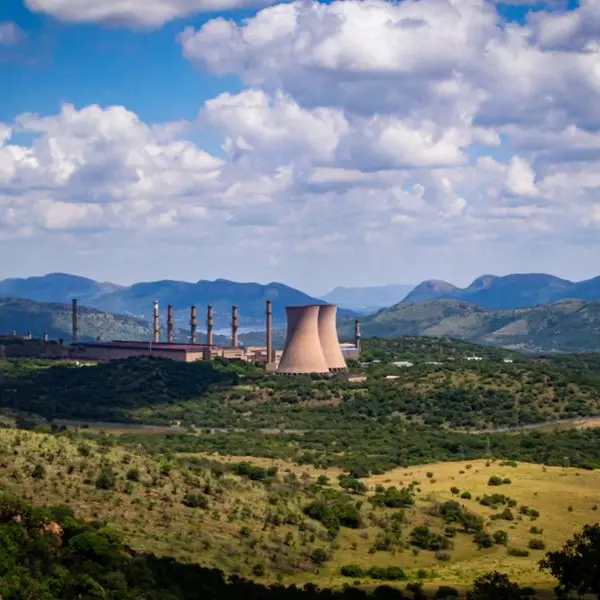
"A key part of the World Bank Group's development approach to the region is to increase power generation and interconnectivity to take advantage of low-cost and renewable sources of hydropower and geothermal energy," said the bank. "Developing the hydropower potential in DRC, in particular, will provide Burundi and Rwanda access to low-cost power and a stake in regional stability."
While DR Congo's real GDP growth will be deceptively high at 8.2% this year, much of the expenditure is on security.
"Although the government's desire to expand the budget envelope is understandable, depriving the budget of its disciplining role is not an adequate response to the country's substantial development needs," said the International Monetary Fund. "Rather, it risks reversing hard-won progress in consolidating the fiscal position."
The UN and World Bank's financing, especially in the electricity sector, may help residents of the Great Lakes to lift themselves from poverty, but regional stability will only be achieved by co-operation and political will. And that remains elusive to date.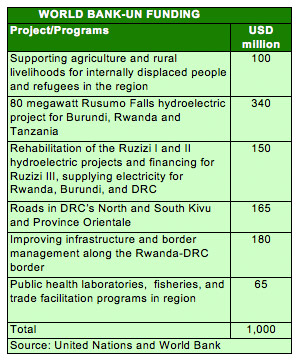
© alifarabia.com 2013