BP's decision to reportedly spend USD11-billion in Egypt's deep-water gas deposits is a significant move by the oil major which could be a game-changer for the country's economy.
BP's decision is even more remarkable given that the UK giant is on a massive asset-divesting spree as it continues to pay a heavy price for the massive oil spill in the Gulf of Mexico.
The British oil major has already sold more than USD32-billion since 2010. But the company is still not in the clear as legal issues and environmental issues in the Gulf of Mexico continue to distract the company.
Given BP's vulnerable position, its decision to reportedly invest USD11-billion suggests the company's confidence in Egypt's natural gas riches.
The country's State Information Service reported that BP is hoping to extract up to a billion square feet of gas per day - or 20% of the country's energy production - from the Mediterranean Sea.
BP's chief executive Robert Dudley expects the project to produce 40% of Egypt's natural gas output, SIS noted.
In late August, the British company also announced gas discoveries in the Taurt North and Seth South gas discoveries in the North El Burg Offshore Concession, Nile Delta. These are the fourth and fifth discoveries made by BP in the concession following Satis-1 and Satis-3 Oligocene deep discoveries and Salmon-1 shallow Pleistocene discovery.
"The discoveries show our commitment to develop the remaining potential of the shallow reservoirs within the Nile Delta and make the best use of the existing infrastructure. It demonstrates the ongoing cooperation with the Ministry of Petroleum to deliver new gas discoveries and incremental supply to meet the future growth of the gas business in Egypt," said Hesham Mekawi, President and General Manager of BP Egypt in a statement.
BP estimates it has already spent USD17-billion in the country over fifty years, and its joint venture with the Egyptian General Petroleum Company (EGPC), currently produces almost 15% of Egypt's entire oil production. Along with its partners, BP currently produces close to 40% of Egypt's total domestic gas demand.
Some of BP's other projects in Egypt include:
- BP has interests in eleven concessions in the Nile Delta, with operatorship of six.
- The company is developing the West Nile Delta (WND) project to supply critical gas to the domestic market
- BP is a 33% shareholder of an NGL plant extracting LPG and propane, United Gas Derivatives Company (UGDC) partnered with ENI/IEOC and GASCO (the Egyptian midstream gas distribution company).
- BP is also present in the downstream sector through Natural Gas Vehicles Company (NGVC, BP 40%) which was established in September 1995 as the first company in Africa and the Middle East to commercialize natural gas as an alternative fuel for vehicles, according to the company.
AN UNDER-RATED SECTOR
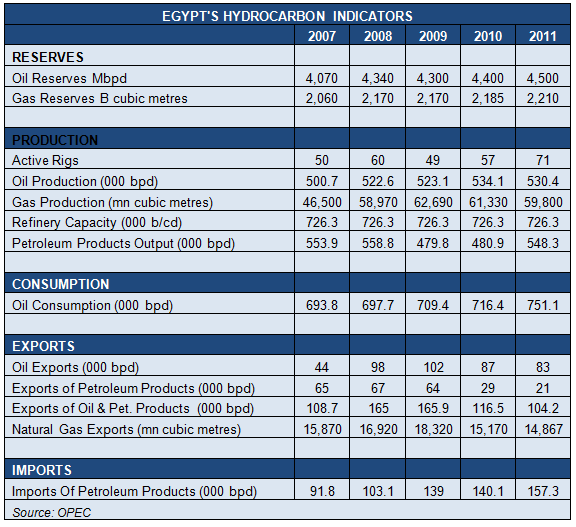
Egypt's hydrocarbons' sector is often under-rated as it's flanked by oil and gas producing giants across North Africa and the Middle East. But it is a significant fossil fuel producer that offers tremendous potential.
The country is the largest African producer that is not part of OPEC (both Libya and Algeria are), and the second largest African producer of natural gas after Algeria.
"Egypt also plays a vital role in international energy markets through the operation of the Suez Canal and Suez-Mediterranean (SUMED) Pipeline, important transit points for oil and liquefied natural gas (LNG) shipments from African and Persian Gulf states to Europe and the Mediterranean Basin," notes the U.S. Department of Energy. "Fees collected from operation of these two transit points are significant sources of revenue for the Egyptian government."
No wonder, major oil companies are upbeat on the country's prospects.
"The transition to the new government is largely behind us, and we have not had a single day of interruption," said Roger Plank, president and chief corporate officer of Apache Corp in a TV interview. "Egypt is short energy and they need new investment and we will play a part in that."
The U.S. gas giant reportedly spent USD510-million in capital expenditure in Egypt in the first six months of the year, remains bullish on its prospects. The company produced just under 100,000 bpd in Egypt and 358,000 million cubic feet of natural gas per day in the first six months of the year. Overall, Egypt accounts for roughly 22% of Apache's oil and gas production.
"Only 18 percent of our gross acreage in Egypt has been developed, with gross production of 217,000 barrels per day (Bpd) and 865 million cubic feet per day (MMcfd) in 2011, or 104,000 Bpd and 365 MMcfd net to Apache," note the company, making it the largest producer of liquid hydrocarbons and natural gas in the Western Desert and the third largest in all of Egypt.
In late 2010, Apache paid USD650-million to acquire four development leases and one exploration concession across 394,300 acres. The assets had estimated proved reserves of 20 million barrels of oil equivalent (59 percent liquids), and first-half 2010 net production of 6,016 barrels of oil and 11 million cubic feet of natural gas per day.
Apart from BP and Apache Corp. other key foreign operators in include Italy's Eni and Spain's Repsol.
"The companies operate in the framework of production-sharing agreements (PSAs), whereby they form 50-50 joint ventures with the state-owned Egyptian General Petroleum Corporation (EGPC) and are entitled to a share of 'profit' oil (typically about 20%) after receiving allocations of up to 40% for cost recovery," notes the EIU.
Meanwhile, Kuwait Energy which generates 70% of its production from Egypt, is also making fresh discoveries in the country.
The company drilled eight exploration wells in the country in the first quarter. "Kuwait Energy made three successes from the carry over wells: the Al Jahraa-1X and El Salmiya-1 wells located in the Abu Sennan concession, and the Ahmad-1X located in Area A. The Company also made a successful discovery from one of the spudded wells in 2012: West Ahmad-1X in Area A started producing at a gross initial rate of 1,250 boepd."
In addition, Dana Gas Egypt produced gas, LPG, condensate and crude oil at an average rate of 32,750 boepd in the first half. Production is expected to increase later in the year as compression facilities and new production wells are added, and two new fields are brought on-stream, the company said.
OIL PRODUCTION: RETURN TO GOOD TIMES?
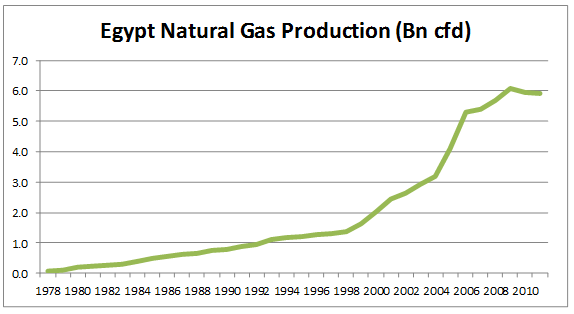
For all of Egypt's promise as an oil and gas centre, the country's oil production is tapering off. From a high of 941,000 bpd in 1994, the country's output has fallen to little over 500,000. During that time, the country's consumption has risen from 427,000 bpd to around 750,000 bpd, turning Egypt into an oil importer.
Even before the Arab Spring, Egypt was grappling with inefficient and costly energy subsidies which were a fiscal drain on the economy. The situation has become worse as the country contend with a serious fiscal crisis in the aftermath of political upheavals.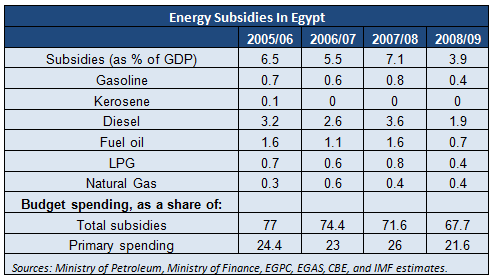
The International Monetary Fund had estimated that more than a quarter of primary spending and about two-thirds of government subsidies are attributable to a few petroleum products (gasoline, diesel, LPG, kerosene, and fuel oil).
"In addition to crowding out priority spending on social and infrastructure needs, subsidies are highly regressive," noted the IMF. "Studies by the World Bank and the USAID provide evidence of the disproportionate benefits to higher income households (almost twice as much for low income households).
While the previous regime was looking to come to terms with the issue, it is unlikely that the new government under President Mohammed Morsi would take the politically sensitive step of removing or eliminating energy subsidies any time soon.
"The political unrest in 2011 did not affect foreign investor presence in Egypt and hydrocarbon production was largely unaffected, since populated areas are far from the top producing regions of the Western Desert and the offshore Nile Delta," notes the EIA. "Additionally, as of yet, there has not been any regulatory changes that would adversely affect foreign company operations."
RISING CONSUMPTION
As the most populous Arab nation, Egypt's oil and gas consumption is rising in trajectory with more than 86 million people.
The Economist Intelligence Unit expects the country's oil consumption to rise from 34 million tonnes of oil equivalent (toe) to 40 million toe by 2015 and 50 million toe by 2020.
Natural gas consumption will rise from 40 million toe in 2011 to nearly 50 million toe in 2015 and exceed 66 million toe by 2020.
CONCLUSION
Despite the potential, the country has serious challenges to confront. The political situation is far from stable and the economy desperately needs aid and loans as the private sector has yet to pick up.
"Getting the country's economy back on track and raising the living standards for all will not be an easy task. The Egyptian people have legitimate expectations for a better life and greater social justice. We at the IMF stand ready to help," said Director-General Christine Lagarde.
Egypt recently asked for USD4.8-billion loan from the Fund and secured other loans and funds from Gulf and western nations.
"We prefer foreign borrowing at this stage given the low interest rate of the IMF loan compared to much higher rates when borrowing domestically," said Prime Minister Hesham Kandil. "Borrowing domestically would crowd out the private sector and the IMF loan would help us avoid that."
The security situation in Egypt is also far from stable. Risk consultancy Maplecroft believes Sinai Peninsula remains Egypt's biggest security challenge. On August 5, gunmen attacked an Egyptian checkpoint at the border with the Gaza Strip and Israel, killing 16 Egyptian soldiers.
"Attacks in the last 17 months have escalated from several non-lethal bombings of the al-Arish gas pipeline (serving Israel and Jordan) to the kidnap-and-release of hostages and deadly frontal assaults on Egyptian and Israeli targets," Maplecroft said in a report.
Repeated attacks on the al-Arish gas pipeline demonstrate the persistent risk posed by armed elements to commercial interests in the region, notes the consultancy.
"At least 14 attacks have occurred since the uprising that ousted then-president Mubarak in February 2011. The attacks have put a spotlight on Egypt's relationship with Israel and the business deals made under the Mubarak regime- among the most controversial being the deal to sell gas to Israel at prices said to be below fair market value."
But even without the export potential, Egypt has huge domestic needs, which makes the country a strong investment potential.
Egypt's natural oil and gas sector could play a crucial role in attracting much-needed foreign direct investment into the country. Egypt's proximity to Europe would ensure that even if its gas export deal with Israel falls through, it can get quick access to a ready customer up north.
© alifarabia.com 2012