Amid the gloom, Egypt's real estate sector continues to remain resilient.
SODIC, or Sixth of October For Development and Investment Company, saw strong new sales in the second quarter published on September 4.
The company reported second quarter net revenues of EGP 327 million, an increase of 152% quarter-on-quarter, although slightly down from the EGP 336 million recorded during the same period last year.
The company attributed the growth in revenues to deliveries in Kattameya Plaza in New Cairo, which clocked more than 100 units in the first half of the year. Deliveries in Allegria, a high-end development in Cairo, also reached 64 units leading to a total of 101 units for the first half of 2013 and more than 880 units since the company began selling units in the development in 2010.
"Crucially, the company has maintained its target of 600 delivered units in FY2013, though the wording of the statement was a touch more prudent than in 1Q2013," said NBK Capital in a note, adding that it expects strong deliveries in the fourth quarter.
SODIC's performance comes at a time of great uncertainty in Egypt. But market observers believe the current efforts by the government to stabilize the economy should make Egyptian real estate one of the more favored investment options, amid an otherwise weak investor sentiment.
The government's USD 3.2 billion stimulus package and recent monetary policy actions point to an upside in the country's real estate sector.
GROWTH DRIVERS
Cairo-based Pharos Research said there are five reasons why there is scope for a real estate pick-up:
1 Declining interest rates, falling 263 bps since June 30, 2013;
2 Government stimulus plan, EGP 2.2 billion to settle dues to contractors;
3 Capital controls, which will focus investment in domestic assets;
4 Absence of other alternative investments in the short-term; and
5 Potential inflationary pressures due to fiscal/monetary stimulus.
In addition, SODIC secured EGP 55 million from the Arab African International to build Westown projects. Palm Hills Development, another real estate company, is looking to increase capital by EGP 600 million to develop its projects.
"We believe the capital increase could also be leveraged on borrowing additional funds from banks," said Pharos.
In addition, potential investments from Gulf states in the real estate and construction sectors could further boost the industry.
Talat Mustafa Group - Egypt's biggest real estate developer - is also expected to resolve a legal dispute on its Madinaty project, "without having any cash impact on the company," according to Audi Saradar Investment Bank.
TMG also sold its 50% stake in a Saudi real estate project earlier this year to free up capital for more investments at home.
UNDERLYING FUNDAMENTALS
It has been a volatile first half for Egypt as Mohamed Morsi's elected government was sacked unceremoniously by the army, leading to violence and great political and economic uncertainty.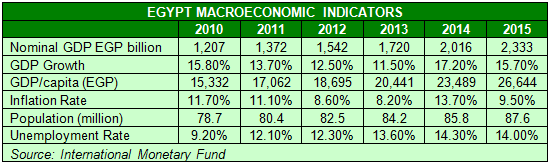
And while the economy is suffering, Egypt's housing needs remain constant. The country's population is said to rise from 81.1 million in 2010 to 85.4 million by the end of this year with Greater Cairo expected to be home to nearly 21 million people.
To address the issue, the Ministry of Housing and New Urban Communities unveiled plans to build 175,000 units in 25 different governorates. Separately, the ministry also announced a 922-acre project in 6th of October City, with nearly 44% earmarked for the housing sector.
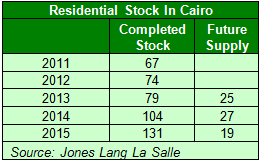
"The Real Estate Tax Authority has announced that any residential property with an annual rental value below EGP 24,000 will be exempted from property tax as of July 2013," said real estate consultants Jones Lang La Salle in a second quarter report on Cairo's property market.
"Recent amendments to the 2008 tax law exempts single-home owners from paying property tax and has raised the bracket to residential properties valued at EGP 2 million instead of EGP 500,000."
As such, selling price across the Cairo residential market rose 8% in the second quarter, with apartment sales price rising 11%. Rental rates for Cairo apartments also rose 8%, while villa rents soared 17% during the quarter, JLL data shows.
MARKET CONSTRAINTS
While latent demand for housing remains high, the country's mortgage laws are inadequate to help expand the market.
"Low income and an unhelpful mortgage law are the main constraints of the development of the real estate industry in Egypt," wrote Alaa Ghanem, analyst at Audi Saradar Investment Bank.
"Mortgage lending stands at less than 0.5% of GDP, compared to 16% in Morocco and 12% in Tunisia. Mortgage growth has been held back by a number of factors, including a lack of awareness among buyers, the large proportion of units that are informally built and which cannot be used as collateral, and most importantly, low income."
In addition, monthly installments are capped at 25% of the salary, compared to 33% in Lebanon.
"About 80% of Egyptians are classified as low-income, and they cannot afford the price of a house, resulting in the highest shortfall in affordable houses in the MENA region with 1.5 million units, according to Reuters," the analyst said in a report on the country.
Companies are also facing higher construction costs due to a deteriorating Egyptian pound, which could impact the economics of some projects.
"Despite the increase in demand, companies are not able to pass the increase in the construction cost to end consumers," Ghanem said.
"Construction cost increased by about 15% in the first quarter of 2013 due to the deterioration of the pound (as most of the raw materials used in construction have to be bought by with foreign currencies) and higher taxes imposed on some commodities including steel and cement."
© alifarabia.com 2013