Cameroon will continue its lackluster growth of around 5% at a time when other African states are galloping ahead. The International Monetary Fund (IMF) expects growth to average around 5.5% annually, in the hope that modest oil exports of around 59,000 barrels per day ramp up over the years.
However, the country is not close to its target of reaching emerging market status by 2035, as it has seen lackluster push for reforms over the years.
Indeed, the Cameroon economy is vulnerable as it relies heavily on the Eurozone economies for growth, said the IMF.
"Since debt cancellation under the Heavily Indebted Poor Countries initiative in 2006, the risk of debt distress has remained low and annual inflation has stayed subdued in the context of the CFA franc peg to the euro (the arrangement is classified as conventional peg."
Per capita real GDP and most social indicators have stagnated, despite an abundant and diversified natural resource base, the fund states.
"Private sector development has been constrained by insufficient electricity supply, inadequate public infrastructure, an unpropitious business climate, poor public financial management (PFM), a shallow financial sector, and weak regional economic integration, even within the Central African Economic and Monetary Community (CEMAC)."
In addition, high subsidies, arrears accumulation, and increasingly non-concessional financing are set to fuel macroeconomic vulnerabilities.
OIL GROWTH
Cameroon's minister of finance Alamine Ousmane Mey told the media on November 30 that the government was planning to increase oil production from 19.7 million to by 30 million barrels annually after launch of the offshore Myia oil field in Douala-Kribi-Campo Basin. The new production will net the country XAF 718 billion (USD 1.5 billion) in earnings.
Fitch Ratings expects foreign direct investments to increase in 2013 and 2014, due to investment in the oil industry.
SOCIO-ECONOMIC LETHARGY
A key criticism of the Cameroonian authorities is their failure to include average citizens in the country's economic growth, which has averaged between 4% and 5% over the past few years without making a dent in the social and human indicators.
"Looking at the health sector more particularly, there has been little improvement in Cameroon's indicators over the past two decades," said the World Bank. "The under-five child mortality rate has only been reduced slightly, while life expectancy has, in fact, declined. Substantial disparities exist in health outcomes between rural and urban areas, as well as across socio-economic groups."
Although Cameroon can boast a decent proportion of doctors (1.9 per 1,000 inhabitants), the country's health indicators are behind the curve.
"Life expectancy for Cameroonians has decreased by about two years since 1990, while it has increased by an average of five years in the rest of sub-Saharan Africa," said the bank. "Worldwide, Cameroon is also among the countries where the mortality rate for children under five years of age (122 deaths per 1,000 live births) has decreased the least."
Part of the reason is the ruling RDPC party's complacency, as it dominates the political scene. Indeed, the party emerged victorious once again in municipal and legislative elections in 2013, and president Paul Biya is widely expected to extend his rule as one of the longest-serving African heads of states with 31 years of rule already under his belt.
"The political situation has been stable, but uncertainty surrounding his succession clouds the medium-term outlook," according to Victor Lopes, an analyst at Standard Chartered Bank.
BUSINESS OUTLOOK
Apart from the potential of developing crude reserves, Cameroon has embarked on publicly funded infrastructure projects to stimulate growth.
"To resolve infrastructure bottlenecks, especially in energy and transportation, the government has launched a large public investment program," said Fitch ratings in its outlook on Cameroon.
"There have been delays in 2013, due to the creation of a public procurement ministry, which has lengthened the administrative process. The acceleration of this program in 2014 will boost the economy, and favorably impact manufacturing over time, especially the aluminum sector, which currently uses 40% of the country's power resources," said Eric Paget-Blanc, senior director at Fitch France SAS in a report which affirmed Cameroon's B rating, with a stable outlook.
Public debt, while manageable at 19.1% of GDP, is steadily growing and could edge up to 30% of GDP as early as 2017.
"The increasing share of non-concessional financing is also becoming a concern. Budget slippages have been funded by an increasing recourse to domestic debt (37% of total in 2013), part of which now takes the form of treasury bills and bonds," Fitch said.
While infrastructure projects will help boost Cameroon, the country must also revisit its business and legal framework to attract investors.
The World Bank's Doing Business Survey places Cameroon in 168th place in its latest survey of 189 countries -- a drop from 162nd place in the previous year's report.
Within Sub-Saharan Africa, only Republic of Congo fared worse. Cameroon has performed poorly in key indicators such as paying taxes (180th), enforcing contracts (175th) and trading across borders (159th).
The weak business framework has kept foreign direct investment away, except in the oil sector.
"We expect the Central African country to attract net FDI inflows averaging only 1.7% of GDP over the 2012-14 period," said management consultancy KPMG. "A major drawback is that Cameroon has a challenging business environment rife with corruption. In an effort to attract foreign investors, authorities have proposed a new bill which would see a range of tax breaks along with administrative and financial incentives to companies, both domestic and foreign, investing at least [XAF 500 million] (around USD 1 million) in Cameroon."
"However, should the economy wish to show stable, sustainable and inclusive growth over the long-term, it would need to start gravitating away from its dependence on oil."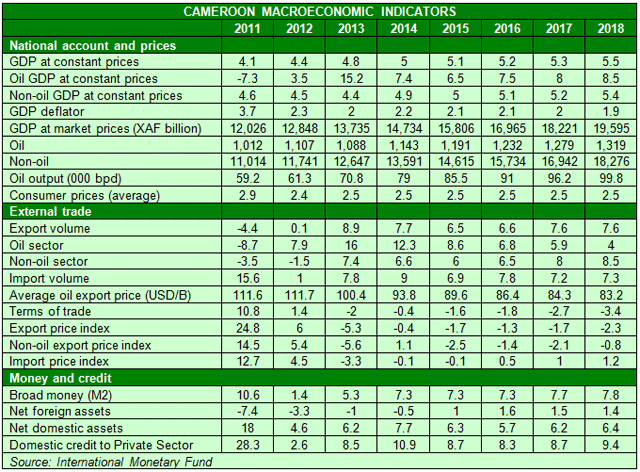
© alifarabia.com 2013