Forecasts for rapid crude oil production from places as diverse as Iraq, Canada, Kazakhstan, the US and Brazil mean we should be swimming in oil at the moment
However, on the ground the reality is very different. If anything, crude oil markets are extremely tight and both Brent crude and West Texas Intermediate - the two major crude oil benchmarks - are trending higher.
Analysts have fixated on the question of whether OPEC will be able to withstand the rush of supplies from non-OPEC sources, which would make their cartel obsolete and ineffectual.
"Right now, though, OPEC's main challenge seems to be less future demand softness than practical difficulties in bringing production to market," said the International Energy Agency in its August report.
"OPEC output last month was down 1.1 million barrels a day on the year, for reasons that had very little to do with lack of demand or competition from North American supply and everything to do with domestic developments in some member countries."
Libya's production fell by 150,000 barrels a day (bpd) month on month to reach one million bpd, due to the civil unrest, tribal militias and workers' strikes.
Iraq's output declined 60,000 bpd and fell below three million bpd for the first time in five months. Indeed, production is expected to plummet by half a million bpd from September onwards, due to infrastructure works at key southern export terminals.
Iran's oil sector, which is weighed down by heavy western sanctions, is running 500,000 million bpd lower than previous years, adding to OPEC's woes.
Non-OPEC Middle East countries have also had a torrid time, as Yemen, Egypt and Syria have all seen their crude production slide. Compared to last year, Yemeni output has fallen by 10,000 bpd, Egypt 20,000 bpd and Syria 100,000 bpd, IEA data shows.
It's not just the Middle East states that have seen output wiped out. The old workhorse North Sea has seen oil production drop by 175,000 bpd in the second quarter compared to the same period last year. Maintenance issues in Buzzard - the UK's largest field - are expected to see further production disruptions going into the third quarter.
Nigeria crude output is also below the 2012 average of 2.1 million bpd as oil thefts keep a lid on export numbers. Indeed, the Nigerian benchmark Bonny Light remains under force majeure since April, affecting about 150,000 bpd. The IEA notes that the Trans-Niger pipeline resumed operations briefly in early July, but was closed again a week later after further attacks, with no restart date in sight.
Meanwhile, Angola has also seen output drop by a fraction, while Venezuela's crude supplies declined by 30,000 bpd as political issues continue to restrict investment in the country's oil sector.
Sudan has also seen production cut by more than half to 150,000 bpd, from 350,000 bpd at its peak.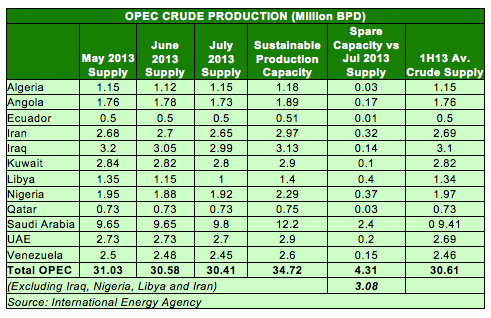
FOUR MILLION BARRELS OF OIL
Combined, more than four million barrels of oil per day have disappeared from the market over the past three years, due to the disruptions outlined above, according to estimates from Bank of America Merrill Lynch.
"While some of these disruptions are temporary, others are far more entrenched," said Francisco Blanch and other BAML analysts in a note to clients.
"In Iraq, even after maintenance work at the Basrah terminal passes, the payment dispute between Iraq and Kurdistan will remain a constraining factor on Iraqi oil exports.
"Resumption of production in South Sudan is tenuous and the security situation in Libya remains an issue. Falling output in Iran and Nigeria on political tensions and pipeline attacks, respectively, have become a mainstay of the oil market, as has civil unrest in Egypt, Syria and Yemen."
These series of temporary and structural disruptions have eaten into OPEC's spare capacity which has fallen to 3.08 million barrels per day, its lowest level since July.
A deeper crisis in places like Libya, or Nigeria, could further destabilize the market, especially at a time when demand is edging back up.
"These short-term indicators, although meaningful, will fade into the background of the broader fundamentals," said Bob Brackett, analyst at Sanford Bernstein.
"The bigger question today is whether ambitious supply growth will materialize, both this year and next year. We still need to grow further, to 55.4 million bpd in Q4 in order to meet the IEA's supply forecasts for the year."
Given the tight supply situation over the horizon, analysts expect Brent crude prices to remain at their present high levels for the foreseeable future.
"After 2015, we expect a steeper increase in oil prices," Brackett said.
"Emerging market demand should remain robust and the impact of fuel economy in OECD markets is overstated. Non-OPEC supply is increasingly focused on mature areas and OPEC capacity growth will lag what's required to maintain stable spare capacity."
© alifarabia.com 2013