Can the US dollar ever be displaced? With its biggest rival euro in the doldrums and the Chinese renminbi nowhere near a currency of global standing, the American greenback seems destined to dominate global financial trade. But its status as a reserve asset is slowly eroding.
The World Gold Council states that central banks are reducing reserve portfolio of allocations to US dollars and euros in favor of alternative reserve assets - with gold leading the way.
Of course, the WGC is a lobby group set up by gold producers for the express purpose of promoting the yellow metal, so its pronouncements should be taken with a grain of salt.
Still, statistics seem to support the WGC's theory.
IMF data shows the official reserves of emerging central banks have risen from USD 2 trillion in 2000 to more than USD 12 trillion by 2012.
During this time, the US dollar's share of total reserves has fallen from 62% to 54%.
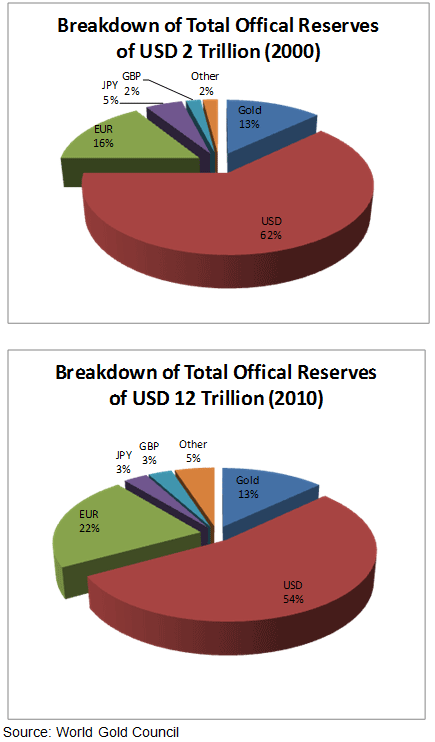
"With concentrated positions in US dollars and euros, they [emerging central banks] have been focused on rebalancing into other currencies," said the WGC. "This process is already well under way with the US dollar and euro component declining from 78% to 74% in the past 12 years."
"Meanwhile the share of 'other' currencies has tripled in absolute terms since just 2008. Assuming this trend continues and US dollar and euro allocations reach 65%, the World Gold Council research finds gold would play a prominent role in the remaining 35% of assets."
Is gold losing its luster?
The WGC report comes at a time when investors are questioning the yellow metal's growth after it had risen 500% in more than a decade. Growth has stalled over the past year, and gold has been overlooked by investors as they pour funds into equities, real estate and other currencies.
"Macro uncertainty still has scope to drive gold prices higher, but investor fatigue has capped upside momentum," said Suki Cooper, analyst at Barclays Capital. "We have revised our gold price forecast lower from USD 1,778/oz to USD 1,646/oz, as the downside risks to the outlook have risen while upside catalysts have receded. In the US, despite headwinds related to the sequestration, retail sales have been strong, and, in turn, increasing confidence in the economy has weighed upon interest in gold."
Speculative positions have eased, driven by long liquidation and fresh gross shorts, while ETP holdings have continued to trickle lower. Net outflows have reached 27 tons so far in March, with the bulk of net redemptions taking place in gold.
"Total metal held in trust remains elevated at 2,623 tons but is 143 tons off the all-time high. Outflows for the year to date have reached 137 tons, compared with modest net inflows of 71 tons over Q1 13 and net outflows of 50 tons in Q1 11," said Cooper.
"There is scope for gold to gain traction, given the forthcoming debt ceiling debate, and the pace of outflows have started to slow. We believe these are more likely to stabilize should equity market gains slow or gold prices stabilize at about USD 1,600/oz, given the entry levels of inflows over the past year. However, the big catalyst to push prices significantly higher is absent for now."
More worryingly for gold, China is looking to limit its gold holdings to 2% of its total reserves, primarily because it does not want gold prices to rise which would hurt Chinese consumers. The Asian giant holds 1,054 tons of gold and is the world's fifth-largest national holder of the yellow metal.
Stashing yellow metal
The WGC reasons that gold is playing a greater role in reserve assets and can offer sufficient diversity and disconnect from global markets to appeal to central banks.
Equally important is the size of the gold market of USD 3.2 trillion and average daily volumes of USD 240 billion, which makes it more liquid than even Dow Jones, S&P 500 and German bunds.
Chinese assets, gold, Canadian and Australian treasuries have emerged as key alternatives to the US dollar and the euro, according to the WGC.
"However, when markets size and access constraints are considered, gold emerges as the dominant asset for diversification with a median suggested optimal allocation of 8% in US dollar terms."
For the moment, central bank action seems supportive of WGC's findings.
The world's central banks have collectively piled up 1,100 tons of gold since the second quarter of 2009 till the end of 2012.
"Total net purchases by central banks of 534.6t [last year] exceeded 2011's already strong total and signaled a return to levels of buying last seen almost 50 years ago," the WGC said in its report. "The year saw a number of new joiners added to the list of institutions building their gold reserves; Brazil and Paraguay were two such names, both making significant purchases during the year."
Other emerging market central banks from countries such as Iraq, South Korea and Philippines have all increased their investments in gold, as they diversify away from US dollars and the euro.
It appears that while retail investors may no longer be enamored by gold, central bank investments should continue to support gold prices for the time being.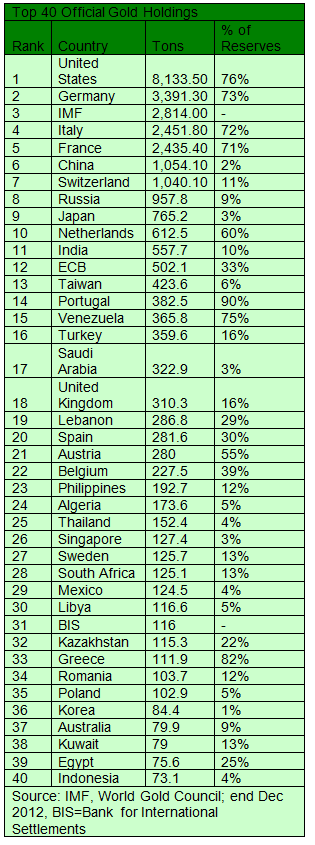
© alifarabia.com 2013