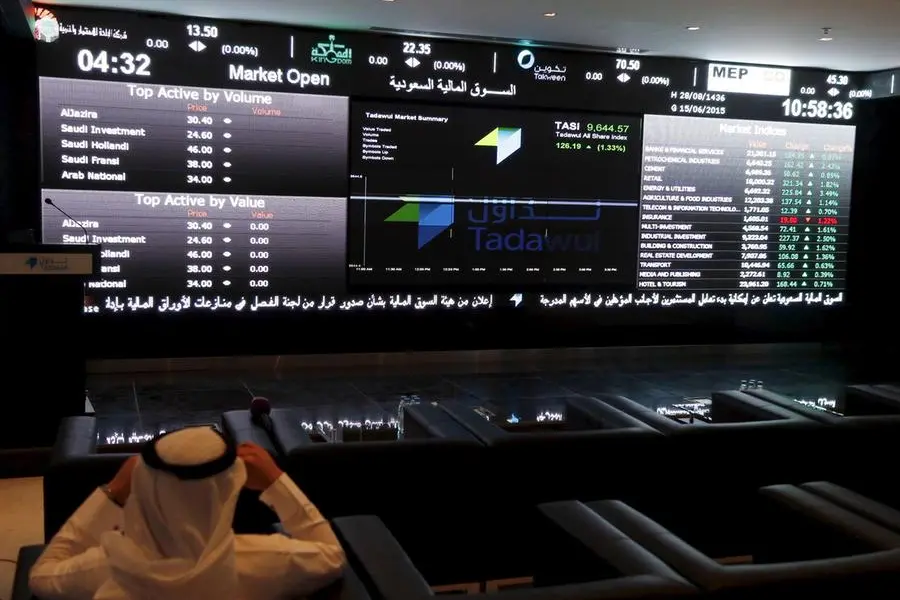
Saudi Arabia's petrochemicals companies saw their half-yearly earnings collectively decline 3.5% this year, but analysts are expecting an improvement in profits in the second half.
"Despite [the fact] that the sector at local and regional levels did not witness any significant growth in 1H2013, we are expecting better operational and financial performance in 2H2013," said Al Jazira Capital.
After more than a decade of unfettered growth, Saudi Arabia publicly-listed petrochemical companies saw their net profits fall 15% to reach SAR 31 billion last year.
But improving global economic outlook in Europe and North America should lift earnings of the Saudi and global petrochemicals industry, although demand in emerging markets like China and India remain a concern.
"Prices of key olefins and its derivatives and other chemical started to witness uptrend in 3Q2013," Al Jazira analysts said in a recent note. "However, the average prices of fertilizer chemical remained under pressure. Olefin complexes are expected to mark better year-on-year financial performance in 2H2013."
Indeed, prices of many petrochemical products shot up 2-3% last month, after declining for much of the first half of the year.
Jeddah-based NCB Capital also expects the petrochemicals sector to get a lift as the global construction and automotive sectors and consumer confidence lead to greater petrochemical demand, especially in the United States.
The investment bank expects Saudi petrochemicals companies to collectively expand by 17.4% year-on-year to SAR 40.1 billion (USD 11 billion) in 2014 as the industry benefits "from improved operational efficiencies at Kayan and Petrochem, coupled with higher earnings from Sahara and Sipchem's start-ups. Any delay or lower-than-expected revision in ethane prices in Saudi will positively impact the sector's 2014E earnings."
DOWNSTREAM PROJECTS
Saudi petrochemical companies have announced a number of projects to boost growth at a time when the global industry is going through significant changes.
"Saudi producers have sound financial and operating fundamentals, and are treading the growth path through downstream expansion, which we believe will boost the bottom-line performance," said Al Rajhi in a note to clients.
The country is expected to add petrochemical capacity to the tune of 40.6 million tons over the next eight years, to add to its existing production level of 86.4 million tons per year - the largest in the Middle East.
A number of projects are under way that will contribute to that total. Sadara Chemical Company - a joint venture between Saudi Aramco and The Dow Chemical Company - started building a Jubail petrochemical complex to produce three tons per annum of chemicals.
SABIC is also developing two downstream plants in Jubail with integrated capacity of 250,000 tons per annum (TPA) of methyl methacrylate (MMA) and 40,000 TPA of polymethylmethacrylate (PMMA).
Saudi Ma'aden is expanding phosphate production at a cost of USD 7 billion, while Petro Rabigh began work on a USD 5 billion expansion of its project.
Jubail Petrochemical Company is also planning to build the world's largest carbon dioxide purification and liquefaction plant to compress and purify about 1,500 TPA from an ethylene glycol plant. The purified gas will be piped to three SABIC companies to boost methanol and urea production.
Saudi mining company Ma'aden has begun trial production of the Sahara & Ma`aden Petrochemicals Company for 250,000 TPA of caustic soda and 300,000 tons of ethylene dichloride.
Meanwhile, Swiss company Clariant and Tasnee signed an agreement to establish a masterbatches (an additive used for coloring plastics) joint venture in Saudi Arabia. Tasnee will acquire a 40% stake in Clariant's masterbatches Saudi operations under the agreement.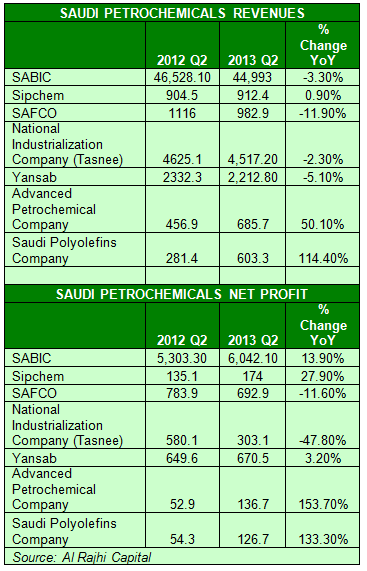
MAJOR WORRIES
While the global economic sentiment remains subdued and the renaissance enjoyed by North American petrochemical producers brings fresh competition to the global petrochemicals industry, Saudi petrochemicals companies should be able to weather the storm, analysts believe.
"We upgrade Tasnee to Overweight, while maintaining all other ratings. We remain Overweight on SABIC, SIIG [Saudi Industrial Investment Group], Yansab and APC [Advanced Petrochemical Company]," said NCB Capital in a bullish note in September.
"The continued recovery in economic conditions in the US and Europe is likely to support petrochemical demand in the coming quarters. Moreover, start-ups and improved operational efficiencies at existing plants are set to drive 2014E earnings."
Yet there are some serious fundamental challenges facing the country's industry. The Saudi petrochemicals sector has benefited from low natural gas prices - which serve as key feedstocks - for decades, but that situation is changing.
Companies like Royal Dutch Shell and Russia's OAO Lukoil are drilling for natural gas in Saudi Arabia, but they might walk away if the government offers the current price of 75 cents per million British thermal units - which is some of the lowest in the world.
Raising natural gas prices is a politically sensitive issue in Saudi Arabia, and while it could hurt the prosperity of the petrochemicals industry, it needs to raise prices to develop the sector and curb waste.
Business Monitor International expects Saudi Arabia to remain self-sufficient in natural gas with output rising from an estimated 116.2 billion cubic meters (bcm) in 2013 to 152bcm by 2022, but new natural gas developments will require much higher prices.
It is likely that Saudi Arabia will leverage its strong petrochemicals base and remain a key player in the global industry. But the days of unfettered growth in the Saudi petrochemicals industry may soon be over, as pricing pressures depress profits and new competition shrinks its market share.
© alifarabia.com 2013