It may be a bit difficult to find Rwanda on the map as it's lodged between much larger neighbors, but it has emerged as a standout economy in the continent.
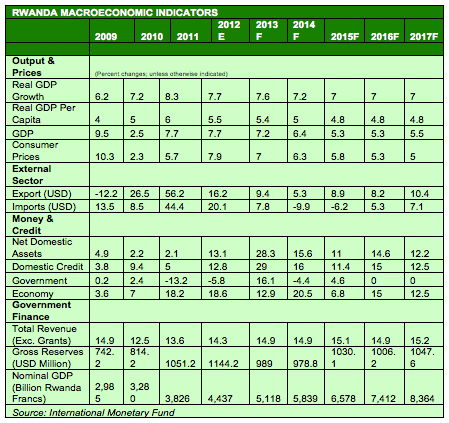
"Rwanda has been an economic success story," proclaims the International Monetary Fund in its latest report on the economy on March 19.
From a low base, the economy is set to double within five years, the fund forecasts in its March 21 report on the country.
While the global economy reeled in 2008, Rwanda galloped ahead at 13.4% and continued its good run with between 6-8% growth leaps over the past four years.
Last year, the country posted a 7.7% increase in GDP, and the IMF expects the country to maintain that momentum till at least 2017.
"Real gross domestic product (GDP) growth averaged above 8% per year in the last decade; inflation has been subdued since 2009; foreign reserves have been kept at adequate levels; poverty based on the household living conditions survey declined from about 57% in 2005/06 to below 45% in 2010/11; and income inequality declined notably," the IMF noted.
Unlike its other African counterparts, which have been boosted by oil and gas finds, Rwanda's success has been driven by good economic governance.
The country emerged as the 52nd easiest place to do business in, according to the World Bank's 2013 study, although it was four places below its ranking in 2012.
Rwanda was ranked eighth globally out of 186 nations, in terms of starting a business, which is in itself a remarkable achievement, given that the country was ranked 150th in 2008.
Rebel ties hit foreign aid
But Rwanda's reputation was tarnished after the United Nations accused the government of supporting and training M23, an armed rebel group in neighboring Democratic Republic of Congo. Rwanda has repeatedly denied its involvement.
The US, United Kingdom, Germany and other Western nations have taken notice of the UN's accusations, and stopped aid to Rwanda in November last year, which led to the widening of the current account deficit, as 45% of the budget is plugged by international aid.
"Risks to the outlook arise mainly from possible cutbacks in aid and a more challenging global environment," the IMF noted. "Staff estimates indicate that a prolonged delay in the delivery of budget support could lower growth in 2013 by 1½ percentage points and possibly more, depending on the magnitude of second round effects."
But in a surprise move, Bosco Ntaganda, a key leader of the M23, voluntarily surrendered to the US embassy in the Rwandan capital of Kigali on March 21, and asked to be transferred to the International Criminal Court (ICC).
Analysts expect the rebel leader's surrender should help Rwanda resume its access to Western aid.
Still, reducing dependence on aid is a key priority for the government, which is seeking a USD 350 million Eurobond to fill a budget hole as aid has dried up. The plan was first mooted in 2012, but postponed.
Investor reaction to the bond will depend on whether the UN is satisfied that Rwanda's president Paul Kagame has stopped meddling in Democratic Republic of Congo's affairs.
Kagame has also been accused of restricting freedom of expression and suppressing opposition parties by the Human Rights Watch, which could reduce investor appetite.
Vision for the future
Rwanda has come a long way from the genocide in 1994 that saw almost a million of the Tutsi and Hutus tribes massacred. Kagame's Rwanda Patriotic Front (RPF), which had finally emerged victorious from the debacle, has been in government since 2000, and turned the economy around remarkably.
The country aims to become a lower middle-income economy by the end of the decade, as part of its Vision 2020 program. Key aspects of the plan include developing human resources and cultivating a knowledge-based economy led by the private sector.
"Private-sector-led growth is a core pillar of Rwanda's vision of middle-income status by 2020," said the African Development Bank. "Overall, 90.8% of Rwanda's workforce is employed in the private sector, which makes it a catalytic sector in terms of reforms to ensure inclusive growth."
"Over 123,000 SMEs operate in the private sector, accounting for 98% of all businesses and 84% of private sector employment. However, 88% of these SMEs are informal and as such, their contribution to total tax revenues, estimated at less than 2% in the budget, remains meager."
Indeed, the country has a long way to meet some of the lofty goals envisioned in the 2020 vision plan.
Reforms needed to shore up economy
The African Development Bank estimates that the country will need an additional USD 200 million to USD 400 million (4% to 8% of GDP), to realize growth of 8.5% annually."However, limited growth in credit to the private sector and low-tax effort are key bottlenecks," the AfDB noted. "Thus, mobilization of public resources through improvements in tax policy and administration and mobilization of private sector resources including through PPPs [public private partnerships] is crucial."
In addition, youth unemployment and poverty remains elevated. And while the private sector is expected to pick up the slack, it has not been energized yet.
Despite high doing business ranking, Rwanda's private sector remains weak and foreign direct investment have not increased as expected, the AfDB noted.
"Maximizing the contribution of Rwanda's private sector in terms of employment, export earnings, and tax revenues is currently impeded by several key bottlenecks including high costs of doing business and inadequate business development services."
The resumption of international aid flow is crucial to Rwanda's economic prospects and new socio-economic projects, and Kagame would do well to remain focused on the country's own affairs and shun the rebel group across its western border.
© alifarabia.com 2013