United Arab Emirates and Saudi Arabia emerged as the best countries in the Middle East and North Africa region to do business in, but progress on reforms has been slow in other countries, according to the World Bank's benchmark Doing Business 2014 report published in late October.
"The Middle East and North Africa had the smallest share of economies implementing regulatory reforms in at least one area (40%), a development that is partly linked to the current political turmoil in the region," said the bank, which does a benchmark annual survey of 189 countries.
The survey focuses on 11 key regulations faced by small and medium enterprises when starting a business in a new country. These include starting a business, dealing with construction permits, getting electricity, registering property, getting credit, protecting investors, paying taxes, trading across borders, enforcing contracts, resolving insolvency and employing workers.
In regional terms, MENA is in the middle of the pack despite setback in reforms during the political unrest of the past three years.
The region ranks below Organisation for Economic Co-operation and Development (OECD), Europe and Central Asia and East Asia and the Pacific, but is placed above Latin America and Caribbean, South Asia and Sub-Saharan Africa.
ENTERPRENEUR HUB: UAE
The UAE was the 23rd best country in the world to conduct business in. The country has made rapid progress in easing procedures to start a business, dealing with construction permits and getting credit.
The UAE enforced three key policies and procedures to facilitate businesses last year, the bank noted:
ELECTRICITY ACCESS: The country made getting electricity easier by eliminating the requirement for site inspections and reducing the time required to provide new connections.
PROPERTY TRANSFER: The Emirates made transferring property easier by increasing the operating hours of the land registry and reducing transfer fees.
PROTECTING INVESTORS: The UAE strengthened investor protections by introducing greater disclosure requirements for related-party transactions in the annual report and to the stock exchange, and by making it possible to sue directors when such transactions harm the company.
The UAE also scored high marks in tax payment (ranked number one globally), trading across borders and registering property.
While the UAE scored high marks in a number of areas, there are still other regulatory aspects that need vast improvement, according to the bank.
The UAE was ranked 100 out of 189 countries in enforcing contracts, and 101st in resolving insolvency issues.
"According to data collected by Doing Business, resolving insolvency takes 3.2 years on average and costs 20% of the debtor's estate, with the most likely outcome being that the company will be sold as piecemeal sale," the World Bank said in its note on the UAE. "The average recovery rate is 29.4 cents on the dollar."
Indeed, the UAE lagged behind regional peers Bahrain, Qatar, Oman and Kuwait in resolving insolvency.
SAUDI POLICIES IMPROVE
While Saudi Arabia was the 26th best economy in the world to conduct business in, the kingdom fell on a number of fronts. It was ranked 84th in starting a business, 127th in enforcing contracts and 106th in resolving insolvency.
However, Saudi Arabia has improved its ranking in registering property, which is an indication of the strides made in reforming in the real estate sector.
Saudi Arabia is also the third best country to pay corporate taxes in (3rd globally), protecting investors (22nd) and getting credit (55th) - although it did not make any improvements compared to last year.
While the UAE and Saudi Arabia, along with their counterparts Bahrain (46th) and Qatar (48th), among the 50 most business-friendly jurisdictions, the rest of the MENA countries fared poorly in the survey.
The regional average rank was 112th, with former Doing Business stalwarts like Egypt falling to 128th place.
Egypt's ranking has fallen in a number of areas including starting a business (44th in 2013 survey to 50th in 2014 survey), getting credit (86th), enforcing contracts (156th) and resolving insolvency (146th).
Egypt was once held up as an example of a rising reforming star by the World Bank, but a series of political upheavals over the past three years has delayed reforms and pushed back the country on a number of business-friendly economic policies.
Despite its near-term troubles, Egypt remains the 10th most improved economy since the survey began in 2005, according to the Doing Business survey, as the country has implemented 23 key reforms over the past nine years.
CONFLICTED COUNTRIES
Not surprisingly, Libya, South Sudan and Syria emerged as the three least-performing economies in the Middle East. All three countries have been ravaged by civil wars and political incoherence that has decimated the economic infrastructure and rendered many of the business laws and regulations unenforceable.
This was the first time the World Bank included Libya and South Sudan in the survey.
"In Libya, the civil code and the civil and commercial procedure codes all date back to 1953," the bank said. "In South Sudan the challenge is not updating old laws and regulations, but creating new ones from scratch. This process takes time. Yet since independence in 2011, South Sudan has passed a company law, tax law and insolvency law."
Meanwhile, Syria was the economy that showed the greatest deterioration in 2012/13 in the areas measured by Doing Business survey.
"The time and cost associated with trading across borders increased substantially, for example, and no building permits are being issued in Damascus, making it impossible to legally build new construction."
Overall, the MENA region remains a region of contrasts, with many countries scoring high marks in some areas and plumbing new depths in others.
"The Middle East and North Africa has a very diverse performance. In some areas, such as paying taxes, it is almost as close to the frontier as OECD high-income economies," the bank said. "In other areas, such as getting credit, the Middle East and North Africa has the lowest performance among regions."
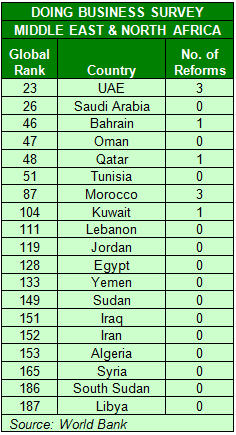
KEY REFORM PROGRESS AND SETBACKS IN MENA
It became more costly to start a business in Bahrain as the authorities raised the business registration certificate fees. However, the country improved access to credit information by starting to collect payment information from retailers. It also made improvements to its labor laws such as an increase in paid annual leave.
Egypt raised the corporate income tax rate as the country looked to increase revenues in a sluggish economy.
Kuwait made starting a business more difficult by increasing the minimum capital requirement. However, the country also strengthened investor protections by making it possible for minority shareholders to request the appointment of an auditor to review the company's activities.
Qatar made improvements in the taxation procedures by eliminating certain requirements associated with the corporate income tax return.
Arab-Spring-hit Tunisia made starting a business more difficult by increasing the cost of company registration.
West Bank and Gaza introduced a minimum wage and reduced the cost of starting a business by eliminating paid-in minimum capital requirement.
© alifarabia.com 2013