It has been a massive quarter for stock markets around the world.
The S&P 500 - arguably the most influential indicator of global stock market health - had its biggest quarter since 1998. In the first three months of 2012, the Dow Jones industrial average gained 8.1%, the S&P rose 12% and the Nasdaq advanced 19%.

But despite their fantastic run, they still did not make it in the list of the ten best performing markets in the world, which were dominated by emerging markets.
Regional markets also had a strong showing with Egypt, Saudi Arabia and Dubai emerging as the best performing markets and leaving their BRIC and many other Asian 'frontier' counterparts far behind.
The world's best performing market was, not surprisingly, located in an oil-producing country. Venezuela's Bolsa De Valores De Caracas rose 71% in the first quarter as the country benefited from high oil revenues, despite the unsettling news that strongman President Hugo Chavez is battling cancer.
Mr. Chavez also faces the biggest electoral challenge of his 12 years in power, and the government has embarked on a huge fiscal expansion programme since the beginning of the year and this will likely continue in 2012 - there may well be a correction before the end of the year.
An even bigger surprise, however, was the Egypt Stock Exchange which had tanked last year, falling close to 50%. But the market has made a smart recovery rising nearly 30% in the first quarter - at one stage it had risen close to 50%, but has scaled back since.
It is heartening to see investors continue to believe in Egypt despite its political challenges that continue to dampen its long-term growth prospects.
Many analysts believe Egyptian stocks have fallen to very attractive levels, and are luring investors with greater risk appetite.
The Egyptian market could be further buoyed if the International Monetary Fund's much talked about loan comes through.
But there are a few hurdles to get through: The Fund is demanding the approval of the political parties in Egypt's parliament before signing a USD3.2bn loan agreement sought by the government.
Saad el-Husseiny, the head of parliament's budget committee says in the past parliamentary approval used to come after the signing of such agreements, but this time the IMF is seeking parties' approval prior to the signing.
"The borrowing is contingent on Egypt's interim government presenting the global body with proposals on how it would reform the country's economy," notes Cairo-based CI Capital Research.
Egypt's economy also grew 0.4% in 2Q11/12, compared to a growth of 5.6% a year earlier, which came above CI's expectations.
Other frontier and emerging markets - Vietnam, Romania and Pakistan - rounded up the five best-performing markets in the world.
SAUDI AND DUBAI MARKETS RISE
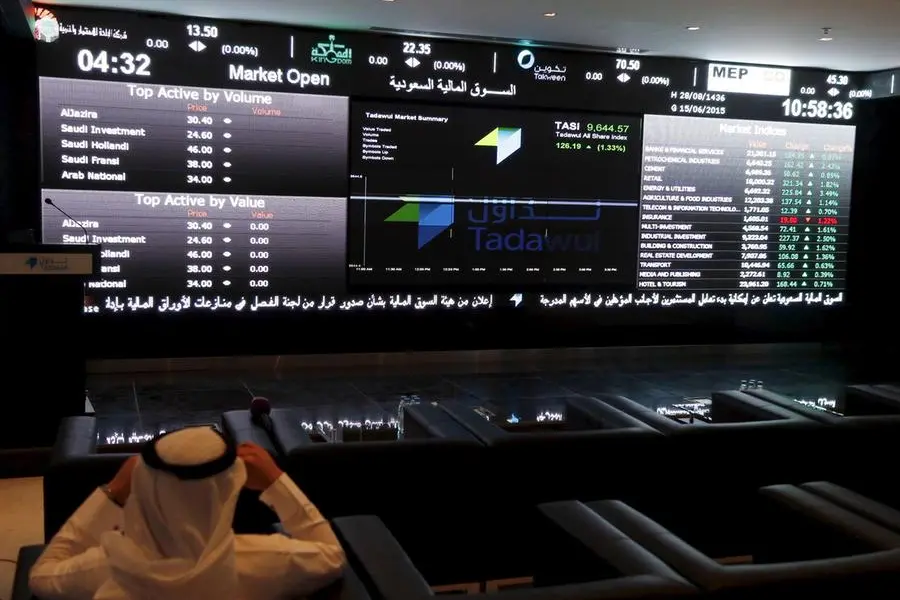
Saudi Arabia, the region's largest exchange by market value, also saw sterling growth of 21.87% in the quarter.
The Tadawul had lost 3.1% last year, but has made a strong recovery since then as Saudi Arabia enjoys strong oil sector growth.
Jadwa Investment says the Tadwawul rally has enough legs to grow no more than a further 7%, by the end of this year and expects the TASI to cross the psychological 8,000-mark by the end of the year.
Cairo-based EFG-Hermes disagrees arguing that the opening of the Tadawul could lead to another spike, which may be a good exit point for many investors.
"We continue to believe that the Saudi market will allow direct foreign ownership in 2H2012. Such a move is likely to lead to a strong positive re-rating led almost entirely by retail investors," said EFG in a note. "We do not expect foreign institutions to enter the market in the short-term due to size constraints, a valuation premium versus emerging and frontier markets, and red tape. We would therefore see a reactionary spike as a profit-taking opportunity."
Dubai Financial Market, which has wallowed in historic lows for a long time has also seen a strong recovery and emerged as the seventh best performing stock market in the world in the first quarter.
A possible upgrade of UAE and Qatar markets by MSCI to 'emerging market' status could lead to a further jump for both markets.
The recovery is a testament to the emirate's resilience as it was hit hard by the global financial crisis. The emirate is working its way through its debt crisis and looking to bring investor confidence back into its fragile real estate market.
STOCK ARE BACK GLOBALLY
The regional stock market renaissance is part of a global recovery and renewed faith in equities.
PIMCO's managing director Bill Gross, who famously said he was not buying U.S. Treasuries over the past year despite being the world's largest bond trader, expects stocks to remain in ascendancy.
"When interest rates cannot be dramatically lowered further or risk spreads significantly compressed, the momentum begins to shift, not necessarily suddenly, but gradually yields moving higher and spreads stabilizing or moving slightly wider," Gross, the founder of Pimco, said in his investment letter. "In such a mildly reflationary world, unless you want to earn an inflation- adjusted return of minus 2% to 3% as offered by Treasury bills, then you must take risk in some form."
The bond guru favours high-quality, short-duration bonds and dividend-paying stocks, primarily in the developing world, rather than OECD countries.
"With regard to all of these broad asset categories, an investor in financial markets should not go too far on this defensive, as opposed to offensively oriented scenario," warned Mr. Gross. "Unless you want to earn an inflation adjusted return of minus 2-3% as offered by Treasury bills, then you must take risk in some form. You must try to maximize risk adjusted carry - what we call 'safe spread.'"
Warren Buffett also recently re-emphasised his dislike of gold and bonds and favoured stocks as a growth strategy.
"The notion that gold and cash are safer than equities have been proven false time and time again. Indeed, equities will continue to outperform these 'safe assets' purely because equities are commercial 'cows' that will live longer and continue to give greater quantities of 'milk'," wrote the world's second-richest man in his annual investment letter.
Other institutional investors like Barclays Capital also see more upside left in equities.
"We retain our view that despite recent asset price rallies, it is too early to position for an imminent downturn. Investors are still unwinding defensive positions and the global economic and financial backdrop has improved significantly since Q4 11. Flows to emerging markets are likely to continue, although at a subdued pace, and will probably support equity."
But while many market observers continue to talk up equities, there is also a growing chorus of analysts who say the global market equity has run up too quickly.
"Right now, investor sentiment if anything is rather bullish, the market is overbought, insider selling is very high and the technicals have deteriorated in the sense that in the latest rally, the number of new highs has diminished significantly and so, I rather think that we are at the beginning of a more meaningful correction," said international investor Marc Faber on March 30 in a media interview.
Indeed, a correction is already on the way, as many markets have fallen from their highs in February as part of a self-correcting exercise.
Will that be enough - or are we in for a banner year for stocks in 2012?
CONCLUSION
Goldman Sachs analyst Dominic Wilson believes the next few days are crucial for the global markets as a string of data from developed markets is revealed.
"We think that risk assets are likely to move higher as long as US data remain consistent with GDP growth of somewhat more than 2%," he said in a note to clients over the weekend.
"Given more mixed news in March, and the likelihood that weather-related boosts will fade in the month or two ahead, the stakes have been raised for the releases over the next 24 hours. At the risk of oversimplification, if the ISM and global PMIs bounce convincingly, we think the market is likely to be able to make fresh highs. If instead we see a second month of declines, we are likely to turn more cautious."
Others like the notoriously bearish Nouriel Roubini say that the U.S. may well be facing "a fiscal austerity cliff" that could send the economic recovery in retreat.
All these events will play strongly into the regional markets which have benfitted from improved global recovery and a strong upturn in oil prices.
But there is enough life in regional stocks, separate from the global economic recovery. The stock markets of the Gulf are rising on the back of investments that are trickling into the regional economies. Barring an external catastrope - such as a renewed Greek debt crisis or Spanish debt getting out of hand or the escaltion of the Iran crisis - the regional markets especially in the Gulf could well scale a few more peaks before finally calming down.
Also Read: Why Warren Buffett Hates Gold?
Tadawul's Blistering Growth
© alifarabia.com 2012