Middle East countries in the midst of a political transition face three key shocks that could worsen economic sentiment.
The International Monetary Fund (IMF) says the economic situation in the affected countries has become increasingly difficult amid:
(1) a still weak external environment,
(2) rising regional tensions stemming largely from the civil war in Syria,
(3) and heightened domestic political uncertainty in many countries, at times accompanied by violence.
The Arab Countries in Transition (ACT) comprise Egypt, Libya, Jordan, Morocco, Tunisia and Yemen.
The six countries are expected to collectively expand their GDP by 3% in each of the next two years - a moderate improvement from the 2.5% posted last year.
"This moderate growth is not generating the jobs needed to stem the rise in the number of unemployed, which has increased by more than 1 million people since early 2010," said the IMF.
The three underlying factors have weakened private sector sentiment, private sector activity and private investment, particularly foreign direct investment.
Arab Maghreb Union states have seen their foreign direct investment drop to USD 7.4 billion last year, compared to USD 11.36 billion just before the global financial crisis in 2008.
In countries like Egypt, FDI shrank from USD 9.5 billion in 2008 to USD 2.8 billion last year. Tunisia (USD 1.9 billion), Yemen (USD 349 million) and Jordan (USD 1.4 billion) have all seen their investment inflows contract since the heydays of 2007 and 2008.
Only Morocco was an outlier, attracting a record USD 2.83 billion in FDI last year, beating previous highs of USD 2.8 billion in 2007.
All in, the six countries had annually attracted more than USD 20 billion in 2006, 2007 and 2008, but seem to have lost their luster and attracted around USD 11.1 billion last year.
Even as investments dwindle, the authorities in the six countries have collectively disbursed USD 38 billion since the onset on the crisis. Despite generous support of many Gulf states, they have not been above to bridge the finance gaps.
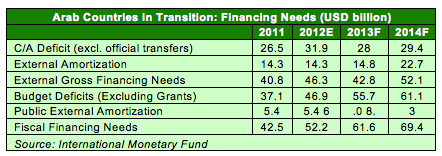
In all, five of the six ACT countries (excluding Libya, which does not need financing) will see their fiscal financing needs balloon to USD 61.6 billion this years and USD 69.4 billion in 2014.
REFORM DELAY
While much of the fiscal shortfall is driven by political tensions and violence, the authorities have not helped themselves by delaying reforms.
"The economies of the ACTs have a vast potential for strong and sustainable private sector-led growth," the IMF reported, especially as many of the countries represent a large and young labor market.
"Realizing this potential requires reforms across a multitude of areas to create better conditions for entrepreneurship and achieve higher living standards. Many reforms will take several years before affecting economic outcomes; they should be initiated without delay."
While regional authorities have been focused on laying the groundwork on the rules of engagement including new constitutions, laws and policies to develop a more inclusive process, some of the structural reforms have taken a backseat.
It's true that those reforms will take a long time to come to fruition as they require extensive dialogue, but the states could still pursue some quick wins.
These 'quick wins' could include:
1. More transparency in the budget process, the hiring of key personnel and greater clarity on the goals that are likely to be achieved, so that citizens can have more moderate expectations and also raise the government's credibility.
2. Special effort should be made to safeguard the interest of the most vulnerable groups, in terms of social and economic participation so they feel included in the process.
"Initiation of a dialogue with the business community to identify and streamline the most binding business regulations, including those affecting labor markets, would encourage investors," the fund noted.
3. Involving large investors to help develop skills and training for young could help bring more people in the workforce and raise the skills level.
4. Improvement and development of credit bureaus, licensing processes and ease of business laws especially for small-to-medium enterprises could be especially helpful.
"Alongside, the authorities should work to strengthen anti-monopoly regulations and institutions to facilitate market development and seek deepening trade integration to open up new business opportunities."
5. In the medium to long-term, these countries will also need to review their allocation of public expenditure and phase out unpopular or inefficient programs.
But there are significant challenges on the way, not least by the Syrian crisis which has spilled over other countries. Although the crisis has abated somewhat, continued influx of refugees would upset labor markets in many of the countries, and overburden the budgets of its neighbors.
"Equally damaging could be setbacks to the political transitions as well as an escalation of violence in Libya, Tunisia, Egypt or Iraq, which would further delay economic reforms and deter investment. In some countries, new disruptions to energy supplies (for example, oil production in Libya or Jordan's gas imports from Egypt) would take a toll on fiscal and external positions."
© alifarabia.com 2013