The Arab World is getting hotter and drier, and there is a danger that the snow-peaked caps of Lebanon, Arabian Gulf coastal areas and coral reefs threaten the tourism industry, a new report warns.
The Arab World is getting hotter and drier, and there is a danger that the snow-peaked caps of Lebanon, Arabian Gulf coastal areas and coral reefs threaten the tourism industry, a new report warns.
"The year 2010 was already the warmest globally since records began in the late 1800s, with 19 countries setting new national temperature highs," wrote Inger Andersen, regional vice president Middle East and North Africa region at The World Bank. "Five of these were Arab countries, including Kuwait, which set a new record at 52.6 °C in 2010, only to be followed by 53.5 °C in 2011."
Apart from the environmental degradation to the region, it would have real and direct consequences to the region's economy.
Separate research by the World Bank on Syria and Tunisia shows climate change will reduce incomes in both the countries by about 7%. Yemen would fare far worse, with a 24% drop in income, the report notes.
Admittedly, governments in all the three countries are preoccupied with far greater real and present political dangers, and their citizens can be forgiven for not concentrating on the environmental impact of their actions.
But time and tide waits for no one.
"Climate change may also affect water availability and its impacts (potentially severe) in both rural and urban areas. By 2050, water runoff is expected to decrease by 10%," Mr. Andersen said. "The gains in agricultural productivity over the past two decades may slow and even decline after about 2050.
Recurrent droughts may spur increased rural-to-urban migration, adding additional stress to the already overcrowded cities, notes the report. Flash floods that result from intense storms may particularly affect cities; 500,000 people have already been affected by flash floods in Arab countries.
The region, already short on freshwater resources, will face even greater water-related hardships. The bank estimates that half the country in the Arab World will suffer from "absolute water scarcity" and the remaining will fare only slightly better.
This would affect agricultural production, which generates 40% of jobs in the Arab World, according to the bank's estimates.
And while the region is focused on the current political issues which are stealing all the headlines, climate related disasters are also great disrupters in the Arab World.
The World Bank estimates that climate disasters have affected 50 million people and cost USD11.5-billion to Arab economies over the past 30 years.
UBER URBANIZATION
Urban areas will also suffer as they encroach on natural areas that protect and absorb climate changes. A little more than 56% of Arabs currently live in urban areas, a number which will grow to nearly 75% by 2050.
"Flash flooding is increasing in cities across the region as a result of more intense rainfall events, concrete surfaces that do not absorb water, inadequate and blocked drainage systems, and increased construction in low-lying areas and 'wadis'. The number of people affected by flash floods has doubled over the last ten years to 500,000 people across the region."
The dramatic flooding in Jeddah in 2009, which saw twice the yearly rainfall average descend on the city within four years, wreaked havoc, claiming 150 lives, and damaging 7,000 vehicles and 8,000 homes.
The authorities' inability to cope with the disaster, suggest that governments are ill-prepared for rapid climatic change.
"Despite this, few cities are making investments in storm drainage to accommodate the increased exposure to flood waters, instead choosing cheaper, short-term solutions," the report states.
The 2010 floods in Dubai, the city's Municipality Drainage and Irrigation Network Department relied heavily on mobile pumping units to make up for the lack of adequate storm drainage (Al Khan 2010).
"Such a solution is not a sustainable answer to a climate that is becoming increasingly unpredictable."
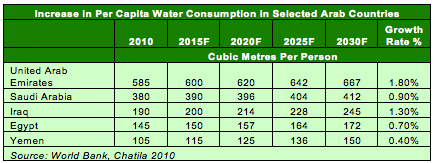
Excessive demands made on precious water supply will also take its toll. The UAE will lead water per capita consumption in the region over the next two decades, rising on average 1.8%.
As a result of rapid economic and social changes, average temperatures in the Arab World are expected to rise by 3 degrees Centigrade by 2050, turning the already hot region into a furnace.
In addition, new research suggests there is going to be reduced rainfall over the lower Nile and Arabian Peninsula till at least 2017.
Rising sea levels along the coastal zones of the Mediterranean and the Arabian Gulf will also lead to billions of dollars in estimated losses, the report warns.
"An assessment of the vulnerability of the most important economic and historic centers along the Mediterranean coast (the cities of Alexandria, Rosetta, and Port-Said) suggests that, in the event of a sea-level rise of only 50 centimeters, more than 2 million people would have to abandon their homes. Moreover, 214,000 jobs would be lost, and the cost in terms of land and property values and lost tourism income would be more than USD35-billion."
TOURISM
More importantly, climate change could severely disrupt the region's tourism ambitions.
The wider Middle East region generates USD50-billion from tourism, encompassing religious tourism in Saudi Arabia, archaeological treasures in Egypt, skiing in Lebanon and sun, sea and shopping jaunts in Dubai.
"Snowfall in Lebanon (for skiing), Red Sea coral reefs, and many ancient monuments across the region are threatened by climate change and severe weather... Some destinations, such as Alexandria, will be further threatened by seawater inundation as sea levels rise. In most cases, there is already a need to better conserve and protect these cultural sites."
Places like Oman, which felt the full fury of Cyclone Phet, killing 44 people and leaving USD700-million worth of damage in its wake in 2010, can expect to see more extreme conditions, warns the bank.
Meanwhile, 85% of coral reefs are considered threatened in the Arabian Gulf, hurting eco-tourism plans.
The World Bank believes that current political upheavals in the region - so-called Arab Spring - could be a cataylst for change.
Political change, including those changes originating from the Arab Spring, can provide an opportunity to increase civil society participation in adaptation governance and a move toward a more inclusive approach to addressing climate change issues and building climate resilience, says the Bank.
Of course, not everybody is convinced that climate change is a direct result of human action and carbon dioxide emissions.
In an open letter to Ban Ki Moon, the Secretary General of the United Nations, more than 125 climate scientist that policy actions that aim to reduce CO2 emissions are unlikely to influence future climate. Policies need to focus on preparation for, and adaptation to, all dangerous climatic events, however caused.
The Secreyar general had remarked that Superstorm Sandy that struck the East Coast in November was due to climate change.
Earlier in Novmber, Mr Moon noted that on matters of climate "science is clear; we should waste no more time on that debate."
However, the 130 scientists rebutted that claim.
"We the undersigned, qualified in climate-related matters, wish to state that current scientific knowledge does not substantiate your assertions," they said in a letter published on the eve of a climate change summit in Doha.
The letter notes that there is data shows "there has been no statistically significant global warming for almost 16 years."
"There is no sound reason for the costly, restrictive public policy decisions proposed at the U.N. climate conference in Qatar. Rigorous analysis of unbiased observational data does not support the projections of future global warming predicted by computer models now proven to exaggerate warming and its effects," the letter noted.
© alifarabia.com 2012