Africa's massive infrastructure needs present a huge opportunity for the private sector, but governments will need to improve the regulatory environment and strengthen regional markets to lure companies.
"Africa's annual infrastructure needs are estimated at USD 93 billion, i.e. 15% of Africa's GDP," according to Arnaud Dornel, lead financial sector specialist at the World Bank.
"Actual investments in infrastructure total USD 45 billion annually, with more than half funded by the public sector. About a third of the infrastructure gap can be met through operational optimization, reducing the gap to USD 31 billion, i.e. 5% of GDP."
The USD 31 billion figure might be mouth-watering for the private sector, but there are a number of obstacles in the way including political risks, lack of regulations and weak domestic capital markets.
Currently, much of the infrastructure investments are driven by African governments either directly or through bonds or state-owned enterprises, which often crowd out not just international firms but also the domestic private sector.
Clearly, though, governments alone cannot resolve the yawning infrastructure financing gap.
Lack of infrastructure costs the African continent around USD 40 billion annually, depriving more than 15 million Africans of jobs every year, according to Cédric Mbeng Mezui, coordinator, African Financial Markets Initiative at the African Development Bank, in a March presentation on infrastructure development.
If African nations had spent USD 12 billion more on road repair in the 1990s, they could have saved USD 45 billion in subsequent reconstruction costs, according to an estimate by McKinsey Global Institute.
Today, only 34% of rural Africans live within two kilometers of an all-weather road, only 25% have electricity and only 61% have access to improved water sources. The World Bank estimates that on current trends, universal access to sanitation and improved water is more than 50 years away in most African states.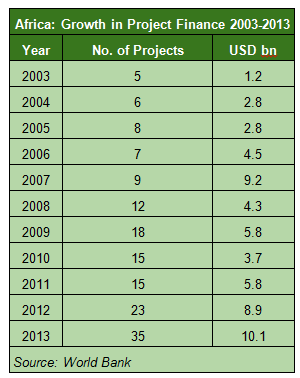
RISE OF PPPs
Public private partnerships (or PPPS) could help fund 40% of the infrastructure needs, or USD 12 billion annually, World Bank's Dornell said.
Between 2003 and 2013, Sub-Saharan Africa (SSA) closed 158 project finance deals with debt for a combined total of USD 59 billion, representing just 3% of the global project finance market.
World Bank data shows 21 SSA countries had one or more project finance deals in the last 10 years. Nigeria (USD 17 billion), Ghana (USD 11 billion), South Africa (USD 10 billion) and Angola (USD 4 billion) topped the financing list thanks to a few major transactions.
Not surprisingly, extractive industries such as oil and gas, and mining accounted for 64%, or USD 37 billion of Sub-Saharan Africa's project financing needs.
"Worldwide, extractive industries account for 36% of the total project finance market, almost half the share of Africa," Dornell said in his presentation. "The extractive industries' disproportionate share of Sub-Saharan Africa's project finance market highlights the region's infrastructure gap."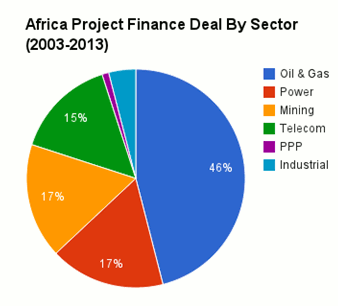
MACROECONOMIC CONDITIONS SOUND
The International Monetary Fund's latest global economy report pegs Sub-Saharan growth at 5.4%, but the fund echoes other analysts' prognosis that infrastructure investments will be crucial for future growth and creation of jobs.
"Throughout the region, urgent requirements include improving the efficiency of public expenditure; investing in strategic and carefully selected projects to develop energy supply and critical infrastructure; and implementing structural reforms aimed at promoting economic diversification, private investment, and competitiveness," the fund warned.
African officials acknowledge that infrastructure is critical to the region's continued development as it would boost growth, raise productivity and assist in poverty reduction. However, building and upgrading infrastructure is costly and implies large financing needs.
"Better road and rail networks are necessary to increase regional trade and investment; higher levels of power generation will improve the productivity of businesses; better communication services will facilitate cross-border financial transactions; access to clean water and sanitation will improve the general health of the population, thus contributing productively to development," said IMF African Department deputy director Anne-Marie Gulde-Wolf.
KEY SECTORS
The African Development Bank (AfDB) outlines some of Africa's key sectors that should get the bulk of infrastructure investment:
Power: Power demand will increase from 590 TWh [terawatt per hour] in 2010 to over 3,100 TWh by 2040. Capacity needs to be raised from the present level of 125 GW to almost 700GW by 2040.
Transport: transport volumes will increase six-eight times with much higher increases in some landlocked countries.
Ports: Volumes that go through the various African ports will increase from current levels of less than 300 million tons to over two billion tons by 2040.
Data: Data traffic volumes are expected to increase from around 300 GB per second today to over 6,000 GB per second by 2040.
Many African countries have pursued the bond route to finance their needs, however, governments need to ensure liquidity and transparency to guarantee those funds are diverted to the right areas.
"Some African countries have already taken steps to build a market for infrastructure bonds even though these are not 'project bonds'," said AfDB in a separate report titled Infrastructure Project Bonds In Africa.
"Kenya is an example where the government has raised money through bonds and earmarked it for infrastructure. Investors have been granted certain tax privileges in order to invest. Even though these are not project bonds, such measures are helpful to build awareness of infrastructure finance. In general, tax incentives for bonds used to fund infrastructure are a sensible measure for public and private issuers."
DEVELOPING FINANCIAL MARKETS
Africa's capital markets are unable to support the continent's infrastructure needs. They lack depth, liquidity and sophisticated instruments and the region does not have a strong retail and institutional investor base to leverage either.
This has made it difficult to address the vast and growing infrastructure and housing development needs. Declining access to external funding has highlighted the urgent need for governments to mobilize resources from domestic capital markets to meet their development needs, said Donald Kubera, president of the AfDB, in a foreword to the Infrastructure report.
"To convince the private sector to increase its involvement in infrastructure financing, African governments need to continue financial market reforms. This will develop efficient markets for infrastructure bond financing, and foster an investment environment suitable for private sector activities.
"Contractual, political, and regulatory risks - as well as investor protection provisions - also have to be re-examined. Adequate measures need to be adopted to stimulate local, regional and international investment in infrastructure bonds."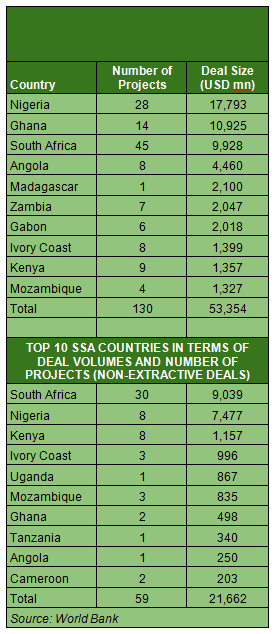
The feature was produced by alifarabia.com exclusively for zawya.com.
© Zawya 2014