More than 8.5 million children in the Arab world remain out of school, presenting a huge socio-economic challenge for regional authorities.
Rising populations, double-digit unemployment rates and general disillusionment among the youth is fuelling this fire that has already felled regimes in many countries across North Africa and the Levant.
"Civil war rages in Syria, refugees surge across borders and the lasting effects of the Arab Spring are uncertain. What is certain, however, is that it is essential to give attention to the welfare of the region's young people and to economic health in order to build the foundations for lasting political stability and, in many countries, for a transition to democracy," notes Brookings Institution in a new report.
"Education is central to this effort. In particular, the ability of educational systems to help the region's children and youth develop the competencies and skills that will serve them well for their future lives and livelihoods."
The region has made some progress in improving educational standards, but the demographics are changing far too quickly and the authorities are distracted by a range of equally urgent socio-economic issues.
A little over 3 million more students are in Arab classrooms than a decade ago, but while there is a tendency to finish primary school, the education system has witnessed more students drop out of lower secondary school than a decade ago.
Indeed, adult literacy rates have risen fastest in the Arab states over the past two decades, but population growth has meant that the number of illiterate adults has only fallen from 52 million to 48 million, according to estimates.
WIDENING ENROLMENT GAP
In many parts of the Arab world, there is a wide gap in enrolment between the richest and poorest, according to the United Nations Educational, Scientific and Cultural Organization.
"Part of the reason is that governments have yet to assume sufficient responsibility for pre-primary education: as of 2011, private providers were catering for 33% of all enrolled children, rising to 71% in the Arab states," UNESCO said in a report published January 29. "The cost of private provision is one of the factors that contribute to inequity in access at this level."
While pre-primary gross enrolment ratio in the Arab world rose from 15% in 1999 to 23% in 2011, it remains the second lowest among all regions after Sub-Saharan Africa.
"Algeria stands out as the country with the highest share of government provision in the region, at 86%. In addition, it achieved the largest expansion in pre-primary education, from just 2% in 1999 to 75% in 2011," UNESCO said in its report. "At the same time, Algeria undertook this rapid expansion of the public system, it encouraged private provision in urban areas. An inspection system monitors implementation of the curriculum in both types of institutions."
POVERTY AND EDUCATION
Even where students are in classrooms, there is no guarantee that they are actually learning. As many as 56% of Arab students at the primary level are not learning, while 48% of secondary level students are not accumulating basic foundational skills, according to an assessment with benchmark tools.
"Learning outcomes vary significantly across countries in the region for which we have data, but are particularly worrying in Yemen, Morocco, Kuwait and Tunisia where between two-thirds and [90%] of primary-age students are failing to learn," said Brookings.
"At the lower secondary level, over 60% of students are not learning in Morocco and Oman. The learning performance of children in Arab countries is also below expectations, given the countries' income levels."
ADULT LITERACY TARGETS
A number of Arab countries such as Bahrain, Kuwait and Qatar are close to achieving their target of adult literacy of 95% by 2015, but a number of countries including Saudi Arabia, UAE, Syria and Algeria are expected to fall short.
Iraq, Egypt, Morocco and Yemen are even further behind, according to UNESCO, as adult literacy rate in those countries is expected to remain below 80% by 2015.
The lack of education has an immediate and direct impact on unemployment levels.
"Because young people have been lacking the skills demanded by modern business, and because the formal private sector has remained underdeveloped, many young Arabs have ended up being unemployed or working in the informal sector," Brookings noted.
"Of the young men and women who currently find jobs in Egypt, only 28% find formal sector jobs--18% in the public sector, and 10% in the formal private sector. The vast majority, 72%, end up working in the informal micro and small-scale sector (MSE)--with no labor contract, no job security and no social benefits."
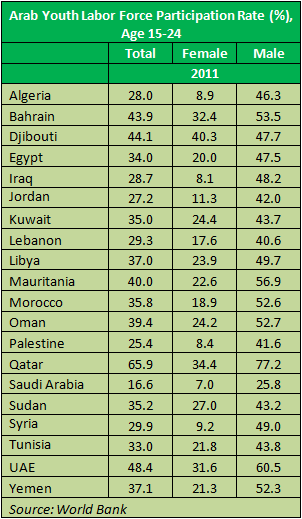
Youth unemployment in Egypt stands at around 24.8% and Tunisia 29.4%, compared to 17.8% in Brazil and 11.4% in Malaysia. The Arab world also has the lowest labor participation rates in the world compared to other regions such as South Asia, East Asia and Latin America, highlighting the disenchantment of Arab citizens.
FOUR RECOMMENDATIONS
Clearly, the number one focus has to be early childhood education, which can inculcate a sense of learning at a very early stage. Research shows that a 25% improvement in pre-primary gross enrolment could raise wages by 6.4 times in low-income countries such as Yemen.
Secondly, students can't learn without teachers. A UNESCO report notes that the Arab world is second only to Sub-Saharan Africa in shortage of teachers worldwide.
"The region needs to create an additional 500,000 posts and replace 1.4 million teachers who are leaving the profession, in order to achieve universal primary education by 2030."
Thirdly, as conflict remains part and parcel of the Arab world, donors need to pay special attention to refugee children, whether they are Syrians fleeing to Jordan, Palestinians in Lebanon or Libyan refugees in Algeria.
Fourthly, governments need to collaborate with the private sector to develop a comprehensive education plan and prepare the youth with the skill sets that are in demand in the real world.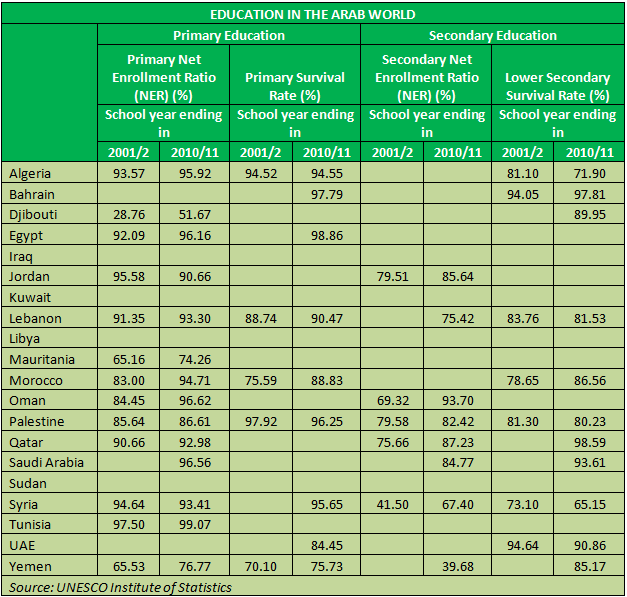
The feature was produced by alifarabia.com exclusively for zawya.com.
© Zawya 2014