Oil breakeven prices in Abu Dhabi are set to fall below USD 100 per barrel, as debt obligations and fiscal pressures on the government start to ease, according to Bank of America Merrill Lynch (BAML).
"Exceptional and sticky support to Dubai, banks and GREs in 2009 had led to a near quadrupling of the Abu Dhabi government fiscal oil breakeven price from USD 33 per barrel at the eve of the global financial crisis in 2007 to a peak of USD 121 per barrel in 2009," said Michael Saliba, analyst at BAML in a note to clients.
The analyst expects breakeven price in 2013 to average at USD 95, leading to a surplus of 2.7% of GDP.
Abu Dhabi's expenditure had been rising around 20% annually between 2009 and 2011 as the government stepped in, but conditions are easing.
"The increase in total expenditures can be traced back partly to higher current spending (58% of total) and largely to the increase in net loans and equity extended over the period," said Saliba.
"The latter category of spending stood at AED 88 billion in 2011 (28% of total and 11% of GDP), 4.5 times its level of 2007, and consists of mostly direct budgetary transfers to Dubai (summing AED 33 billion over 2009-11), building and housing loans, and equity or capital injections to GREs [government-related entities]."
While Dubai steals all the limelight once again with its strong recovery, Abu Dhabi is the quieter, stronger partner producing crude oil at near record levels over the past few years.
The Abu Dhabi economy is edging close to a trillion dirhams, posting AED 911.6 billion (or USD 248 billion) last year and growing at a rate of 7.7%.
The non-oil sector grew 9.6%, surpassing all earlier forecasts and estimates. "These results underline the robustness, stability and competitive advantage of the Emirate's economy, boosting its appeal to local and foreign investors," said Statistics Centre of Abu Dhabi (SCAD).
Abu Dhabi's GDP at current prices has doubled 2.4 times from 2005 to 2012, increasing form AED 383.430 billion to AED 911.591 billion during this period, SCAD said.
"The size of non-oil activities and sectors also doubled 2.4 times over the same period, form AED 167.975 billion in 2005 to AED 396.744 billion in 2012 at current prices, making these sectors a key driving force for the emirate's economy."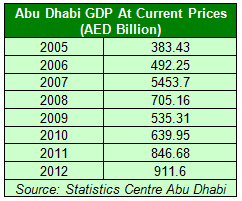
PRUDENT ACTIONS
The emirate has also taken action against its fiscal weaknesses and offered AED 17 billion to strengthen its banks in the aftermath of the global financial crisis.
Prudently, the emirate also took major initiatives in slowing down high-profile projects for a period of time to concentrate on addressing the short-term challenges facing the country.
The UAE federal government adopted a medium-term budget in line with the federal strategy including improvements in budget automation and revenue forecasting, said the International Monetary Fund (IMF).
"Abu Dhabi developed a medium-term macro-fiscal model to inform policy decision making, while Dubai put in place a three-year budget framework to guide the budgeting process," the IMF said.
"Building on these achievements, MTFFs should continue to be refined and, in the case of Abu Dhabi, increasingly integrated into the budget formulation process."
The emirate also made concerted efforts to monitor GRE debt and other financial data through a debt management office.
Since then, the emirate has returned with renewed energy and has focused on a number of announcements focused on the financial services sector, renewable energy, aviation, tourism and petrochemicals.
Abu Dhabi's decision to merge Aldar Properties with Sorouh Properties has also helped the emirate restructure its real estate proposition at a time of lethargic growth.
The merger of aluminum companies EMAL and Dubal also reveal the Abu Dhabi and Dubai authorities efforts to find synergies and consolidate their offering in times of great pressure on the global commodities markets.
In addition, news of Abu Dhabi and Dubai merging their financial markets underlines the notion that the two key emirates will not hesitate to cooperate and build on their strengths in a number of areas, and could be the start of more consolidation across the UAE economy.
MORE INVESTMENTS UNDERWAY
Earlier this year, Abu Dhabi has also unveiled an AED 330 billion five-year plan to invest in a number of infrastructure projects and will recruit the private sector in a number of the developments.
A separate AED 3 billion housing loan program for nationals would also generate construction activity in the emirate.
While the Abu Dhabi has instructed major government-related entities to aim for investment grade in the near future, they will remain instrumental in developing the capital.
Companies like TDIC, Mubadala, Taqa, Aldar and IPIC apart from some key banks, are key pillars of the emirate's economic drive.
"Given the emirate's strategic economic diversification drive and renewed industrialization efforts into higher value-added sectors, we expect strong backstop shareholder support for strategic GREs intertwined with Abu Dhabi's
2030 economic vision and would remain comfortable reaching out for yield in the
Abu Dhabi quasi-sovereign space," said Saliba.
With Abu Dhabi Investment Authority's USD 627 billion serving as a cushion and oil prices in triple digit figures, the emirate's finances remain on solid footing, presenting it an opportunity to move ahead while other countries struggle with unemployment issues, social unrest and lack of capital financing.
"The stable outlook balances Abu Dhabi's economic resilience and policy flexibility, resulting from its exceptionally strong external and fiscal net asset positions, against the risks emanating from structural and institutional weaknesses that could derail growth, as well as against its high contingent liabilities and limited monetary policy flexibility," Standard & Poor's said in its assessment earlier this year.
© alifarabia.com 2013