For all its fiscal might and financial muscle, the Abu Dhabi economy hasn't picked up spectacularly despite high oil prices. The Abu Dhabi Department of Economic Development estimates the emirate's economy to post a 3.9% growth this year, which is subdued, compared to its Saudi and Qatari counterparts.
Non-oil GDP will post 5.5% growth, but the hydrocarbons sector will struggle to match the high growth of last year, when high oil prices and record production contributed to stellar growth.
However, the Department expects the emirate's GDP growth to pick up at an average of 5.7% over the next three years.
Non-oil GDP "growth should continue, averaging 6.5% during the period 2013-2016, reflecting growing private sector investment and the completion of infrastructure serving free and other economic zones in the emirate," notes the department.
"Domestic household consumption in Abu Dhabi emirate is expected to grow by about 9.6% in real terms during 2012, and to average around 8.1% p.a. in the 2013-2016 timeframe, reflecting a buoyant economy and growth in per capita incomes."
Abu Dhabi is looking to push capacity, as the country is part of the OPEC group looking to supply extra oil to world markets. The country has been producing at peak levels ever since the Arab Spring crisis wiped out Libyan crude production and while that has returned to the world market, Iranian, Yemeni, Syrian and Sudanese oil is much reduced.
The Abu Dhabi government is hoping to raise capacity by 200,000 barrels per day to take its total UAE crude production to 3 million barrels per day.
In addition, the new Fujairah-Abu Dhabi pipeline that bypasses the troubled Strait of Hormuz ensures that Abu Dhabi's crude production won't be hit in the unlikely circumstance of the Strait being forcibly shut off by Iran.
While the oil sector remains beholden to commodity prices and the ebbs and flows of the global crude markets, the emirate can make a difference in the non-oil sector.
"The impact of the major spending plans announced by the Abu Dhabi government in Q1 2012 has yet to be felt, as few new projects have been commenced to date," notes Jones Lang La Salle in a report to clients. "The pace at which these projects progress will play a major role in determining how quickly demand increases in the Abu Dhabi market in 2013."
The latest headline PMI held at 53.3 in August (a level below 50 represents a contraction), implying steady if unspectacular expansion of the non-oil private sector economy.
"Encouragingly, output, orders and employment all continued to rise," notes Samba analysts James Reeve and Andrew Gilmour. "It is also noteworthy that after a two year low in July, export orders appear to be firming again, suggesting that businesses are managing the slowdown in Europe and constraints on trade with Iran." 
GETTING CONSTRUCTIVE
Construction, which grew at an astonishing 20.4% per annum during the peak period if 2005-2010, is now expected to grow 5.5% this year, especially as the emirate re-evaluates and delays big-ticket projects. The Department expects the sector to post 6.2% growth during the 2013-2016 period.
Abu Dhabi continues to suffer from oversupply of housing units, which is negatively impacting real estate prices and real estate companies.
To address the issue, the Executive Council has decreed that all government employees should live within the emirate, putting an end to the practice of Abu Dhabi residents living in the emirate of Dubai. The decree is expected to take effect in 2013.
While this could resolve short-term issues, it could have a domino effect, with Dubai government potentially ordering its government employees to live in the emirate, thereby hurting the Sharjah real estate market.
The move could have a major impact on the poorer northern emirates, which is something that the federal government needs to take into account.
An equally significant move by the Abu Dhabi government is to merge the Abu Dhabi listed Aldar Properties and Sorouh.
A senior Sorouh official told Thomson Reuters that the merger agreement between the two companies could be announced 'within a month', as the beleaguered companies look to consolidate their operations and reduce costs.
Analysts expect Aldar to benefit the most from the merger as it repairs its balance sheet. "The merger would give it access to a cleaner balance sheet, expand its equity, lower its gearing ratios, widen its asset base and improve its credit profile," noted investment bank EFG-Hermes. "Therefore, the merger could help Aldar to refinance some of its debt, should it decide to do so."
However, the operational synergies that the two companies are seeking may not come as quickly as hoped.
"As the Abu Dhabi housing stock could expand by as much as 20% by the end of 2013, putting further pressure on prices and rental rates, we believe that any operational synergies between the two developers are unlikely to be realised within the next 2-4 years, unless the backlog of government commissioned projects increases sharply," noted the Cairo-based bank. "We believe that joint residential project launches would be unlikely in the short-term while both companies complete their development pipelines."
Jones Lang La Salle's latest report on the emirate states that more than 2,200 residential units came on line in the last quarter, and a further 6,000 units are expected to enter the market by the end of the fourth quarter, to take the total stock to 208,000 units, although there might be further delays.
"Although a large proportion of the residential pipeline announced prior to 2008 has since been delayed, the aggregate supply could still reach 239,000 units by the end of 2014," notes the report.
Meanwhile, residential prices continued to decline in the third quarter, falling by 3%, to take the total drop from its Q4 2008 peak to 53%.
However, sales picked up in the quarter, led by Emirati buyers, suggesting some improvement in market confidence.
Rental rates appear to be bottoming out, having fallen by 1% during the third quarter, although JLL expects rents to fall further till the end of the year.
"The new regulation requiring Abu Dhabi government employees to live within the Emirate could have a positive impact on the rental market during 2013 as it could potentially strengthen the hand of owners in their negotiations with tenants," said JLL.
TOURISM BOOST
Abu Dhabi has high hopes for its tourism sector, and is hoping that its various mixed development projects will bear fruit in the future. The Abu Dhabi Department of Economic Development expects tourism sector to grow at 7.5% each year till 2016, but at the moment, the sector is not yielding impressive returns. Abu Dhabi's occupancy rates stands at 58% till August year-to-date, the lowest in four years.
Meanwhile, average daily rate has fallen 8% till August compared to the same period last year.
Still, the emirate saw 1.3 million till July, a 7% improvement over the same period last year.
JLL expects 6,700 hotel rooms to come to the market by the end of 2014.
"Notable openings scheduled for Q4 2012 include Ritz Carlton Grand Canal, and Novotel / Ibis Abu Dhabi Gate amongst others," said JLL. "The short term supply pipeline has reduced, with a number of projects having been delayed or put on hold indefinitely."
Abu Dhabi is also building an AED10.8-bilion airport terminal to boost capacity, according to media reports. The government expects to raise capacity around 30-million to 40 million passengers each year when it opens in 2017. The authorities expect the emirate to handle 14 million passengers this year.
Etihad Airways is expected to lead the drive as the airline is on an acquisitive spree, picking up stakes in Virgin Australia, Aer Lingus, Air Berlin and Air Seychelles.
The Abu Dhabi Department of Economic Development has also announced the development of new industrial cities in Ruwais and Madinat Zayed.
"Although off a low base in recent years, there is confidence that non-oil merchandise exports will continue to grow healthily, contributing to the success of new economic zones operational from this year onwards," notes the Department, highlighting the success of Auto City. "At the opposite end of the size spectrum the Executive Council continues to support the activities of the Khalifa Fund for Enterprise Development, which is concerned with identifying and assisting promising SME start-ups of varying sizes proposed by citizens."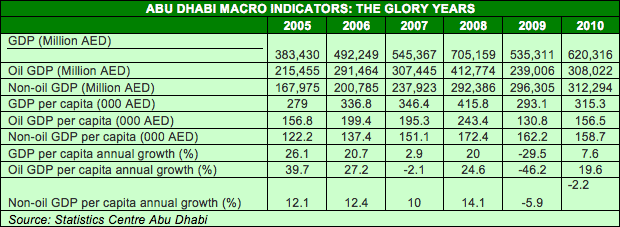
CONCLUSION
All the initiatives lead to Abu Dhabi's 2030 goal of building a diversified economy that is not at the mercy of oil prices. This is crucial as the emirate has depended heavily on hydrocarbon prices and has not diversified enough, unlike the neighbouring emirate of Dubai.
However, the capital emirate has the financial cushion to bide its time and carefully choose its focus areas. With USD627-billion invested in its sovereign wealth fund, the emirate can afford to be choosy.
But the Abu Dhabi government showed signs of being aggressive during the glory years of 2002-2008 when it started loosen the purse strings. But the government pulled back in the aftermath of the global financial crisis, reviewing various projects and consolidating operations in various areas.
As the clouds of economic uncertainty begin to dissipate, or perhaps because the lack of global catalysts, the government will have to strike a balance between its natural inclination to be conservative and stimulating the economy.
© alifarabia.com 2012