The timing could not have been more inconvenient.
In the week Gulf leaders met to discuss ways to create a more unified group, similar to an 'EU model', European Union leaders were struggling to keep their group united amid an unravelling economic and political crisis.
Sameera Rajab, Bahrain's Minister of State for Information had told an Arabic newspaper a few days before the Gulf leaders' meeting that "a union between Bahrain and Saudi Arabia is a progressive step in the integration journey between GCC countries. It will be similar to the European Union but not a copy of it."
These days the EU is hardly a poster child for economic and political integration. With the euro project itself in doubt, and its weakest link, Greece, in danger of either leaving the union or being kicked out, the Gulf states may want to look elsewhere or forge their own path towards a closer Gulf Co-operation Council.
It's clear that the latest attempt to present a united front is a political move on the part of Saudi Arabia and Bahrain, which have openly suggested a closer union to thwart any Iranian threat.
Saudi King Abdullah Bin AbdulAziz Al Saud has been actively looking to strengthen the Kingdom's hand in the fast-changing regional environment ever since the Arab Spring became a powerful social force.
Saudi Arabia has seen his peers such as Hosni Mubarak in Egypt swept away by the rising tide of protest movements and has also witnessed its fierce rival Colonel Moammer Qadddafi meet a most ignominious end.
But Saudi Arabia's biggest threat remains Iran which has been accused of meddling in Bahrain - and that has been too close to home for the Saudi King to ignore.
Using the full force of its military and diplomatic skills, Saudi Arabia has tried to arrest the deteriorating situation in Bahrain. The latest proposal to bring together a closer union, at least between Saudi Arabia and Bahrain, seems like a logical path for the Saudis to pursue if they wish to continue influencing the country's political affairs.
Of course, the opposition in Bahrain, which insists it's not a pawn of Tehran, believes that the people of Bahrain should have a say in such a major decision by the governments.
"There should be a referendum," said Abdul Jalil Khalil, a senior member of Al Wefaq, Bahrain's largest opposition party. "A union of GCC countries is not acceptable."
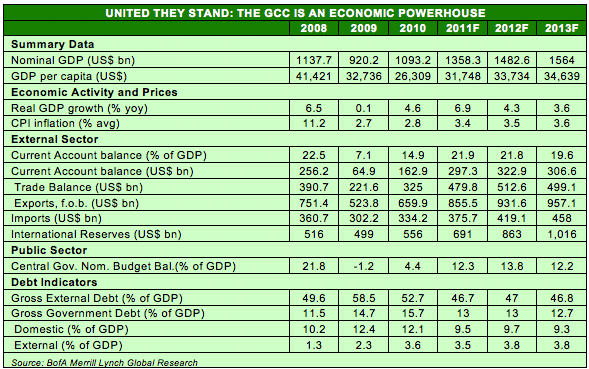
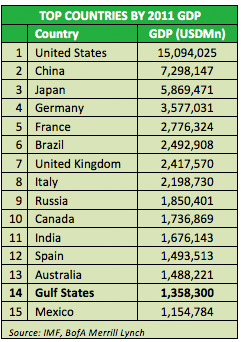
The Gulf is a potent economic force and its appears to have under achieved to date given its vast oil and natural gas resources. The combined region boasts close to 500-billion proven oil reserves - the largest concentration of hydrocarbons in the world, and 35 trillion cubic feet of gas - the second largest in the world. Saudi Arabia is already a G20-nation and the combined the six Gulf states can claim to be the world's 14th largest economy.
MOTHBALLED UNION COMES BACK TO LIFE
The 31-year-old union seemed to have been on the backburner ever since the global financial crisis swept the region in 2008.
With Dubai's real estate and Kuwait's financial services sector decimated, Gulf economies were in no mood to discuss a closer union. Abu Dhabi retrenched, and other Gulf economies pursued economic policies independent of each other and for a while all talk of a Gulf Monetary Union and a more robust Customs Union were no longer on the agenda.
Indeed, as trouble started brewing in the Eurozone, GCC countries also started to have second thoughts about merging their economies.
The union was dealt another blow when the UAE decided to withdraw from plans for a GCC-wide single currency in May 2009.
The Emirates joined Oman, which had withdrawn from the monetary union as early as 2006, but the UAE's pullout was a bigger setback given its economic clout.
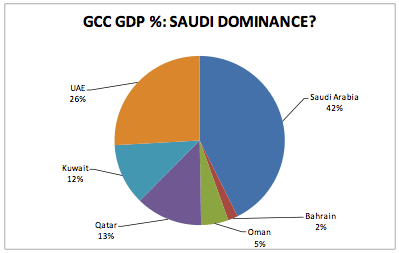
While the other four Gulf countries reiterated their commitment to the monetary union, it seemed clear that without the second largest economy in the region, the union was going to be a Saudi-show.
Another key factor that played into the UAE's decision was when Riyadh was chosen as the proposed venue for the united Gulf central bank - which Abu Dhabi had been rooting for - and the UAE feared that the power of the proposed union was gravitating towards the already-influential Saudi Arabia. It feared that it was a sign of things to come where Riyadh would dominate and the other five countries would orbit around its decisions.
RENEWING VOWS
It's unclear whether these issues were discussed in the 14th consultative meeting, but the signal was clear that the Gulf states needed more time to study the proposal.
Here's how the various GCC state-owned news agency covered the news, which perhaps gives some insight into their countries' inclinations:
Kuwait News Agency, easily the most robust Gulf news agency, reported to the point: "Leaders of the six Arab Gulf countries Monday postponed a Saudi initiative to transform the GCC into a Saudi proposed union to an extraordinary summit, with a date to be determined later for 'comprehensive and accurate' study."
It used the word 'postponed' which was rather telling.
The Bahrain News Agency was more upbeat in its assessment:
"The Kingdom of Bahrain today welcomed at conclusion of the Gulf Cooperation Council meeting held in Riyadh the agreement by the GCC leaders to the proposal of the Custodian of the Two Holy Mosques for the Ministerial Council to continue studying the report of the specialized council specializing in the issue of moving from a cooperation to a Union Phase, and to forward recommendations to the supreme council during a meeting to be held in Riyadh."
The Emirates News Agency (WAM) report made no remarks on the discussions at the event, only stating that the UAE Vice President and Prime Minister and Ruler of Dubai His Highness Sheikh Mohammed bin Rashid Al Maktoum returned home from Riyadh after the meeting.
Qatar News Agency and Oman News Agency also gave nothing away in their respective English reports on the event, merely informing that their respective leaders attended the event.
It was left to the Saudi Press Agency to fill in the details.
Here are the key points from the press conference held by Prince Saud Al-Faisal, Saudi Minister of Foreign Affairs, and Secretary General of the GCC Dr. Abdullatif bin Rashid Al-Zayani, as reported by the SPA:
1 GCC leaders reviewed a report by the specialized commission, which is now tasked with studying proposals to change the GCC from a 'co-operation' to a 'union'. The commission will submit its recommendations to a summit meeting of the Supreme Council to be held in Riyadh [date not determined].
Prince Al-Faisal reportedly said that the reason for establishing the GCC Union was to address 'issues not solved yet'.
2 GCC leaders discussed the region's political developments, "including the recent Iranian provocative acts in the occupied UAE islands." [In April Iranian President Mahmoud Ahmedinajd visited the occupied UAE island Abu Musa, further escalating tensions between Iran and the Gulf].
"If Iran is looking forward to relations with the GCC member states, it should not consider such relations without solving this [island] problem," said Al-Faisal. "We follow the wise policy of the UAE in this regard, which does not seek a military solution, but a political one that is reached through understanding."
3 The GCC leaders also addressed a number of issues relating to the "march of GCC joint action", and discussed means of following-up the implementation of related decisions, Prince Saud Al-Faisal said, without elaborating further.
4 The GCC leaders instructed their respective interior ministers to sign an "amended security agreement" in their next meeting [date not determined].
5 The United States has lifted the arms embargo against Bahrain.
6. The GCC states have also agreed to provide grants for five years to Jordan and Morocco for development projects, according to the Secretary General. [Both countries are looking to join the GCC club].
7. The SG also praised efforts by the new Yemen President Abd Rabo Mansour Hadi to implement the GCC initiatives. [Yemen is also looking to join the GCC by 2016].
8 The toughest and sharpest words were reserved for Tehran at the conference:
'Iran's threat is clear, I don't think it hides the threat. Therefore, as I mentioned, this issue was discussed, but not in the context of Saudi-Bahraini relations," said Prince Saud Al-Faisal. "Any threat in this context is unacceptable and rejected. Iran has nothing to do with procedures taken by GCC countries, even if such procedures led to union. Iran is free to seek union with whom it wishes. We hope that it shows good-neighbourliness that we seek."
9 Syria also came under discussion [King Abdullah had publicly chided Syrian president Bashar Al Assad earlier in the year for waging war on his own people], suggesting that bloodshed and violence continues in the country despite UN and Arab initiatives.
CONCLUSION
The Arab Spring that swept the region has brought the Gulf countries closer. From military action in Bahrain to financial aid to Manama and Muscat, to diplomatic and political intervention in Yemen, Syria, Egypt and Libya, the six Gulf states suddenly find more common ground then reasons to disagree.
But differences there are. While Saudi Arabia already wields tremendous influence in Bahrain, other Gulf states are keen to protect their sovereignty. Qatar, for example is a political maverick and its political ambitions are sometimes at odds with its GCC peers. Kuwait is wary of upsetting its own fragile Shia-Sunni balance, while the UAE prefers using soft power and has a preference for economic trade agreements rather than political wheelings and dealings.
But while a United States of Gulf seems unlikely, the GCC states could benefit from coming closer at least economically. Smooth movement of labour and goods, and easy transfer of capital and investments could be a less fractious way to ease its way into a closer economic union.
© alifarabia.com 2012