PHOTO
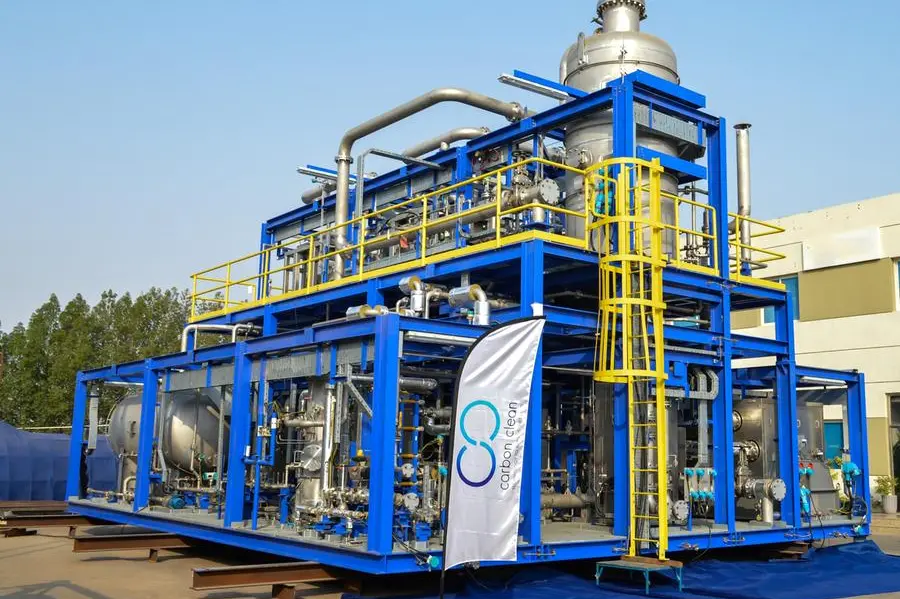
UK-based Carbon Clean, a global carbon capture technology company, is stepping up engagement in the Middle East as it seeks to expand deployment of its modular CycloneCC system across the region’s hard-to-abate sectors.
The company, which completed a pilot with Adnoc and is now testing with Aramco, is talking to players in oil and gas, steel, cement, and other energy-intensive industries in order to integrate its modular carbon capture technology into their decarbonisation roadmaps, Chief Technology Officer Prateek Bumb told Zawya Projects.
“Large scale carbon capture projects are expensive, need extensive planning, and often face cost overruns due to their size,” he explained during an interview at ADIPEC 2025. “Our CycloneCC solution offers a modular, scalable pathway for companies to reduce [carbon capture] costs and achieve decarbonisation targets.”
Bumb, who co-founded Carbon Clean in 2009 with Chair and CEO Aniruddha Sharma, said space limitations at industrial sites make large carbon capture facilities difficult to deploy, positioning compact modular technologies like CycloneCC as a practical alternative.
He noted that CycloneCC is well-suited even for large Carbon Capture and Storage (CCS) hubs, which aggregate CO2 from industrial clusters and share transport and storage infrastructure to cut costs and achieve economies of scale.
“You want to capture CO2 more efficiently and cost-effectively — or in some cases, industries simply lack the space. That’s where our technology fits in, capturing CO2 and feeding it into the hub’s transport and storage network.”

He clarified that Carbon Clean focuses solely on carbon capture, not storage or utilisation.
“Our role is to reduce carbon capture costs so that utilisation or storage become economical and then, we scale this modular system.”
The company has already scaled CycloneCC to 100,000 tonnes per annum capacity, with plans to reach 500,000 tonnes per annum within three years.
“So, if a customer wants to capture a million tonnes of CO2, just two to three trains would be needed,” he said.
Compact technology, proven chemistry
At the heart of CycloneCC is rotating packed bed technology, which evolved from Carbon Clean’s proprietary Amine-Promoted Buffer Salt (APBS) solvent chemistry – APBS is deployed at nearly 50 sites worldwide and credited with capturing 2.8 million tonnes of CO2 over the past decade.
While the solvent chemistry reduced operating costs for carbon capture plants, early deployments revealed a recurring challenge - limited space at customer sites.
Other challenges included high construction costs and system engineering and integration constraints.
“We achieved 30 to 35 percent operating cost reduction with solvent innovation,” Bumb said. “But when deploying conventional plants, customers were struggling because of lack of space. We wanted to de-risk that challenge, and that was the genesis of rotating packed bed technology.”
Bumb said CycloneCC is a prefabricated system that can be deployed in six to eight months compared with three to four years for traditional systems.
“Compressing that timeline is one of the factors in reducing the costs significantly,” he explained. “With CycloneCC, we reduced capital costs by 20–25 percent compared with conventional systems. Our goal is to halve total costs in the next three years, making carbon capture cheaper and downstream utilisation and storage economically viable for industrial users.”
But he cautioned that the cost of deployment and achievable cost reductions vary, influenced by factors such as site characteristics, geographic location, and in recent times, tariff structures.
“We’re on track to achieve the cost-reduction targets we set during our 2022 fundraising,” Bumb said. “Through the Adnoc deployment, we met all agreed KPIs, demonstrating both modularity and scalability. The project achieved TRL 7 (Technology Readiness Level 7).”
The company’s May 2022 fundraising press release had highlighted the potential to reduce capex and opex by up to 50 percent and drive down the cost of carbon capture to $30/tonne on average. In an interview with Carbon Herald news portal that month, co-founder Sharma had said the target cost could be achieved by 2025.
Potential sectors
Sectors with the greatest potential for CycloneCC include in the region cement, waste-to-energy, shipping, biomass, oil and gas, noted Bumb
“These are some of the key industrial sectors that we are actively involved in,” he said, adding that beyond regulatory mandates, many Middle Eastern industrial companies are voluntarily adopting carbon capture as part of their sustainability strategies.
On the utilisation front, regional clients are considering methanol, sustainable aviation fuel and building materials use cases to de-risk scale-ups.
The Carbon Clean executive said that companies have started viewing CO2 as a valuable molecule, and are working on business models to monetise it.
“Early movers will get the advantage in terms of deployment going forward.”
Policy and validation
Bumb emphasised that global and regional policy frameworks remain critical to accelerate commercial adoption, calling for financial incentives, tax credits, and government-backed pilots to de-risk early-stage projects.
He also cited Europe’s Northern Lights CCS initiative in Norway - the world’s first open-access CO2 transport and storage project - as a model of coordinated infrastructure and business alignment.
“If the right business model is in place to make carbon capture industry profitable, things will really fly,” he said.
Carbon Clean primarily operates under a technology licensing and equipment sales model.
“We are seeing a lot of interest on carbon capture as a service model,” Bumb noted.
Validation from national oil and gas giants like Adnoc and Aramco has helped accelerate customer conversations in the region, he said.
“When an Aramco or an Adnoc selects us for a pilot or a demonstration, it gives us lot of credibility,” he explained. “They follow extremely rigorous technical and commercial evaluation processes before investing in any pilot, which validates the viability and scalability of our technology. Our experience working with oil majors is that they want to really see technically verified on their facility.”
He added that such validation also helps accelerate decision-making with industrial players globally.
(Reporting by Anoop Menon; Editing by SA Kader)
Subscribe to our Projects' PULSE newsletter that brings you trustworthy news, updates and insights on project activities, developments, and partnerships across sectors in the Middle East and Africa.