PHOTO
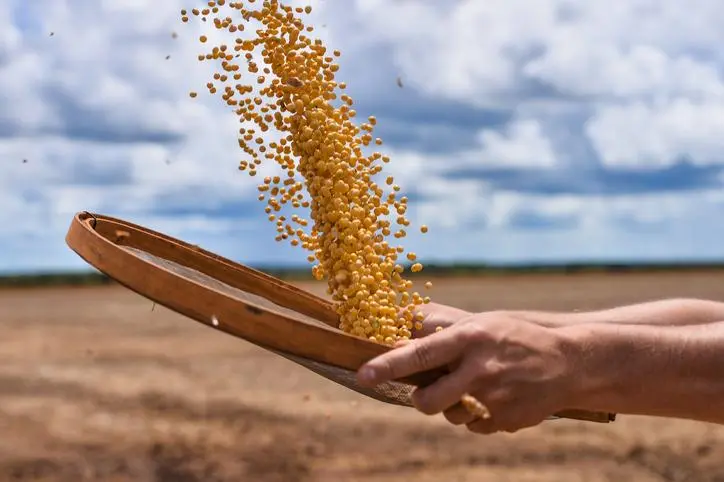
NEW YORK - Soybeans are having a moment. The Trump administration claims China will buy $40 billion to $50 billion in agricultural goods from the United States over the next two years including way more of the humble oilseed. The trade dispute limited what had previously been a massive export market for U.S. farmers. But even if the United States can get around World Trade Organization restrictions on import quotas, farmers still have a few problems.
Soybeans, which are mostly crushed to make animal feed and used for vegetable oil, accounted for roughly 60% of U.S. agricultural exports to China in the years preceding the trade skirmish. Getting to the $40 billion target means China would have to buy about a third more than the United States has ever exported to them, according to the Chinese consulting firm JCI.
But African swine flu is estimated to have halved the number of soymeal-eating hogs in China, according to RaboResearch, denting demand. The country’s purchases are expected to rebound by about 4% from the 2018-2019 season, according to Agroconsult. But purchases should still remain below pre-African swine flu levels.
U.S. farmers are having their own problems, too. Trade war concerns and a shortened growing season due to bad weather left this year’s crop almost 20% below the prior season’s haul. So the ceiling on soybean exports to China is likely closer to 27 million metric tons, reckons Agroconsult, 40% below the target estimated by JCI.
And, finally, there’s Brazil. The country is the newly crowned leader in soybean production and has taken advantage of the U.S. trade spat and started supplying China with most of its beans. Brazil’s farmers’ harvest is now expected to exceed the U.S. yield by about 25%.
Brazil’s falling interest rates and political unrest in Latin America also helped weaken the real, the country’s currency, some 15% from its high to low last year. Though it has appreciated from its bottom, Brazilian farmers still have an edge.
American farmers may struggle to lure Chinese buyers back en masse now that these new trade patterns have been formed, especially in light of the uncertainty. And American farmers, too, may no longer want to put all their beans in one basket.
CONTEXT NEWS
- U.S. President Donald Trump said on Dec. 31 that the U.S. will sign Phase 1 of a trade deal with China on Jan. 15. As part of the deal, China is expected to increase its purchases of agricultural goods from the U.S. from the pre-trade-war amount of $24 billion to $40 billion to $50 billion annually over two years.
- Brazil’s agricultural exports to China increased to $35.4 billion in 2018 from $26.6 billion the prior year. The U.S. farm exports to China declined from $24 billion to $13.2 billion during that period. China is Brazil’s top export destination. The U.S. Department of Agriculture said on Jan. 2 that Brazil was forecast to overtake the United States as the leading soybean producer in the world.
(Editing by Lauren Silva Laughlin and Amanda Gomez)
© Reuters News 2020