PHOTO
Dubai has commenced primary tunneling work on the 20.5-billion-UAE-dirham ($5.6 billion) Blue Line metro, which is set to open on September 9, 2029, Dubai Media Office announced on Sunday.
The 30-kilometre (km) metro line comprises a 15.5-km underground section and a 14.5km above-ground section.
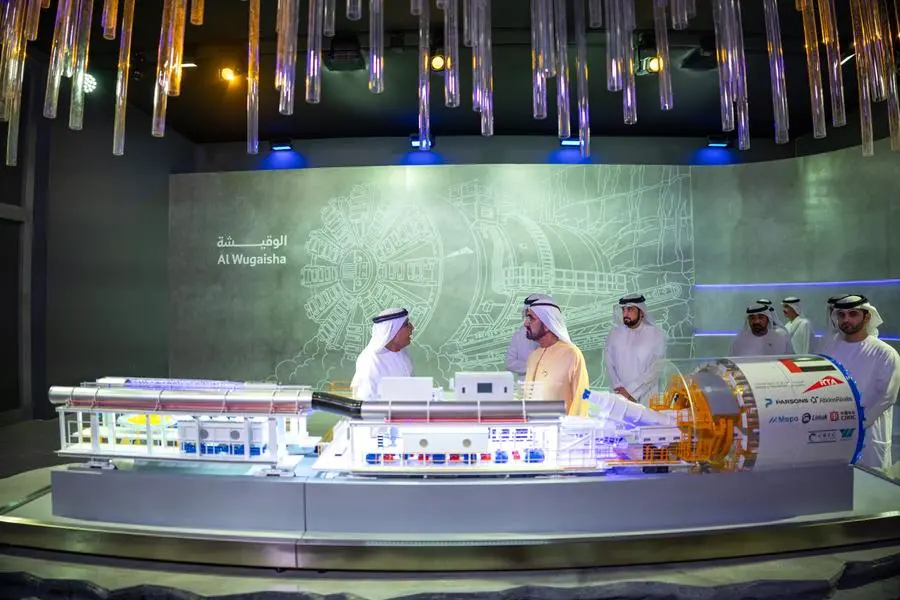
The start of the tunneling works was launched by Sheikh Mohammed bin Rashid Al Maktoum, Vice President and Prime Minister of the UAE and Ruler of Dubai, the statement said.
Construction work on the project, which began in June 2025, is currently 20 percent complete and is expected to reach 30 percent by the end of the year.
“The Dubai Metro Blue Line represents an extension of an integrated vision aimed at building a more connected, efficient and sustainable city,” said Sheikh Mohammed.
“Our major projects to reshape the new Dubai continue… a new global airport, next generation transport networks, a renewed international financial centre, and AI powered digital infrastructure and government services, with more to follow in the coming months.”
The design-build contract for Blue Line was awarded to the Turkish-Chinese consortium of Mapa-Limak-China Railway Rolling Stock Corporation (CRRC) in December 2024, with the two Turkish contractors overseeing civil works while CRRC is supplying the rail systems including a fleet of 28 driverless trains.
A joint venture of AtkinsRealis and Parsons Corporation is serving as the Project Management Consultant (PMC).
Over 10,000 workers and 180 rail specialists have been mobilized for the project, which will feature 14 stations, including 3 interchange stations, 7 elevated stations and 4 underground stations, and a train depot in Al Ruwaiyah 3.
Tunnelling works
In the first phase, tunnelling works will proceed in three directions from International City 1 Station, with the first Tunnel Boring Machine (TBM) heading towards Mirdif, the second towards the Auto Market, and the third towards Al Warsan (International City 2). In the second phase, these TBMs will be deployed beneath Emirates Road towards the train depot in Al Ruwaiyah 3, and from Al Rashidiya towards Mirdif. The average excavation advance rates of these TBMs range from 13 to 17 metres per day.
Germany-based CREG Wirth, part of China Railway Engineering Equipment Group, is providing the three TBMs for the project.
Viaduct over Dubai Creek
According to the statement, construction of piers for the 1.3km viaduct across Dubai Creek has begun, with bridge structures expected to start taking shape by June 2027.
This marks the first metro crossing above the creek as existing Red and Green metro lines currently cross the creek below ground.
The tunneling and construction works is supported by two ready-mix concrete batching plants – a 200 cubic metre-capacity plant in in Al Ruwayyah and a 120-cubic metre plant in International City, and two precast plants - precast viaduct factory in Al Ruwayyah 3 with a daily capacity of 10 to 12 viaduct segments, and a precast tunnel ring factory in International City with a daily capacity of 12 rings.
Iconic stations
Construction of Blue Line metro stations is progressing at an accelerated pace, according to the media office statement.
The iconic station at Dubai Creek Harbour has been designed by Skidmore, Owings & Merrill (SOM). The Emaar Properties Station extends across 11,000 sqm, and will be the world’s tallest metro station at 74 metres. It is designed to accommodate 160,000 passengers daily, with an anticipated 70,000 daily users by 2040.
International City (1), slated to become the largest underground interchange station in the Dubai Metro network, covers over 44,000 sqm and is expected to handle 350,000 passengers daily.
The statement said three of the stations have been designed around the theme of air, two around the theme of water, four around the theme of earth and two stations around the theme of fire.
The Blue Line is also the first transport project in Dubai to fully comply with green building standards, targeting LEED Platinum certification.
The network
The Blue Line will connect with the Green Line at Creek Station and the Red Line at Centrepoint Station.
The first route starts at Al Khor Interchange Station (Creek Station) on the Green Line in Al Jaddaf, passing through Dubai Festival City, Dubai Creek Harbour, and Ras Al Khor, before reaching International City (1) interchange station. From there, it continues to International City (2) and (3), Dubai Silicon Oasis, and ends at Dubai Academic City. This 21-kilometre route includes 10 stations and features a mix of underground and elevated tracks.
The second route begins at Centrepoint Interchange Station on the Red Line in Al Rashidiya, passing through Mirdif and Al Warqaa to the interchange station at International City (1). This 9-kilometre route comprises four stations.
With a capacity of 46,000 passengers per hour in both directions and a train frequency of approximately two minutes, the Blue Line is expected to serve nearly 200,000 passengers daily by 2030, rising to 320,000 passengers daily by 2040.
The Blue Line will serve nine key districts with a projected population of around one million under the Dubai 2040 urban master plan. It will also support urban planning initiatives like the 20-Minute City, ensuring that over 80 percent of services are accessible within a 20-minute commute, while promoting transit-oriented development (TOD).
The total benefits of the project are expected to exceed AED56.5 billion by 2040, driven by savings in time, fuel consumption, reduced accident-related fatalities, and lower carbon emissions. It is anticipated to reduce traffic congestion on key road corridors by 20 percent and boost the value of land and properties surrounding its stations by up to 25 percent.
The Gold Line
In April, Sheikh Mohammed had launched the AED34 billion Gold Line, the city’s first fully underground metro line and its largest transportation project to date.
The Gold Line will pass through 15 key strategic areas across Dubai, strengthening transport links to 55 major real estate developments and is expected to serve around 1.5 million residents through 18 stations.
AECOM is the lead consultant for the project.
Blue and Gold expansion
Dubai Metro’s current total length is 90 km which includes around 52 km for the Red Line, 23 km for the Green Line, and 15 km for Route 2020. The network comprises 53 stations, with 29 on the Red Line, 18 on the Green Line, and seven on Route 2020. Additionally, the fleet consists of 129 trains.
The combined Dubai Metro and Tram network extends 101 km, and comprises 64 stations (53 metro stations and 11 tram stations) and 140 trains (129 Metro trains and 11 tram trains). Completion of the Blue Line will extend the combined metro and tram network to a total of 131 km (120 km metro and 11 km tram), comprising 78 stations (67 metro and 11 tram) and 168 trains (157 metro and 11 tram). With the Gold Line's completion, the combined network will touch 172 km (162 km metro and 11 tram) and comprise 96 stations (85 metro and 11 tram). The rolling stock details haven't been released yet.
(Editing by Anoop Menon) (anoop.menon@lseg.com)
Subscribe to our Projects' PULSE newsletter that brings you trustworthy news, updates and insights on project activities, developments, and partnerships across sectors in the Middle East and Africa.