PHOTO
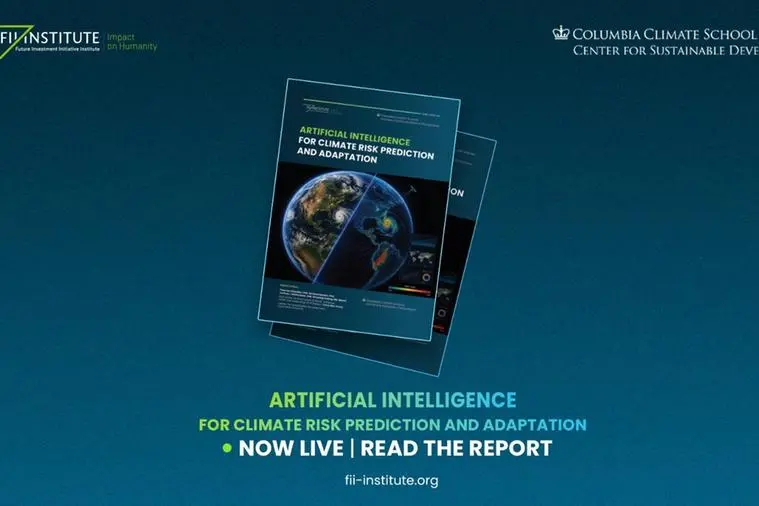
ROME, Italy, The Future Investment Initiative (FII) Institute today announced the launch of its latest report, Artificial Intelligence for Climate Risk Prediction and Adaptation. The report, authored by Thomas Chandler, PhD; Richard Hendra, PhD; Joshua L. DeVincenzo, EdD; and Shuyang Huang, MS, examines how artificial intelligence can help governments, emergency managers, investors, and communities better anticipate, prepare for, and respond to climate-related disasters.
The report will be launched in connection with FII PRIORITY Europe 2026, taking place in Rome from June 17–19, 2026, under the theme “Europe Reimagined: Capital, Sovereignty & Strategic Autonomy.” The Summit will convene global leaders across investment, policy, technology, energy, and industry to examine how capital can strengthen resilience, competitiveness, and long-term growth.
The report points to the scale of the challenge facing governments, insurers, infrastructure operators, and communities, citing Munich Re data showing that global natural catastrophe losses reached approximately US$320 billion in 2024, including US$140 billion in insured losses.
The report highlights how AI can support climate risk prediction through faster forecasting, early warning systems, damage assessment, resource allocation, and real-time emergency coordination. It also warns that AI tools will only deliver real impact if they are trusted, explainable, locally relevant, and supported by strong data systems.
Key takeaways from the report include:
- AI is making substantial progress across climate risk management, including preventive maintenance, digital twin technologies, real-time disaster monitoring, and rapid damage assessments for housing recovery.
- Firms focused on data provenance, linkage, verification, and infrastructure monitoring may represent some of the most durable opportunities within the climate AI ecosystem.
- Current disaster recovery systems often focus on returning communities to pre-disaster conditions, rather than addressing the vulnerabilities that made impacts worse. AI can help support more proactive response, recovery, and resilience planning.
- A major digital and knowledge divide remains between the Global North and Global South, especially around access to credible information, trusted data sources, and educational resources. Workforce development will be critical.
“AI has the potential to transform how societies predict, prepare for, and respond to climate risk, but technology alone is not enough,” said Dr. Thomas Chandler, one of the report’s authors. “The real test is whether AI can be integrated into institutions, trusted by communities, and used to reduce vulnerability before disasters occur.”
Dr. Chandler will join leaders and experts at FII PRIORITY Europe 2026 in Rome, where climate resilience, AI, data infrastructure, capital allocation, and strategic autonomy will be part of the wider conversation on Europe’s future competitiveness.
The report argues that effective AI-enabled climate adaptation depends on cooperation between governments, investors, technology companies, emergency managers, and local communities. It calls for greater investment in open and interoperable data systems, AI literacy, public-private partnerships, and tools that keep human judgment at the center of emergency decision-making.
About FII Institute
The FII Institute is a global nonprofit foundation with an investment arm and one agenda: Impact on Humanity. Through its THINK, XCHANGE, and ACT pillars, the Institute fosters great ideas, empowers innovators, and invests in scalable solutions across critical sectors including AI and robotics, sustainability, healthcare, and education.
For more information, please visit: https://fii-institute.org
For media inquiries, please contact media@fii-institute.org