PHOTO
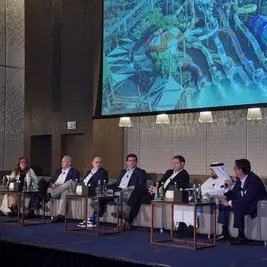
UAE: Global aviation leaders underscored the need for faster regulatory coordination, smarter use of technology and stronger international consensus to advance the sector in an increasingly complex global environment, during a high-level panel session on Day 2 of the World Governments Summit 2026.
The session, titled “What Is the Next Destination for Aviation 2.0?”, was moderated by Richard Quest of CNN and featured H.E. Toshiyuki Onuma, President of the International Civil Aviation Organization (ICAO), and Sir Tim Clark, President of Emirates Airline.
Onuma said ICAO’s primary mandate remains ensuring safety, security and sustainability across global aviation, stressing that consensus-building among global actors is complex but essential.
“Safety and security are shared goals. As long as we focus on these fundamentals, I remain optimistic that consensus can be achieved,” he said.
On sustainability, Onuma noted that aviation regulation must now extend beyond technical standards to include long-term environmental frameworks, adding that prioritising aviation within broader economic and policy agendas is a key challenge.
Clark praised airspace management in the Middle East, describing regional coordination as a “Herculean task” that has been handled effectively compared to other parts of the world.
He said technology already exists to significantly improve passenger flows, border control and airport efficiency, citing Dubai as a leading example.
“We can move people through airports without physical intervention. The technology is there. What’s needed is the will to adopt it,” he said.
Clark highlighted the critical role of ICAO in providing a global regulatory framework, while acknowledging that progress can be slowed by the need for unanimity among states.
“Consensus is difficult in today’s world, but ICAO provides the common ground that allows aviation to function safely and efficiently worldwide,” he said.
The discussion also addressed emerging challenges such as commercial space launches, airspace congestion and outdated regulations. Onuma said ICAO is working with member states to identify obsolete rules and modernise frameworks in line with industry needs.
The WGS 2026, which runs for three days until Feb. 5 under the theme “Shaping the Governments of the Future,” brings together more than 60 heads of state and government and their deputies, over 500 ministers, representatives of more than 150 governments, more than 80 international and regional organisations, over 700 CEOs, and more than 6,250 participants from around the world.