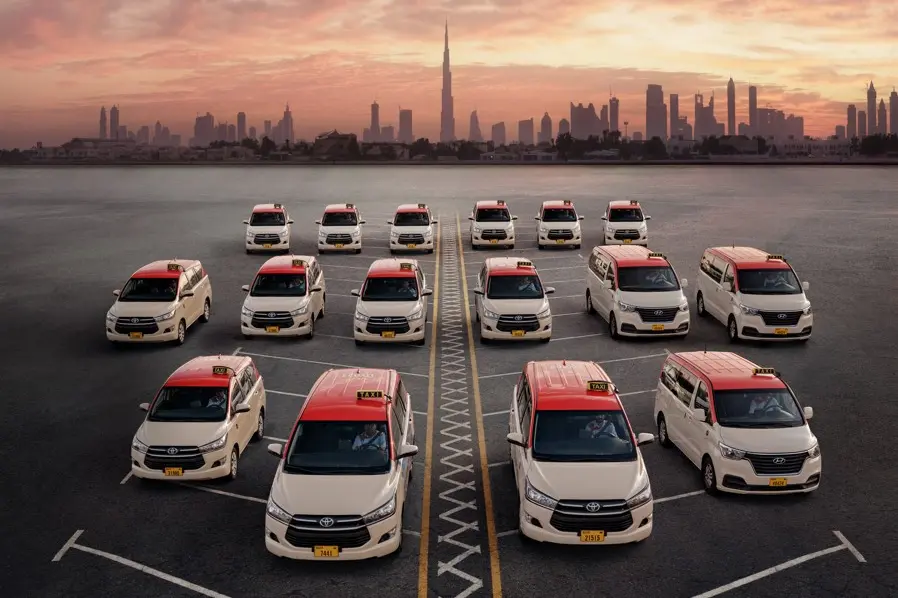
PHOTO
Underpinned by Continued Fleet Growth and confidence in Dubai’s Structural Economic Strength
- Operational Fleet expanded by 1,545 vehicles, up 16% year-on-year, supporting continued capacity growth across segments
- Performance in January and February remained positive, with revenue growing 10% year-on-year and EBITDA increasing 17% year-on-year
- Q1 2026 financial performance impacted by the heightened regional uncertainty in March with revenue decreasing 6% year-on-year and EBITDA decreasing 22% year-on-year
- Continued execution against five-year strategic plan, including further expansion of e-hailing capacity through Bolt and launch of fully autonomous ride-hailing services in Dubai in partnership with Baidu’s Apollo Go platform
- Post period end, DTC announced the acquisition of 600 new license taxi plates through the latest auction by the Dubai Roads and Transport Authority (RTA), increasing market share to 47%
- Approved final cash dividend of AED 142.0 million for H2 2025, distributed in April 2026, with FY 2025 total dividends up 7.5% on FY 2024
- DTC remains confident in Dubai’s long-term economic fundamentals, which continue to support structural demand across the mobility sector
Dubai, UAE: Dubai Taxi Company PJSC (“DTC” or the “Company”), a leading provider of comprehensive mobility solutions in Dubai, today announced its financial results for the three-month period ended 31 March 2026 (“Q1 2026” or the “Quarter”).
DTC delivered a resilient operational and financial performance in Q1 2026, following the strong momentum carried into the year from FY 2025. Performance in January and February remained robust, supported by continued fleet expansion and sustained demand for the Company’s smart, sustainable mobility solutions. In March, however, heightened regional uncertainty weighed on performance, particularly across taxi and limousine activity, resulting in lower trip volumes during the month. As a result, revenue in Q1 2026 declined 6% year-on-year to AED 551.1 million. For January and February 2026, revenue increased 10% year-on-year, reflecting sustained momentum and continued structural demand for mobility services.
Segment Performance
DTC’s taxi segment recorded revenue of AED 455.3 million in Q1 2026, down 12% year-on-year, primarily due to lower trip volumes in March. For January and February 2026, taxi revenue increased 5% year-on-year, supported by continued fleet expansion while maintaining strong utilization levels. As of March 2026, DTC’s operational taxi fleet stood at 6,217 vehicles, including 594 fully electric vehicles, reflecting continued progress in the transition towards a more sustainable fleet, supported by the EV charging agreement signed with DEWA in 2025.
The limousine segment recorded revenue of AED 29.2 million in Q1 2026, down 15% year-on-year, largely due to reduced airport operations, while the bus segment increased 7% year-on-year to AED 33.7 million. For January and February 2026, limousine revenue declined by 9% year-on-year, primarily driven by usual seasonality effects, while the bus segment grew by 1% year-on-year.
The delivery bike segment sustained its strong momentum, delivering revenue growth of 61% year-on-year to AED 26.6 million in Q1 2026, supported by continued expansion in the resilient and fast-growing on-demand delivery market. For January and February 2026, delivery bike revenue increased by 74% year-on-year.
Across the taxi and limousine segments, DTC completed 11 million trips in Q1 2026, down 14% year-on-year. For January and February 2026, taxi and limousine trips were broadly flat year-on-year at 8.5 million, supported by sustained demand across the fleet. As of March 2026, DTC’s total operational fleet across all segments increased by 16% year-on-year to 11,417 vehicles, reflecting continued investment in the Company’s disciplined capacity scaling strategy.
DTC’s strategic partnership with Bolt, signed in 2024, continues to support the expansion of e-hailing activity across the Company’s taxi and limousine segments. In Q1 2026, taxi and limousine e-hailing trips increased 9% year-on-year to 5.0 million across all platforms. The continued growth in e-hailing adoption demonstrates the resilience of this channel and highlights significant future upside across DTC’s fleet, in line with Dubai’s ambition to transition 80% of taxi trips to e-hailing over the coming years.
Financial Performance
DTC’s EBITDA declined 22% year-on-year to AED 120.7 million in Q1 2026, reflecting the impact of the current regional situation on taxi and limousine trip volumes in March. For January and February 2026, EBITDA increased 17% year-on-year on a higher revenue base, supported by continued growth in trip volumes across business segments. EBITDA margin for the quarter was 22%, compared with 26% in Q1 2025. For January and February 2026, EBITDA margin remained at 26%, with continued implementation of operational efficiencies partially offset by ongoing promotional investments in Connectech.
Net profit declined 39% year-on-year to AED 50.7 million in Q1 2026, representing a net profit margin of 9%, compared with 14% in Q1 2025. Performance was impacted by lower trip volumes in March due to heightened regional uncertainty. For January and February 2026, net profit increased 25% year-on-year, supported by continued growth in operating profit.
DTC maintained a healthy balance sheet, with a conservative net debt-to-EBITDA ratio of 1.0x and cash and cash equivalents of AED 358 million, including wakala deposits, as at 31 March 2026.
DTC’s Group CEO, Mansoor Rahma Alfalasi, commented: “DTC delivered a resilient performance in the first quarter, building on the strong momentum achieved in 2025. We continued to expand our fleet, invest in digital capabilities and drive efficiencies through ongoing optimization initiatives. Demand in January and February remained robust across our core segments with positive revenue and EBITDA growth, reflecting the strength of our market position and the structural drivers underpinning our growth strategy. In March, our business was impacted by the increased regional uncertainty which saw a reduction in tourist inflows and a move to remote working and learning. Throughout this period, we remained fully operational, and we continued to serve customers in the UAE across all our business verticals.
“Looking ahead, we continue to monitor the regional environment closely however we remain confident in Dubai’s strong long-term macroeconomic fundamentals, supported by ongoing urbanization, population growth and continued investment in transport infrastructure across the emirate.”
Strategic & Operational Highlights
In 2024, DTC launched a new five-year corporate strategy for 2025 to 2029, centered on innovation and operational excellence to further reinforce the Company’s position as the region’s premier mobility operator. DTC delivered strong progress against those strategic priorities in 2025, expanding its mobility ecosystem and strengthening its market leadership position in smart, sustainable transportation solutions.
This momentum continued in Q1 2026 and into April with DTC launching fully driverless commercial ride-hailing services in Dubai in partnership with Baidu Inc., through its autonomous platform Apollo Go. This marks Apollo Go’s first international deployment and positions DTC at the forefront of autonomous mobility in the region. The initial rollout includes 50 vehicles, with phased expansion to more than 1,000 driverless vehicles in the coming years, directly supporting Dubai’s ambition to transition 25% of all journeys to autonomous transport by 2030. The launch reflects DTC’s continued focus on leveraging advanced technologies, strategic partnerships and operational scale to deliver innovative mobility solutions across the emirate.
Further expanding e-hailing capacity and access in Dubai, DTC and Bolt entered into a strategic partnership during the period with National Taxi, a leading UAE taxi operator, to integrate 1,823 National Taxi vehicles into the Bolt e-hailing platform, significantly increasing available fleet capacity and service coverage in Dubai. The agreement builds on the strategic alliance signed with Kabi, one of Dubai’s largest taxi operators, in 2025, to integrate the combined DTC and Kabi fleets into the Bolt platform.
Post period end, on 23 April, DTC announced the acquisition of another 600 new taxi license plates through the latest auction by the Dubai Roads and Transport Authority (RTA), reinforcing its position as the emirate’s largest taxi operator and increasing its market share to 47%. With this addition, DTC’s taxi fleet will grow from 6,217 to 6,817 vehicles. With phased introduction of the new vehicles starting July 2026, the structured rollout plan is designed to maintain high levels of operational efficiency and service quality, while meeting the growing demand for mobility services across Dubai.
FY 2025 Final Dividend
At the Company’s Annual General Meeting, shareholders approved a final cash dividend of AED 142.0 million for H2 2025, equivalent to 5.68 fils per share, bringing total FY 2025 dividends to AED 302.7 million, equivalent to 12.11 fils per share, representing a 7.5% increase compared with FY 2024. The approved distribution is in line with DTC’s dividend policy of targeting a payout of at least 85% of annual net profit, distributed on a semi-annual basis. The dividend was distributed to shareholders in April 2026.
Outlook
DTC continues to monitor the regional environment closely but remains well positioned to deliver continued growth supported by Dubai’s resilient, structural macroeconomic fundamentals, historically strong population and tourism expansion, and record investments in transport infrastructure. The Company remains focused on driving efficiencies, expanding digital enablement and fleet optimization to strengthen long-term profitability and deliver attractive, sustainable shareholder returns.