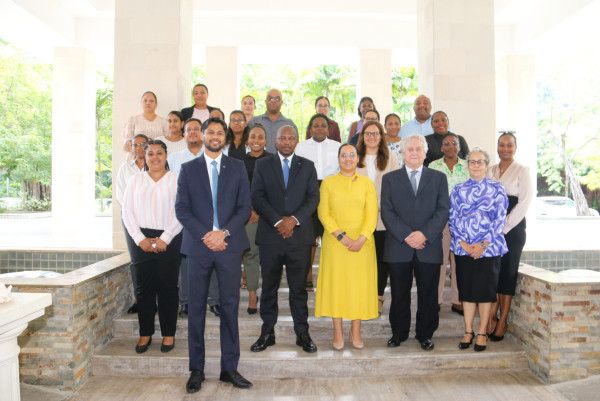
The Working Session of the Seychelles Human Rights Treaty Reporting Committee (SHRTRC) on the Universal Periodic Review (UPR) and Treaty Body Reporting officially opened on Tuesday 7 April 2026 at the Savoy Seychelles Resort and Spa.
The three-day workshop is organised by the Ministry of Foreign Affairs and the Diaspora in collaboration with the Human Rights Unit of the Commonwealth Secretariat and the Permanent Mission of Seychelles to the United Nations Office in Geneva, represented by Ambassador Cillia Mangroo.
In her opening remarks, Ambassador Mangroo expressed appreciation to all contributors to Seychelles’ National Report, noting that their collaboration ensured a comprehensive document that reflects national realities and responds to recommendations from the previous UPR cycle. She reaffirmed that human rights are both international obligations and constitutional commitments, requiring collective responsibility across all institutions.
While acknowledging progress made by Ministries in fulfilling reporting obligations, she highlighted ongoing capacity constraints and emphasised the importance of strengthening technical capacity, coordination, and timely reporting. She noted that the establishment of the SHRRC marks a significant step forward, particularly in coordinating the National Report, but stressed that continued efforts are needed to enhance institutional effectiveness and adherence to reporting timelines.
Ambassador Mangroo also recognised the vital role of civil society in promoting an inclusive, transparent, and responsive human rights framework, underscoring the importance of partnerships in supporting Small Island Developing States like Seychelles.
Human Rights Advisor at the Commonwealth Secretariat, Mr Phumlani Dlamini, commended Seychelles for successfully submitting its National Report for the fourth UPR cycle, describing it as a clear demonstration of the Government’s commitment to upholding human rights. He highlighted that Seychelles’ participation in international reporting processes strengthens its global voice while ensuring compliance with its obligations, noting that the country is party to all nine core international human rights treaties.
Mr Dlamini acknowledged that reporting remains a challenge for all countries and requires strong national mechanisms. He welcomed the establishment of the SHRTRC as a key step toward improving reporting and implementation, reaffirming the Commonwealth Secretariat’s commitment to supporting member states, particularly small states, in building capacity and engaging effectively with UN human rights mechanisms.
The workshop will focus on sharing best practices for national implementation, reporting, and follow-up, strengthening the mandate of the SHRTRC, and addressing Seychelles’ reporting obligations. Discussions will also aim to identify overdue reports and reduce the reporting backlog, including through drafting responses to the Human Rights Committee on the International Covenant on Civil and Political Rights.
Distributed by APO Group on behalf of Ministry of Foreign Affairs and the Diaspora, Republic of Seychelles.