PHOTO
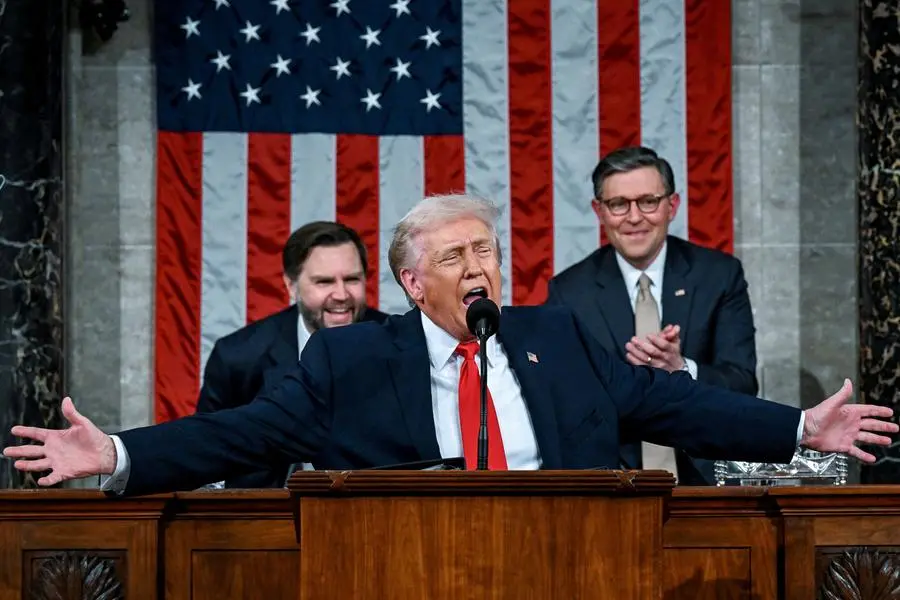
SAN FRANCISCO/NEW YORK - U.S. President Donald Trump boasted of stock market gains in his State of the Union speech on Tuesday and pledged that the government would contribute to workers' retirement savings, while saying little to reduce jitters on Wall Street about the future of his tariffs and global trade policy.
"People were probably looking for something more definitive on the tariffs and I'm not sure we've had that," said Karen Jorritsma, head of Australian equities at RBC Capital Markets in Sydney.
Trump boasted of 53 stock market record highs since he won his second term in November 2024 in his address.
"Because the stock market has done so well, setting all those records, your 401ks are way up," Trump said, referring to a widely used retirement savings account.
Trump also announced plans next year to match 401k employee contributions of up to $1,000 each for "forgotten American workers" who do not have access to retirement plans that offer employer contributions, without providing details.
Such government-funded retirement savings contributions could fuel future gains in the stock market, said Jake Dollarhide, CEO of Longbow Asset Management in Tulsa, Oklahoma.
Trump's address comes at a pivotal point for investors, sideswiped by market turbulence in recent months and craving stability. While worries about pricey valuations of AI-related companies have been behind much of Wall Street's swings, ongoing uncertainty about U.S. trade policy has also kept investors on edge.
After the Supreme Court overturned Trump's emergency-powers tariffs last Friday, Trump signed an order for 10% tariffs to last 150 days to replace broad duties under an emergency law that were struck down by the Court, and then on Saturday said he would increase the rate to 15%.
In his speech, Trump said "almost all" countries and corporations want to stick to tariff and investment agreements previously made with the United States.
While the S&P 500 has gained 13% in the 400 days since Trump's January 2025 inauguration, the benchmark has barely increased in 2026 as Wall Street lags international stock markets and the dollar trades near 2022 lows.
State of the Union speeches have historically had little impact on financial markets, given that they tend to serve as occasions for incumbent presidents to trumpet their achievements and lay out broad policy agendas.
(Reporting by Suzanne McGee, Laura Matthews and Noel Randewich; additional reporting by Tom Westbrook in Singapore editing by Megan Davies, Rod Nickel, Colin Barr and Kim Coghill)