PHOTO
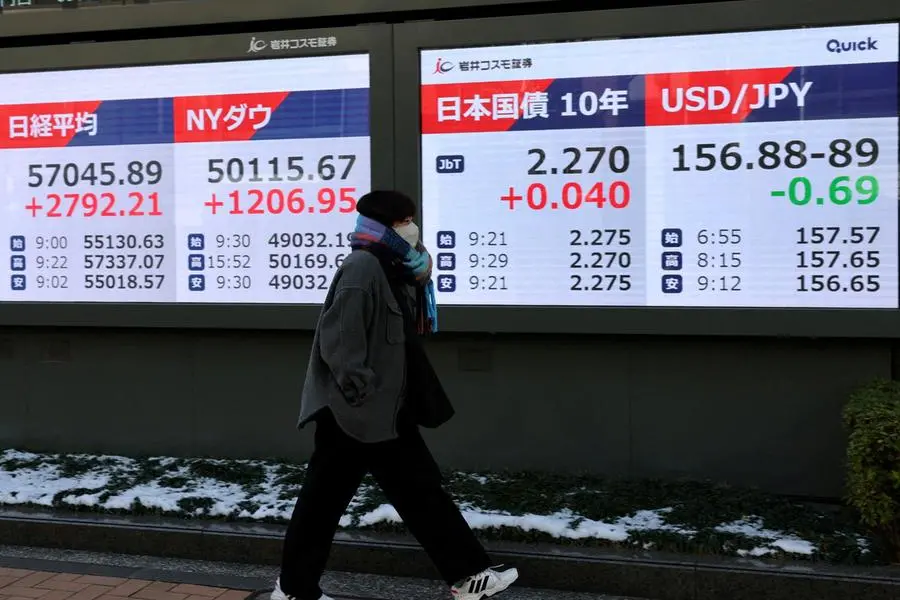
Global shares edged up on Friday to within a fraction of a fresh record high, and were set for a monthly gain, even as geopolitical tensions and persistent concerns about AI caused wild swings under the surface.
Manish Kabra, head of U.S. equity strategy at SocGen, said in the absence of any major news, the market is refocusing on fundamentals which he described as "rock solid."
"This is on a global basis. When I say fundamental, this is the profit cycle, the growth cycle, the broadening of the growth," said Kabra.
Global shares rose 0.2%, while Europe's STOXX 600 was up 0.4%, buoyed by positive earnings.
Nevertheless, jitters around AI spending and fears about the technology's broader business disruptions, as well as U.S.-Iran tensions, have weighed on sentiment this week.
U.S. stock market futures were flashing red during early European trading, with S&P futures off 0.2% while the tech-heavy Nasdaq futures were flat.
Tech shares fell on Thursday even as Nvidia posted better-than-expected results for the January quarter and forecast current-quarter revenue above market estimates.
"It seems 'the Street' simply wanted more, or perhaps just isn't prepared to chase the stock at its current lofty valuation," IG market analyst Tony Sycamore said about Nvidia's results in a note.
Shares in Nvidia down over 5% ended Thursday.
IRAN TENSIONS SIMMER
Markets were also closely watching the latest developments in U.S. and Iran nuclear talks, as Washington amassed more military resources in the Middle East.
An Omani mediator of U.S. and Iran nuclear talks gave an optimistic summary of the latest round of negotiations, but signs of a breakthrough that would avert potential U.S. strikes remained elusive.
"With no major breakthroughs announced in the U.S.–Iran talks, crude markets remained in wait-and-see mode, continuing to price in a significant risk of military escalation between the two countries," said Mantas Vanagas, senior economist at Westpac Group.
U.S. crude rose 1.4% to $66.16 a barrel, and Brent rose to $71.65, up 1.3%. Spot gold shed 0.15% to $5,178.29 an ounce.
The U.S. and Iran plan to resume negotiations over Tehran's nuclear programme after consultations in their countries' capitals, Omani Foreign Minister Sayyid Badr Albusaidi said in a post on X after the day's meetings in Switzerland.
Any substantial move forward could curb chances for U.S. President Donald Trump to carry out a threatened attack on Iran that many fear could escalate into a wider war.
POLITICS ALSO IN FOCUS FOR CURRENCIES
The dollar index, which measures the greenback against a basket of currencies, was flat at 97.73, with the euro up 0.07% at $1.1805. The yen was flat 156.16 per dollar.
Sterling rose 0.1% to $1.349 after British Prime Minister Keir Starmer's Labour Party suffered an election defeat in an area of Greater Manchester that it had dominated for almost a century.
The yield on benchmark U.S. 10-year notes fell 2.6 basis points to 3.99%.
Data in Japan showed cooling inflation in Tokyo and weaker-than-expected factory output, complicating the case for policy rate increases by the central bank. The data came on the heels of Prime Minister Sanae Takaichi putting forward two Bank of Japan board nominees who share her dovish mindset.
Japanese Finance Minister Satsuki Katayama signalled heightened vigilance over currency moves, telling parliament the government is monitoring the yen's recent drop with a strong sense of urgency.
(Reporting by Rocky Swift in Tokyo and Lucy Raitano in London; Editing by Tom Hogue, Sam Holmes and Kim Coghill)