The latest round of conflict between Iran and the trio of Western powers, Israel and Gulf allies once again brings to the fore the fragility of oil markets.
Even a few weeks ago, rumours of an Israeli attack on Iranian nuclear facilities were confined to neo-conservative think tanks, and fringe right movements, but now the discourse has entered the mainstream and oil markets.
Influential and powerful financial institutions such as PIMCO and JP Morgan have both weighed in recent days on the repercussions of a continued showdown with Iran.
It's nerve-wracking and worrying. And it's no longer a fringe theory, but a real possibility.
The only thing suggesting that this event may not come to pass is that the U.S. and Europe do not have a domestic political appetite to wage yet another war in a foreign land, nor do they have the budgets and funds to spend on a war in the midst of domestic austerity cuts and massive unemployment.
Which makes the JP Morgan argument even more compelling - what if Iran were to make the first move and cut supplies to the world?
The threat of an escalation of conflict with Iran has left many analysts and observers fretting about its impact on oil prices and the global economy.
And it is no longer a fringe debate been conducted by Washington think tanks, but it has entered the psyche of the mainstream audiences. PIMCO, one of the most influential bond traders in the world, and JP Morgan, the powerful investment bank, have both weighed in on the threat to Iranian and wider Gulf supplies in the wake of a war between Israel and Iran.
The world economy is already working its way through weak growth, sovereign debt crisis, unemployment and general business pessimism, and to add this an oil shock would mean a global recovery will be delayed and, quite frankly, derailed.
There has been a lot of market chatter over the past few weeks regarding a potential Israeli strike on Iranian facilities. The market's focus on the region has been heighted by the latest International Atomic Energy Agency (IAEA) report on Iranian nuclear activities. 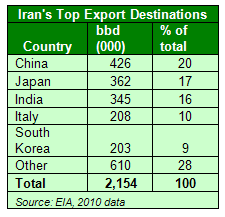
Added to this was the recent ransacking of the UK Embassy in Tehran by Iranian protestors and the subsequent decision by some of the EU members to expel Iranian diplomats has escalated the conflict.
The EU has imposed further sanctions on 180 Iranian and individuals.
"All of this could have significant and direct implications for the oil market and secondary implications for the global economy, depending on which scenario actually plays out," says Greg E. Sharenow of PIMCO.
Iran, of course, produces 4 million barrels per day (bpd) and exports 2.3 million bpd, mostly to Asian countries such as China, India, Japan and Korea and the remaining to OECD nations. Overall, it is the fourth largest oil producer in the world, and also has the fourth largest oil reserves in the world.
The PIMCO analyst says he doubt that other OPEC members will be able to replace lost Iranian exports and we are concerned that they are at risk for lower, not higher, output.
While Saudi Arabia will likely respond by boosting output, PIMCO estimates that excess capacity is unlikely to be much higher than 1.5 million barrels per day. The big problem is that Saudi Arabia has limited export capability to the Red Sea and relies on the perilous Strait of Hormuz for most of its crude oil exports.
A total of 16 million barrels of oil exports through the Strait of Hormuz each day, in addition to liquefied natural gas (LNG) exports from Qatar. While the U.S. military presence should keep the Straits open (gulp), the market will initially be very afraid of larger losses. The new Abu Dhabi Crude Oil Pipeline (ADCOP) project to go into service shortly will only relieve a fraction of the bottleneck should one develop.
"Further, given the heightened level of geopolitical instability around the globe, the conclusions we can draw by evaluating this particular situation may be useful when assessing the danger of other potential or realized supply disruptions. Although we cannot (and will not) predict whether an attack is imminent, or even likely, it is important to analyze the potential outcomes to prepare portfolios for tail risk events."
Today, markets are much more vulnerable to significant price spikes stemming from a new supply disruption than they were during the 1990/1991 Iraqi Invasion of Kuwait or even 1980 Iran-Iraq War, says Sharenow.
Due to significant production outages and relatively strong non-OECD demand leading to sharp draws on inventories this past year, the market also has significantly less "cushion" than it did earlier this year when the Libyan conflict began.
Therefore, any event could pose a formidable risk to the global economy (e.g. a real supply disruption scenario would require higher prices to lower demand in order to balance the market). This could come at a time when the global economy, or at least the developed world, is facing fiscal headwinds and limits on monetary policy
4 SCENARIOS
PIMCO outlines four hypothetical scenarios for output and prices that could materialize if Israel attacks Iran's nuclear sites.
- Scenario 1: Exports minimally effected. Concerns would drive initial price response. IEA would likely make statements about willingness to meet any shortfall in supplies. Oil could spike initially to $130 to $140 per barrel and then settle in a higher range, around $120 to $125, in relatively short order as a premium (mostly a risk premium) becomes embedding into the market, at least for a while. The timing of the spike would depend on how much the market is taken by surprise and whether or not the strike is priced in ahead of time.
- Scenario 2: Iranian exports cut off for one month. IEA would likely swing into action and Saudi Arabia could begin to offer more oil into market. In this case, we would expect prices could reach previous all-time highs of $145/bbl or even higher depending on issues with shipping. The IEA and Saudi Arabia can meet market needs, but the increase in uncertainty and the loss of spare capacity would affect pricing. In this case, after a few months, we would expect prices could fall back to $130 to $135/bbl range.
- Scenario 3: Iranian exports are lost for half a year. This is where the potential outcomes get quite dicey. We think oil prices could probably rally and average $150 for the six months, with notable spikes above that level. The IEA would likely release oil steadily, but consumption will need to take a hit from prices and slower economic activity. Once Iranian crude oil returns to the market and the environment stabilizes, oil would likely return to around $110/bbl or even lower depending on global strength at the time.
- Scenario 4: Greater loss of production from around the region, either through subsequent Iranian response or due to lack of ability to move oil through Straits of Hormuz. This is the Armageddon scenario in which oil prices could soar, significantly constraining global growth. Forecasting prices in the prior scenarios is dangerous enough. So, we won't even begin to forecast a cap or target price in this final Doomsday scenario.
WHAT IF IRAN MAKES THE FIRST MOVE?
JP Morgan analyst Lawrence Eagles says the market is under-pricing the notion that Iran could withdraw oil exports to shock the system if it feels threatened that the sanctions noose around it is tightening.
"The tighter sanctions become, the greater the potential for Iran to become the first-mover--halting exports ahead of the imposition of tighter sanctions," says Eagles. "The end result may ultimately be the same, but the loss of supplies could come earlier, and associated concerns would be perceived to be higher, elevating the market impact. With several European countries removing envoys to Iran in the wake of the storming of the UK embassy, and France proposing tougher oil-based sanctions, the risks of such a disruption have materially increased."
This Iranian move could be triggered if one of Iran's key customers pulls out. In recent days South Korea (an important Iranian client) has stated it may ban Iranian oil imports. We have already seen existing financial sanctions complicate the payment process for several importers, with India providing the most recent example earlier in 2011.
With such a tight concentration of buyers, there are only few countries that could take up the slack in the event of an embargo--and if they agreed in consort not to increase imports, the impact of a selective consumer embargo could be significant, says Mr. Eagles.
"The main argument against such sanctions is that if they have a significant impact on Iranian finances, they could also have a significant impact on global oil prices, which would be unwelcome in the current fragile state of the global economy."
This would undoubtedly shock the oil market, and while we are confident that it would trigger the rapid use of strategic reserves, the initial market shock could be in the $20 to $30 barrel range, according to JPMorgan estimates.
CONCLUSION
A few mysterious explosions in Iran suggests something more sinister might be afoot, with Israel already implementing a shadow war on Iran. There is also speculation that a cyber attack was launched to disrupt Iran's nuclear ambitions.
Clearly, the United States is ensuring that as its troops leave Iraq, it will not allow Iran to have a free run in the region.
By forcing greater sanctions, more political pressures and threat of an attack, western powers, in collusion with its Arab allies, are keeping to keep a tight lid on Iran's ambitions.
A military attack by Israel, of course, would be a catastrophic idea. While oil prices may jump, there is a wider threat of oil supply disruptions, plunging the global economy into turmoil. That's not going to be good for anybody, whether they are friends or foes of Iran.
© alifarabia.com
© alifarabia.com 2011