Sometimes it pays to be insulated from the wider world.
While Sub-Saharan Africa has growing trade ties with the rest of the world, many of the African countries remains largely disconnected and that may benefit the region as it posts sterling growth this year and the next.
The region is expected to grow 5% this year and an even more cheerful 6% in 2014, exceeding emerging market growth of 4.5% and 5.1% during the same period, said the International Monetary Fund in a new report.
"Nevertheless, spillovers from sluggish external demand, reversal of capital flows, and declines in commodity prices are contributing to somewhat weaker growth prospects in many countries," relative to the IMF's forecast earlier this year.
Sub-Saharan economies are less concerned about a US default and more focused on deceleration of economic growth in China and other emerging markets that could reduce exports and lower commodity prices.
"A sharp or protracted decline in oil and commodity prices would affect commodity exporters that do not yet have sufficient fiscal buffers (Angola, Nigeria) and could affect planned or ongoing resource development projects (Ghana, Guinea, Liberia).
Of course, a US default will certainly trigger a commodity price collapse.
LOW-INCOME GROUP TO MOVE AHEAD
Countries in the low-income group - and thus least affected by global events -- are positioned to post the strongest growth over the next two years.
Ivory Coast will lead Sub-Saharan Africa in economic growth with a stellar 8.5% growth this year, but the Democratic Republic of Congo will exceed that with a double-digit growth of 10.5% in 2014.
Ivory Coast economy has picked up pace as the government pursues The National Development Plan (2012-15), which is aimed at reducing poverty and aspires to push economy to emerging market levels.
"Through this plan, the government is targeting growth of 9%, 10% and 10.1% in 2013-15, respectively, with the help of both private and public investments," noted management consultancy KPMG in a report. "The government plans to increase public investment from 3% of GDP in recent years to 9.7% of GDP by 2015."
Meanwhile, DR Congo is also pushing hard to alleviate its people out of poverty with the help of a new Poverty Reduction Strategy led by multilateral agencies.
The country has seen substantial foreign direct investment especially in its untapped mineral reserves that include diamonds, oil, gold and copper.
"Macroeconomic policies have provided strong support to the recent resurgence in economic performance," KPMG said. "Fiscal dominance has been greatly reduced in recent years, owing to the government's commitment to zero (net) financing of the budget from the Banque Centrale du Congo (BCC). This has helped break a vicious inflation-exchange rate depreciation cycle, relatively stabilizing the business environment."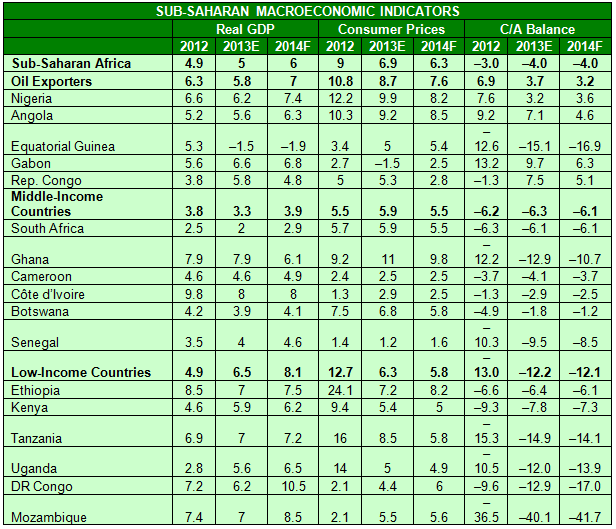
LEADING ECONOMIES MORE SUBDUED
While some of the region's poorest economies are soaring, Sub-Saharan Africa's leading economies are expected to see much more subdued growth.
"South Africa's growth slowed further, in large part due to tense industrial relations, anemic private investment, and weaker consumption growth, the latter affected by slowing disposable income growth and weakening consumer confidence," said the IMF.
Nigeria, the region's second largest economy after South Africa, has also seen its currency weaken against the US dollar and suffer crude oil production outages.
Angola has also been affected by delays in the execution of its budget, while countries in the Sahel region, Central African Republican and Kenya are facing new terrorist threats that could dampen investor confidence and delay projects, hurting the economic momentum.
"Some frontier markets, such as Ghana and Nigeria, could also be vulnerable to such slowdowns of private financial flows," said the IMF.
Meanwhile, rising stars such as Ethiopia (7.5% GDP growth in 2014), Kenya (6.2%), Tanzania (6.2%) and Ghana (6.1%) are widely expected to enjoy a stellar growth in the New Year.
GROWTH IN ASIA, EUROPE MATTERS
Much will also depend on growth in two key export markets for Africa: Asia and Europe. While Asia will show some growth in patches, the Eurozone remains a major worry for many SSA nations.
The IMF does not expect any growth in the 27-nation Eurozone economy this year and a meager 1.2% growth in 2014.
Much to the dismay of Sub-Saharan African nations, demand in the Eurozone will remain "persistently weak" as the public and private sectors continue to deleverage, especially in southern economies of Italy, Spain, Greece and Portugal.
"In the core economies, despite recent improvements in confidence, private demand is also affected by concerns about global growth and continued uncertainty about euro area prospects and policies," the IMF warned.
While there a number of headwinds facing the region, clearly Sub-Saharan Africa offers more growth opportunities than other parts of the world.
However, that does not mean Sub-Saharan Africa can rest on its laurels, for its journey has only begun.
Issues of inadequate electricity access, unemployment and poor education standards means millions of African citizens are not included in the five-plus percentage growth in many of the countries mentioned above.
"In the medium term, all countries in the region will need to step up their efforts to promote sustainable and inclusive growth by investing in physical and human capital, deepening financial sectors, promoting agriculture, improving the business climate, and encouraging economic diversification," the IMF concluded.
© alifarabia.com 2013