PHOTO
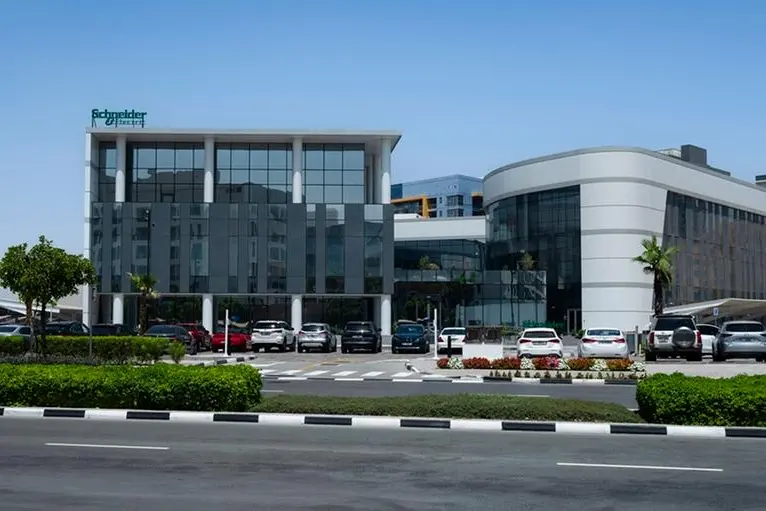
The Nest, Schneider Electric’s new regional headquarters in Dubai's Silicon Oasis area, is a prototype for sustainable, digitally connected workplaces, according to a top company executive.
Walid Sheta, Middle East & Africa President at Schneider Electric told Zawya Projects that the 10,000 square metre (sqm) building, which accommodates over 1,000 employees, serves as both a prototype and living lab for testing, refining, and showcasing smart building technologies in real-world conditions - illustrating how they can enhance sustainability in the built environment.
“The Nest Dubai demonstrates the highest standards of smart building integration across Schneider Electric’s global portfolio,” said Sheta. “It stands out for the way it manages resources, employee safety, security, and well-being with the most advanced digital technologies.”

Built around four core pillars - sustainability, people-centricity, efficiency, and resilience - The Nest reflects Schneider's Electricity 4.0 vision, where electrification and digitalisation converge to create next-generation buildings that are smart, adaptive, and future-proof, according to the Schneider Electric executive.
Sustainability: The Nest aims to reduce emissions by over 700 tCO2e annually by 2026 and targets 47 percent onsite renewable sourcing.
People-centricity: Designed with people in mind, the building aims to provide a healthy atmosphere with exceptional indoor air quality and abundant natural light. The Nest includes 360 workstations, 90 meeting rooms, a dedicated training centre, and a modular amphitheater, all designed to boost collaboration, productivity, and talent development.
Efficiency: The Nest integrates digital monitoring and automation to optimise electricity and water efficiency. It leverages AI for HVAC, maintenance, and operational optimisation, targeting over 50 percent energy and water savings and automated workflows for facility management by 2026.
Resilience: The building is designed to be future proof, featuring a micro grid for power resilience, digital twin for simulation and operational efficiency, and a cyber secure edge data centre, ensuring predictive maintenance and digital asset management.
Launchpad for next-generation buildings
Since opening in May 2025, The Nest has achieved carbon neutrality within three months, earning the WiredScore SmartScore Platinum certification with perfect scores across user functionality, technological foundation, and innovation. It is also under assessment for WELL Equity Rating and LEED ID+C Platinum certifications.
“Our goal isn’t just to meet standards, but to explore the full potential of what a building can offer its occupants,” said Sheta. “That’s why we’re exploring additional aspects of building performance such as wellbeing, which is subjective and difficult to standardise, but central to how we define success. Another area where we’re deeply invested is cybersecurity, a critical aspect of buildings as they become more digital, autonomous, and self-sustaining. So, while we pursue certifications, we’re also focused on expanding the boundaries of what’s possible.”
The inauguration of the Dubai office also marked the launch of the company’s Impact Buildings Programme, which aims to establish a model for next-generation buildings. The programme leverages Schneider Electric’s EcoStruxure suite — including Building Operation, Power Monitoring Expert, Building Data Platform, and Planon Integrated Workplace Management — to improve building efficiency and sustainability across its global real estate portfolio.
The road to net zero
Sheta acknowledged that global sustainability efforts are facing new challenges — notably massive surge in energy demand driven by growth of artificial intelligence (AI) and the difficulty companies face in managing Scope 2 and 3 emissions.
“Economic development and emissions reduction are not mutually exclusive,” he said. “Both can be achieved through long-term strategies that help mitigate external factors.”
Schneider Electric provides both turnkey solutions and consulting services for clients seeking to achieve net-zero goals.
“Our consultants help clients develop comprehensive strategies to reduce scope 1–3 emissions and achieve decarbonisation and net-zero goals through a solution-agnostic approach,” Sheta said. “We also provide electrification and digital transformation consulting services, particularly for clients in hard-to-abate sectors to help them transition away from fossil fuels.”
He advised that a company’s sustainability roadmap should include sustained investment in R&D, incremental operational improvements through consistent adoption of new technologies and processes, and a shift toward renewable energy.
“Above all, what matters is a clear commitment to sustainability,” he concluded.
(Reporting by Dennis Daniel; Editing by Anoop Menon)
(anoop.menon@lseg.com)
Subscribe to our Projects' PULSE newsletter that brings you trustworthy news, updates and insights on project activities, developments, and partnerships across sectors in the Middle East and Africa.