PHOTO
· Ford invests R2.5 billion ($170 million US dollars) in local production of the all-new Ford Everest seven-seat SUV and expansion of the new Ranger pickup
· Expansion will create 1,200 new jobs in South Africa
· All-new Everest extended range to include 2.2 and 3.2 derivatives, production commences at Silverton Assembly Plant in Pretoria in third quarter 2016
· Ford will export all-new Everest into Sub-Saharan Africa countries
Amman, Jordan - Ford Motor Company is investing R2.5-billion ($170 million US dollars) to expand operations in South Africa at its Silverton Assembly Plant in Pretoria, South Africa, to produce the all-new Ford Everest, along with the new Ford Ranger that was launched at the end of last year.
This investment will create approximately 1,200 new jobs at Ford South Africa and within the South African supplier network. "Our customers love the capability and utility offered by the all-new Ford Everest," said Jim Farley, Ford executive vice president and president of Europe, Middle East and Africa. "By producing the Everest in South Africa, we will be able to make it more readily available, and in a greater variety of models, for customers throughout Sub-Saharan Africa.
"The R2.5-billion investment reaffirms the importance of these markets as part of our growth strategy across the Middle East and Africa," Farley added. "It further reinforces South Africa's position as a strategic export base for Ford Motor Company."
The Silverton facility joins AutoAlliance Thailand in Rayong; Ford's Chennai plant in India (where it is sold as the Endeavor) and the JMC Xiaolan Plant in Nanchang, China, as production hubs for the Everest. Initial production at Silverton of the Everest will commence in the third quarter of 2016, with the first units expected to come to market in the fourth quarter. South African-produced models will be sold locally and exported to markets across Sub-Saharan Africa.
Part of this investment has been directed towards the production of the new Ranger, which is already running at maximum capacity at the Silverton Assembly Plant - with domestic sales and export demand at an all-time high.
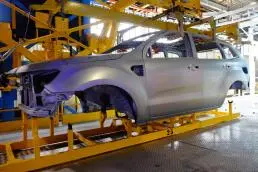
The Silverton Assembly Plant features state-of-the-art automation utilising Ford's global manufacturing processes, and will be equipped to produce 10 000 Everest's per annum. "The all-new Everest has been extremely well received since it was launched in September last year, with demand far outstripping supply," said Jeff Nemeth, president and CEO of Ford Motor Company Sub-Saharan Africa Region.
"This crucial investment will enable us to increase volumes and expand the Everest range to eight derivatives across a broader price range. It will allow customers across Sub-Saharan Africa to choose from two powerful engines mated to robust six-speed automatic or manual transmissions for exceptional capability."
Currently, the all-new Everest is imported from Thailand, using the locally produced 3.2-litre five-cylinder Duratorq TDCi engine. It is only available in South Africa in 3.2 Automatic guise in two specification levels - XLT and the range-topping Limited. With the commencement of local production, a 2.2-litre Duratorq TDCi four-cylinder diesel engine will be added to the range, along with a wider spread of specification levels.
Built at Ford's Struandale Engine Plant in Port Elizabeth, the latest-generation Duratorq TDCi diesel engines - which are also used in the new Ranger - offer maximum fuel economy along with exceptional performance.
The all-new Ford Everest is a rugged seven-seat SUV featuring body-on-frame construction, intelligent four-wheel drive and an Advanced Terrain Management System to help navigate challenging terrain with ease.
In recent years, Africa has emerged as an increasingly important region for Ford, with continued investment and growth.
In 2008, Ford announced plans to build the Ford Ranger at its Silverton Assembly Plant with an investment of R3.4 billion. The investment allowed Ford to transform both of its South African plants into world class facilities to produce the Ford Ranger and Duratorq TDCi engines for local consumption and export.
The Ford Ranger is exported to 148 countries in Africa, Middle East and Europe, while engines and machined components are supplied to Argentina, Thailand, North America, India and China.
In 2014, Ford formed its newest business unit, Middle East and Africa comprising 67 markets to support the region with a dedicated focus and clear understanding of the unique conditions and customer needs.
The African growth story continued in 2015, when Ford confirmed that it would assemble the Ford Ranger in Nigeria, using semi knock-down (SKD) kits and components imported from South Africa.
Ford Motor Company's growth story goes beyond its manufacturing expansion in South Africa. In 2015, Ford sold 78 471 passenger cars and light commercial vehicles in South Africa, the highest number on record. The South African-built Ranger pickup performed particularly well, with an 18.1% year-on-year increase in sales and a total of 33 920 Rangers sold in 2015.
"As we continue to grow our business here in South Africa we are committed to improving the skills of our employees and creating new opportunities within the company and the broader supply chain. It is only through the dedication and commitment of our work force, suppliers, dealers, union and government partners that we have been able to secure this investment and expand our operations, broadening our footprint in Africa even further," Nemeth concluded.
-Ends-
About Ford Motor Company
Ford Motor Company is a global automotive and mobility company based in Dearborn, Mich. With about 199,000 employees and 67 plants worldwide, the company's core business includes designing, manufacturing, marketing, financing and servicing a full line of Ford cars, trucks, SUVs and electrified vehicles, as well as Lincoln luxury vehicles. At the same time, Ford is aggressively pursuing emerging opportunities through Ford Smart Mobility, the company's plan to be a leader in connectivity, mobility, autonomous vehicles, the customer experience and data and analytics. For more information
Ford's history in the Middle East goes back more than 60 years. The company's local importer-dealers operate more than 155 facilities in the region and directly employ more than 7,000 people, the majority of whom are Arab Nationals. For more information on Ford Middle East, please visit www.me.ford.com
Ford Middle East is also a responsible corporate citizen with currently three CSR initiatives running in the region including the Ford Motor Company Conservation & Environmental Grants, Ford Warriors in Pink® breast cancer awareness campaign and Ford Driving Skills for Life safe driving awareness programme for young drivers and teens.
© Press Release 2016