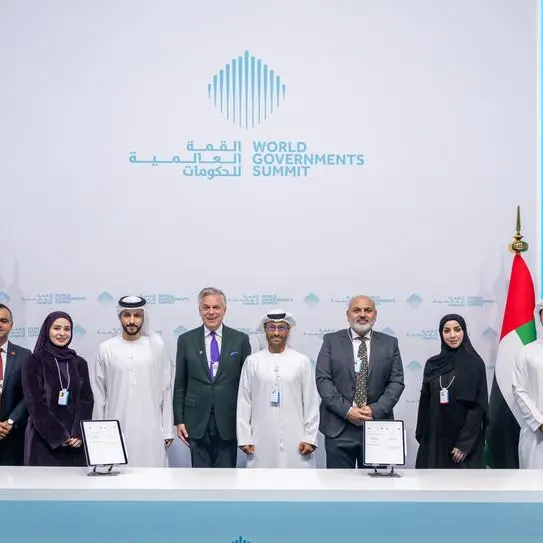
Ashridge shares the latest thinking on employee wellbeing and its link to organisational performance with senior managers and leaders in the Middle East
United Arab Emirates, 14 May 2014: Ashridge Business School staged an exclusive event as part of its ongoing interaction with clients and alumni in the Middle East.
Taking place at The Address Hotel, Dubai Mall, the briefing focused on how the latest insights in neuroscience, the study of the nervous system, can help business leaders to cope better under pressure, while also looking at Employee Wellbeing with the aim of making your workforce more productive. Keynote speakers included Chief Executive, Kai Peters, and Judith Parsons, Business Director.
The keynote presentation from Kai Peters, Ashridge Business School's Chief Executive, discussed how leading organisations in the Middle East are targeting future success by developing their leaders in the latest neuroscience techniques. Insights on the effect of physiological responses to stressful situations on managers are now being used to prime the next generation of business leaders to be able to lead in any circumstance - Peters discussed the latest neuroscience developments and gave lots of working examples as to how companies can use these findings to design effective and successful learning interventions in executive education. He also showcased how Ashridge Business School itself is using these techniques to prepare Middle East managers to think clearly under stress and develop '20/20 foresight' to make the best business decisions via its The Leadership Experience: Leading on the Edge (TLE) programme.
Peters drew upon attributes from new research - The Neuroscience of Leadership Development: Preparing Through Experience - that has revealed that learning in a stimulating environment that mimics the stress of leadership is a powerful way to increase future resourcefulness. The pioneering research, conducted with the University of Reading in the UK, monitored changes in managers' heart rates to analyze their response to stress and performance under pressure via simulated real-life high-pressure Board-level experiences
"More and more organizations around the world are developing their leaders in the latest techniques in neuroscience," said Peters. "This event was all about sharing the latest developments, illustrating how these findings they can be used to teach leaders how to deal with stressful situations and giving participants practical advice on how to effectively incorporate these techniques into their own executive education programme."
Judith Parsons, Business Director at Ashridge Business School, then discussed the rapidly growing body of evidence which links employee wellbeing with organisational performance, quality improvement, innovation and productivity, highlighting some of the key findings from Ashridge's own research programmes in the field. She then discussed the impact that staff wellbeing can have on a company's bottom line, while giving practical examples of best practice and how to develop an effective wellbeing strategy in the work place.
"Employee wellbeing is a "hot topic in organisational life", particularly in the corporate sector. Perhaps that is due to the finding that FTSE 100 companies that report on employee health and wellbeing outperform those that don't by 10%? We wanted to highlight why companies should take the initiative now and integrate wellbeing activities into their ongoing operations - i.e. to avoid future disruptions to business, increase productivity and ultimately have a positive effect on the bottom line," said Parsons.
Parsons went on to highlight how the Middle East has the opportunity to take up this challenge much quicker than the West and be ahead of the curve.
"Middle East companies should act now while employee wellbeing is still a relatively new topic. One area could be around employee health. Corporate health and wellbeing programmes can influence employee health behaviours and result in higher productivity, less absences from work and positive employee health outcomes," she concluded.
As a top international business school, Ashridge provides its clients with unique learning methods, such as experiential learning and group projects. Ashridge is the only international business school that offers executive education hand-in-hand with its own consultancy service and executive coaching division. And some of the Middle East's leading organisations are among the business school's growing portfolio of clients.
-Ends-
For further information and interviews please contact: Joanna Agnew at house of comms on Joanna@houseofcomms.com or 00971528903121
The research - The Neuroscience of Leadership Development: Preparing Through Experience - was conducted by Ashridge business school leadership experts Dr Eve Poole, Ashridge Associate, Megan Reitz, TLE Programme Director, Lee Waller, Director of Ashridge Centre for Research in Executive Development, Angela Muir, Client Director and Programme Director, John Neal, Director of Ashridge's Sport Business Initiative and Professor Patricia Riddell, Head of the Department of Psychology, University of Reading.
The Leadership Experience: Leading on the Edge (TLE) Open programme is an innovative experiential 3.5-day programme based on Ashridge research into the critical events that have shaped leaders' careers.
2014 programme dates:
10th June - 13th June 2014
11th November - 14th November 2014
Find out more:
© Press Release 2014