PHOTO
Dubai, United Arab Emirates: Riding the wave of Dubai’s historic AED 917-919 billion in property transactions in 2025, the Indian Business & Professional Council (IBPC Dubai) convened industry leaders at CRERS Connect, marking a defining moment for the sector with the rebranding of CRERS to Real Estate and Built Environment (RABE), expanding its scope to Architecture, Structure and MEP.
The high-impact forum brought together developers, administrators, material suppliers and policy influencers to decode market momentum, affordability challenges, sustainability, and corridor-driven growth across the UAE.
The event opened with remarks from Sama Srinivas, Convener - RABE (formerly CRERS), IBPC Dubai, followed by a 20-year legacy highlights presentation by Sun and Sand Developers, setting the tone for a practitioner-led conversation on inclusive growth.
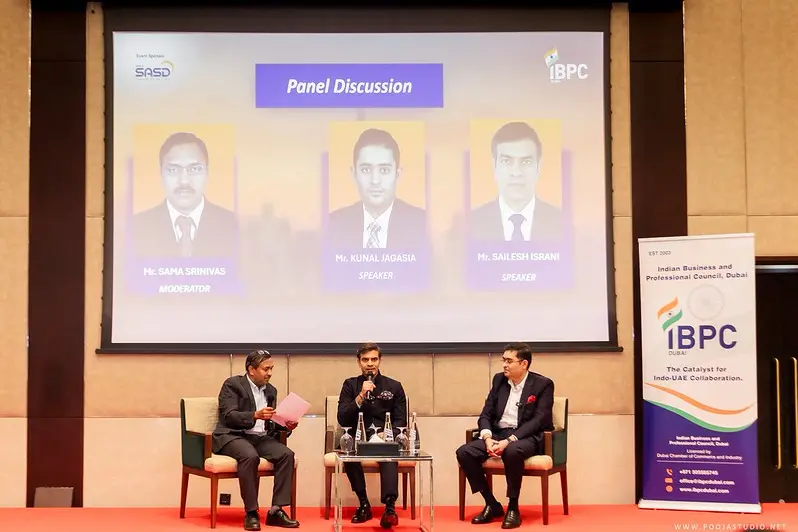
In an in-conversation panel moderated by Sama Srinivas, Sailesh Israni, Managing Director, Sun and Sand Developers, emphasized that affordable housing must be a shared responsibility across stakeholders, not a compromise on quality.
“Affordable does not mean inferior,” Israni noted, sharing that he lives in one of his own developments and focuses on housing solutions for residents earning AED 6,000-15,000 per month. He outlined a practical affordability benchmark widely resonating with attendees:
annual salary × five as a sustainable homeownership algorithm.
He also highlighted the importance of end-user centric development, stressing access to schools, infrastructure, transport and employment hubs before land acquisition, particularly mid-income communities that form the backbone of Dubai’s economy.
Offering the owners’ perspective, Kunal Jagasia, Managing Director, Symbiosis Owners Management Association Services (SYOAM), addressed one of the market’s most debated topics, maintenance charges.
With oversight across 270,000 apartments, Jagasia clarified expectations around community management.
“We are administrators, not service providers,” he explained. “From security and lifeguards to facilities contracts, we tender, procure and manage services on behalf of owners, ensuring compliance, safety and cost transparency.”
His insights helped contextualize why service charges remain a sensitive but unavoidable component of large-scale residential living in a rapidly expanding city.
Discussions also explored how technology must enhance, not replace the human experience in real estate, particularly as digital systems scale across operations, security, and community engagement.
Sustainability took centre stage with Gyan Prakash, Sales Manager, Emirates Steel Industries, delivering an overview of sustainable steel solutions, reinforcing the material’s role in reducing lifecycle emissions while supporting high-density urban growth.
Closing the session, Sahil Arora, Chief of Corporate Affairs & Business Development, BNW Developments, presented a forward-looking overview of Ras Al Khaimah’s real estate trajectory, highlighting its evolution as a staycation and lifestyle investment hub.
With global brands such as Aston Martin, Lamborghini, and Hampton by Hilton anchoring developments on Marjan Island, RAK is emerging as a complementary growth corridor to Dubai, attracting both investors and end-users.
The discussions unfolded against the backdrop of Dubai’s record-breaking 2025 performance, driven by sustained demand across residential and commercial assets. Participants noted that the next phase of growth will be defined not just by scale, but by affordability, operational efficiency, sustainability and livability.
Commenting on the forum, Sama Srinivas said, “The transition from CRERS to RABE reflects how the industry itself is evolving. As the market grows at unprecedented speed, conversations must expand beyond transactions to include build quality, ownership realities, sustainability and inclusive housing. That’s where real value is created.”