PHOTO
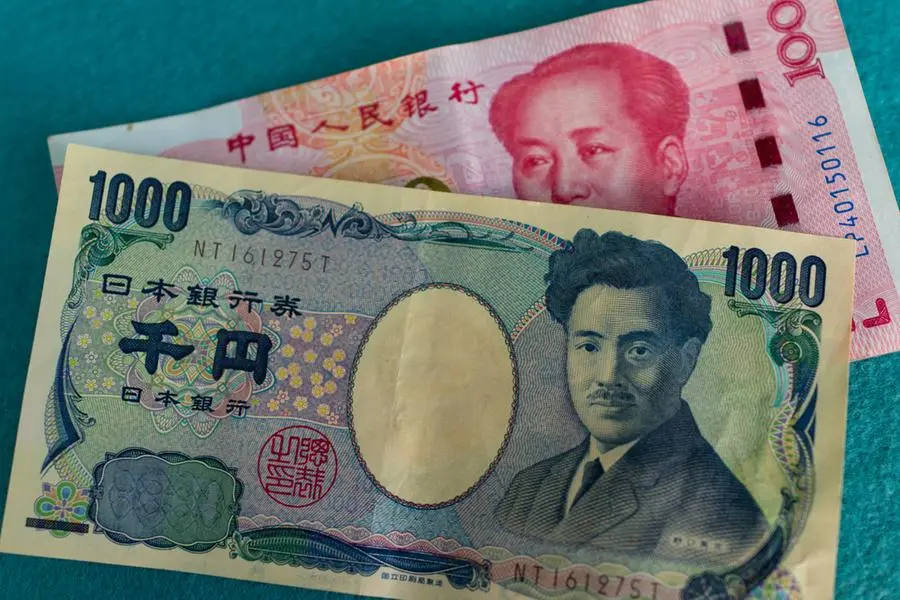
LONDON - The yen fell to its weakest level in a year-and-a-half against the dollar on Wednesday on speculation of a snap election that could pave the way for fiscal stimulus, prompting traders to consider the possibility that Japanese officials may step in to prop up the currency.
The yen slipped as much as 0.2% to 159.45 yen per dollar , its weakest since July 2024. Compounding the pressure on the yen was an auction of five-year Japanese government bonds that attracted slack demand.
The yen has been sinking against everything from the euro to the Mexican peso for months as traders have grown increasingly worried about Japanese Prime Minister Sanae Takaichi's plans to spend big, a risk that would increase should she call an election next month and secure a healthy majority.
With the Japanese currency nearing 160 to the dollar, traders are on alert for possible intervention by authorities in Tokyo to defend it. CIBC Capital Markets head of G10 FX strategy Jeremy Stretch said the issue was less about the outright level at which the yen trades and more to do with how quickly it moved.
'FIXATION' ON DOLLAR VERSUS YEN
"Obviously, the fixation is on dollar-yen, but I think we need to keep a close eye on some of those other yen crosses because they've also been surging - euro-yen is at record levels, for example," Stretch said.
"It's dollar-yen that's very much in the crosshairs and the one that we continue to focus on. But it's not just the only element of this story. For now at least, it still seems to be the case of watching and waiting to see how far it goes before the authorities are perceived, or feared, to step in," he said.
In the last two months alone, the yen has lost around 3% against the dollar. In the run-up to previous interventions, in April and July 2024, for example, it had lost nearly 6% in that same timeframe.
Japanese Finance Minister Satsuki Katayama on Wednesday issued another verbal warning, saying officials would take "appropriate action against excessive FX moves without excluding any options".
This was enough to knock the dollar back to a session low of around 158.87 yen. It was last down 0.1% at 159.06.
STEADY DOLLAR AFTER INFLATION DATA
The dollar held steady near a one-month high against a basket of major currencies after U.S. consumer inflation data that was broadly in line with estimates, firming up expectations that the Federal Reserve would remain on hold later this month despite unprecedented pressure from the White House to lower interest rates.
The U.S. currency fell sharply on Monday, after President Donald Trump's threat of a criminal indictment against Fed Chair Jerome Powell. Global central bank chiefs and top Wall Street bank CEOs lined up in support of Powell on Tuesday.
"There's a very loud chorus of opinion coming from politicians, former Fed chairmen and other officials that Fed independence is sacrosanct and cannot be interfered with," said Brian Martin, head of G3 Economics at ANZ in London.
"It risks having adverse consequences of higher inflation, higher funding costs for the government and more volatility in economic activity," he said on a podcast.
SUPREME COURT RULING ON TARIFFS DUE
Also in the spotlight on Wednesday was a possible Supreme Court ruling on the legality of Trump's emergency tariffs.
"It could rule them legit, and if so we just move on. We suspect they will be struck down, and we'll probably still just move on," analysts from ING wrote in a research report.
"This Treasury market is showing a remarkable capacity to just not care too much about stuff."
Against the Chinese yuan trading offshore in Hong Kong , the U.S. dollar was flat at 6.9752 yuan after the release of trade data for December that showed Asia's biggest economy ending the year with a record surplus of nearly $1.2 trillion. The euro was last flat at $1.1647, while the pound was last up 0.2% at $1.3448.