PHOTO
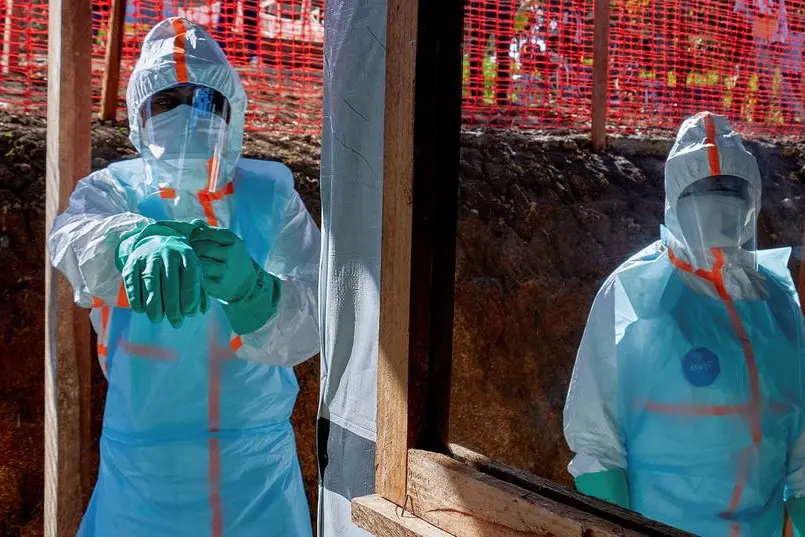
Displacement caused by conflict is complicating efforts to contain the latest Ebola outbreak in the Democratic Republic of Congo, where millions have been forced from their homes and health workers struggle to trace contacts of infected patients.
The DRC is home to around seven million internally displaced people, the second highest figure in the world after Sudan, according to the United Nations.
Many have fled violence multiple times, moving between villages, towns and makeshift camps in search of safety.
While displacement is a tragedy, health officials say it is also complicating efforts to track and contain the spread of the deadly disease.
The outbreak comes at a time the DRC once again has been ranked among the world’s most neglected humanitarian crises. According to the annual report of the Norwegian Refugee Council (NRC) this week, the country has featured in this hopeless ranking for 10 consecutive years.“This reflects the inability of the world to respond to crises that are not considered strategically important by wealthy countries,” NRC Secretary-General Jan Egeland said.
The consequences of the neglect are stark. In 2025, only 27.4 percent of the funding needed to respond to the crisis in the DRC was provided, the lowest level in a decade.
DRC Minister of Health Samuel Roger Kamba says contact tracing has improved since the beginning of the country’s 17th Ebola outbreak early last month.
Two and a half weeks ago, health teams were monitoring only nine percent of individuals who had been in contact with patients. That has risen to 55 per cent, Dr Kamba said on Thursday.
Despite the progress, nearly half of suspected contacts remain unaccounted for.
The problem is closely linked to displacement. People fleeing violence often move repeatedly, making it difficult for health teams to locate and monitor those who may have been exposed to the virus.
Others live in crowded sites where disease can spread easily and where tracing contacts becomes a logistical challenge. Some simply have no way of getting contacted – they have no phones, no residences to visit and no close relatives to help trace.
Tracking these individuals has become a race against time.“People have been asked to return to their homes rather than remain in crowded places, which could expose them to infection,” Dr Kamba said.
Health authorities fear that more population movements could accelerate transmission, particularly in conflict affected areas where access is already limited.
The challenge is especially acute in eastern DRC, where insecurity continues to hamper public health operations.
According to the Congolese Ministry of Health, officials are attempting to monitor around 500 Ebola contacts in territories outside government control in the east of the country.
Authorities acknowledge that follow-up remains difficult. Government spokesperson Patrick Muyaya said authorities in Ituri Province have adopted a community-based approach to maintain access to vulnerable populations.
However, Kinshasa maintains that access challenges in areas controlled by the M23 group cannot be fully addressed unless the rebels withdraw.
The group has controlled neighbouring North and South Kivu Provinces since March last year, including shutting down access via air.
Mr Muyaya and Dr Kamba say the withdrawal of Rwandan soldiers from territories occupied by M23 would facilitate a more effective response.
The difficulties faced by health workers illustrate the link between war and disease. Humanitarian organisations have long warned that displacement weakens health systems, disrupts surveillance and increases the risk of outbreaks spreading undetected.
The NRC notes that millions of Congolese continue to live in conditions marked by insecurity, hunger and limited access to healthcare.
According to the United Nations, around 25 million people in the DRC are affected by chronic food insecurity. “Behind every statistic in eastern DRC are families enduring years of violence, forced displacement and profound uncertainty about their future,” said Eric Batonon, NRC Country Director in the DRC.
It means that the resurgence of Ebola has done more than trigger a public health emergency. It has also shone the spotlight on a humanitarian crisis that has too often been overlooked by the international community.
The outbreak has renewed global attention on eastern Congo, but it has also highlighted a difficult reality that as long as conflict continues to force people from their homes, containing Ebola will remain far more complicated.
In the DRC, the fight against the virus is inseparable from the challenge of protecting and stabilising the communities uprooted by war.
© Copyright 2026 Nation Media Group. All Rights Reserved. Provided by SyndiGate Media Inc. (Syndigate.info).