PHOTO
SYDNEY - Asian shares eased from record highs on Friday as hefty price hikes from Apple showed the downside of the boom in chip demand, while only the threat of Japanese intervention kept the yen from hitting 40-year lows.
Brent crude futures slipped 0.5% to $74.89 a barrel, having bounced 2% from four-month lows overnight on reports that a ship was attacked when exiting the Strait of Hormuz. Tehran has warned vessels against taking routes that it had not approved, though more stranded oil tankers have crossed the key waterway with the help of military escorts, easing supply concerns.
Nasdaq futures declined 0.6% in Asia. The Nasdaq swung lower overnight after Apple slid 6.1% after announcing price hikes for iPads and MacBooks to counter surging memory and storage chip costs, wiping about $250 billion off its market value. Microsoft is raising prices for its Xbox gaming consoles by up to $150 worldwide.
That tempered investor enthusiasm about a blowout earnings report from chipmaker Micron this week, whose shares surged almost 16% overnight to a record high.
"Micron tells us where the profits are. Apple tells us where the inflation is," said Nigel Green, CEO at deVere Group, a financial advisory firm.
"The race to build AI infrastructure has become so intense that demand for advanced memory is outstripping supply," he said. "Apple's decision to raise prices is an early warning that inflation is finding a new route into the economy."
Analysts also say that month-end and quarter-end rebalancing flows might have contributed to the weakness and choppy prices in big tech companies, which have outperformed for much of the second quarter.
On Friday, MSCI's broadest index of Asia-Pacific shares outside Japan fell 1.7%, bringing its weekly loss to 3.4%, having hit a record high just on Monday. It was down 1.6% for the month but up a whopping 24% for the quarter.
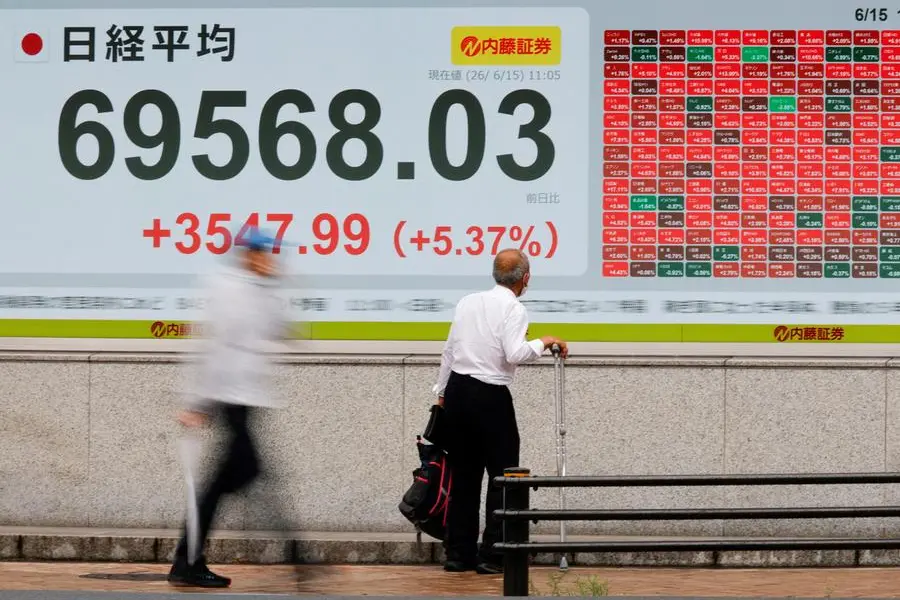
Japan's Nikkei slumped 3% and was headed for a weekly drop of 1.3%. It has climbed 6% for the month and has surged 38% for the quarter.
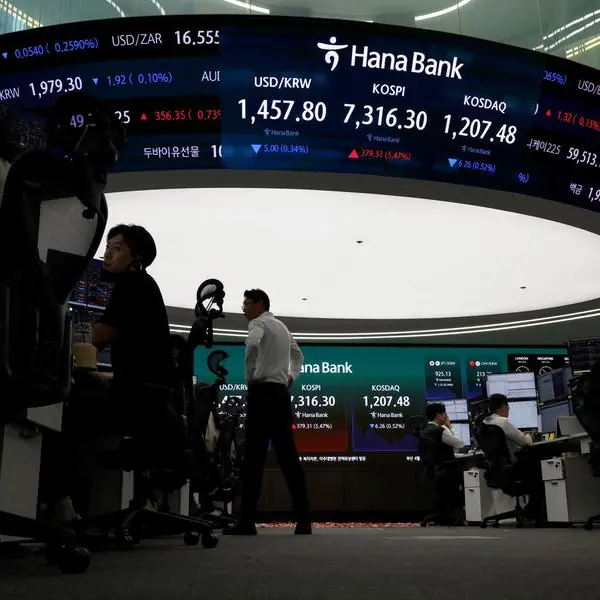
South Korea's KOSPI dropped 3.5% and was down 5% for the week. It has surged a monstrous 70% in the second quarter.
Chinese blue-chips fell 1% and Hong Kong's Hang Seng index lost 1.3%.
YEN WEAK
In the currency markets, the yen teetered near its weakest level against the dollar in 40 years at 161.82, well beyond the 160 level that many see as a line in the sand for Japanese authorities.
It found little relief even as a U.S. inflation reading met forecasts and traders trimmed bets for a rate hike from the Federal Reserve in September.
Separate data also showed the U.S. economy grew faster than previously estimated in the first quarter thanks to a downward revision to imports, but consumer spending almost stalled, casting doubt on growth momentum in the second quarter.
The dollar index, which measures the greenback's strength against a basket of six major peers, held at 101.46, not far from its strongest level since May 2025. It has risen 2.6% this month.
Treasury yields were steady on Friday after slipping a little overnight. 2-year yields held at 4.1250%, having eased 2 basis points on Thursday, while ten-year yields were little changed at 4.4020%, having hit a nearly two-month low of 4.3627% in the previous session.
Precious metals have had a rough month, with spot gold down 11% to $4,020 an ounce and spot silver sliding 24% to $57.3 an ounce.
(Reporting by Stella Qiu; Editing by Kevin Buckland)