A new report on global oil investments puts a cork in the debate about North American shale production putting OPEC out of business.
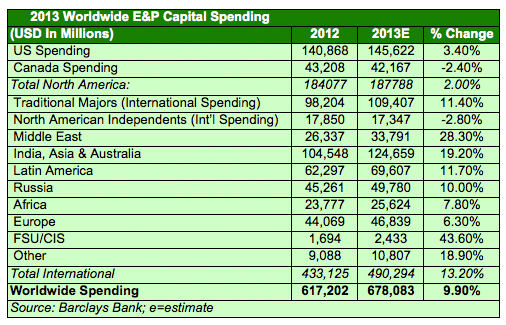
Barclays Capital's benchmark report shows the Middle East region will see the highest increase in energy capital expenditure spending in the world this year.
Companies will spend a record USD 33.79 billion in the region this year in exploration and production (E&P) spend, 28% higher than last year's figure of USD 26.34 billion, according to Barclays estimates.
Meanwhile, the much-touted US oil renaissance will register a mere 3.4% production, while Canadian oil sands and shale will see a 2.4% contraction.
Iraq will likely remain the largest E&P market over the next decade, with annual investments rising from current levels of USD 4 billion to USD 6-8 billion over the next few years.
"We think the Chinese oil companies will continue to play an increasingly vital role to boosting production in Iraq, underscored by China recently becoming the largest consumer of Iraqi oil (Chinese oils are currently investing in excess of USD 2 billion annually in Iraq)," Barclays bank said.
"Kurdistan in northern Iraq is quickly developing into one of the most attractive international exploration opportunities and continues to attract a slew of NOCs (national oil companies) and leading IOCs (international oil companies), despite disapproval from Baghdad."
However, Saudi Aramco will not be a laggard either. The world's largest producer of oil is looking at increasing its investment in unconventional reserves, notably in the shallow-waters in the Red Sea apart from the northeast region.
"The NOC continues to push forward with new technologies and is in the process of setting up four advanced research centers around the world (including in Houston, Detroit, Cambridge, and in China); however, we do not include the costs associated with establishing these facilities in our forecast," said Barclays.
Aramco is spearheading Saudi Arabia's drive to boost domestic gas production for industrial and residential use (at the expense of oil-directed base-load electricity generation) as a way to increase oil exports and revenue.
SUPER MAJOR
While Saudi Aramco is expected to spend around USD 15 billion in exploration and production spending this year, it will be outspent by a number of other international and state-owned companies.
In fact for the first time, Exxon Mobil Corp. will lose its position as the biggest global E&P spender this year, as PetroChina underscores China's dominance in global energy markets.
The Chinese state-owned giant will spend around USD 37-USD 38 billion this year, compared to Exxon Mobil's USD 36 billion.
Of the 20 largest E&P spenders this year, half are state-owned, with at least three from China alone.
AFRICAN CONCERNS
Global companies are wary if investing in Africa, citing security concerns. Terrorism risk has been a recurring topic among investing circles in the continent.
Still, the vast continent offers pockets of opportunities.
"While growth expectations remain largely consistent among African NOCs, some smaller regional independents are ramping investment plans following recent exploration successes (particularly onshore East Africa)," Barclays said.
Nigeria National Petroleum Corp. is also widely expected to raise its budget by 3.4% this year, which will offset insurgency in the country and the chronic problem of oil theft.
The Barclays report is in line with developments in the region's oil and gas sector.
"Riyadh unveiled new plans in early March to expand capacity at several oil fields, bringing total gross additions to 1.45 mb/d over the forecast period," said the International Energy Agency in a recent report.
"Saudi crude production, however, is forecast to rise by around a net 380 kb/d to 12.35 mb/d by 2018, with new capacity largely offsetting mature production as Saudi Aramco plans to rest some old workhorse fields until new technology improves extraction and recovery rates."
New expansion plans include a 300,000 bpd upgrade to the 1.2 million bpd Khurais field, which produces Arab Light crude, starting in 2016. The 1.2 million bpd Khurais field was brought online in 2009 and to date remains the largest single incremental capacity increase in history. The company also dusted off plans to raise Arab Extra Light crude output at the Shaybah field by 250,000 bpd, from the current 750,000 bpd, in 2016, the IEA said.
Meanwhile, Iraq will need to spend USD 125 billion by the end of this decade to reach its target of 9 million bpd. Although the IEA believes it will be a "herculean task", the country's oil and gas sector will continue to attract a portion of that investment despite political and infrastructure issues.
Meanwhile, the UAE, Kuwait, Algeria and Qatar are all ramping up oil and gas production to warrant significant investments.
GLOBAL OUTLOOK
Barclay's global outlook for oil is bullish as it expected a record USD 678 billion to be spent on E&P this year, compared to USD 617 billion last year.
"We previously expected Latin America would lead worldwide spending growth this year; however, budgetary issues in Mexico are now weighing on regional expectations, while growing Middle Eastern ambitions have led to a new regional spending order,' said the bank.
Meanwhile, 2014 is expected to be even more bullish as only 6% of the companies surveyed expected to decrease spend in 2014.
While investment is rising, profit levels are not as healthy as they used to be.
"From 1985 to 1999, global oil production increased by roughly 25%, supported by an expansion in E&P spending of 40% over the same time period. Since 1999, global oil production has achieved another 25% increase; however, the global E&P spend required to generate the production increase in the most recent period has reached astounding levels, with upstream CAPEX growing by over 640%," Barclays noted.
Following the downturn in 2009, worldwide spending has surged more than 65% while oil production has modestly grown by 10%. More interesting in the recent years is the fact that these spending increases have taken place against the backdrop of relatively weak oil demand and sluggish economic growth, which suggests that when energy demand does rebound, the spending increases could accelerate even faster, the bank said.
© alifarabia.com 2013