The last time the IMF analyzed Iran's economy in 2011, it was heavily criticized for praising Tehran's structural reforms.
The IMF was particularly impressed by the government led at the time by Mahmoud Ahmadinejad for "the successful early implementation of the subsidy reform is a critical step in promoting the transition towards a market-based economy."
What a difference a few years make.
The IMF's latest analysis of the country warns that Iran is at a "crossroads", and must draft a quick plan to arrest inflation.
Of course, crippling Western sanctions have radically altered Iran's economic prospects, but the IMF also believes Tehran has failed to implement reforms.
"Large shocks and weak macroeconomic management over the past several years have had a significant impact on macroeconomic stability and growth," said the IMF in its Article IV Consultation with the Islamic Republic on February 12.
The fund noted that a combination of shocks, associated with the implementation of the first phase of the subsidy reform, ambitious social-programs inadequately funded and a marked deterioration in the external environment stemming from the intensification of trade and financial sanctions, have weakened the economy.
"Inflation and unemployment are high, while the corporate and banking sectors show signs of weakness. These shocks have exposed structural weaknesses in the economy and in the policy framework," the IMF said.
A BIT OF REPRIEVE
Recent thaw in relations with the United States has eased economic hardship to a degree and the prospect of a full deal with global powers within the next six months has raised hopes that the economy may recover.
An interim agreement signed on November 24 between Iran and the P5 +1, known as the Joint Plan of Action, was implemented in January. Among the key outcomes was a decision by Iran to suspend its most sensitive nuclear activity in exchange for a limited easing of some international sanctions.
"While the very limited easing of international sanctions included in the interim agreement are not sufficient to facilitate significant new investment into Iran's oil sector, Iran has been actively courting foreign companies on the apparent hope that the Joint Plan of Action will eventually lead to a more comprehensive and permanent agreement," according to the International Energy Agency.
A French delegation of more than 100 executives visited Iran in early February -- the largest foreign delegation to do so since the 1979 Islamic revolution. The country also announced it was revising its unattractive buyback contracts in a bid to attract foreign investors to its oil and gas sector.
"While the new contract structure has not been finalized, the government has qualified that there will be no concession or production‐sharing agreement on offer since they violate the country's laws on foreign ownership," the IEA said.
Meanwhile, state‐owned National Iranian Oil Company (NIOC) plans to unveil the draft of the new development, exploration and production terms to potential investors in Tehran later in February, which will be followed by seminars, with the finalized contract terms due to be unveiled in London in June or July.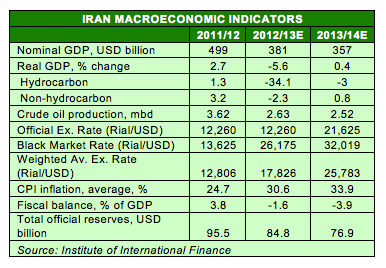
GROWTH STALLED
A revival of the oil industry is crucial as it is the country's economic lifeline. A dramatic collapse in oil exports due to the sanctions led to a massive contraction in GDP over the past few years.
"Prospects for 2014/15 have improved with the interim P5+1 agreement, but still remain highly uncertain," the IMF said. "Under the current external environment, staff projects economic activity to begin to stabilize in 2014/15, with real GDP growing by 1-2% in 2014/15. Inflation would potentially decline to 15-20%, excluding the impact of planned higher domestic energy prices."
A combination of a harsh external environment and poor policy choices could lead to stagflation in Iran -- an economic condition where inflation and unemployment are high, but economic growth is declining.
While easing of sanctions will help, the IMF recommends the government should also embark on a three-pronged strategy to tighten monetary policy, balance fiscal consolidation and raise supply-side reforms to help arrest stagflation fears.
"Throughout the document, the IMF alluded to Iran's floundering corporate sector; it has neither reformed nor received needed government support," said Cliff Kupchan, director, Middle East at Eurasia Group. "The fund criticized insufficient bank regulation, and excessive off-budget spending. Finally, the fund noted insufficient enforcement of the rule of law and property rights. "
IMF does not deeply either on Iran's unemployment, which some figures analysts believe are as high as 15%, or foreign reserves, which are estimated to be quite low by historical standards.
The IMF also did not analyze a scenario if Iran fails to come to a final deal with global powers.
"That scenario is very possible," said Kupchan.
"The IMF document and other available data indicate that despite an improved prognosis, the economy will continue to motivate Iran to seek a final deal."
The feature was produced by alifarabia.com exclusively for zawya.com.
© Zawya 2014