Rising populations and great urbanization in Central Asia and the wider Eurasian region is creating fresh opportunities in the housing and infrastructure sector.
Major Central Asian cities face absolute housing shortages as their populations soar, but market rigidities means there is a need to develop a new plan for old cities, notes the latest report from International Bank for Reconstruction and Development and the World Bank.
"In Tajikistan, population rose 16.5% over 1998-2005, while the housing stock grew only 9%. Rapid migration to Dushanbe led to a housing deficit there of more than 100,000 units," according to the report Eurasian Cities: New Realities along the Silk Road, published March 11.
"In the Kyrgyz Republic, the population grew from 4.4 million in 1990 to 5.3 million in 2008, with Bishkek, which absorbed 200,000 migrants from rural areas in recent years, suffering from acute housing shortages."
The cities along the fabled Silk Road that linked Europe to the Middle East and Far East have gone through its share of transformations over the centuries. They have also shown a tremendous resilience in surviving the Mongol hordes, Islamic conquests and Soviet control through the ages.
But the new economic realities in Central Asia, means reviewing the way the key cities need to be managed.
"The break-up of the Soviet Union, along with the emergence of regional powers such as the European Union, China and India, and the return of the market as society's driving force, have given rise to the need to rethink cities along the Eurasian Silk Road," said the IBRD.
Indeed, China has emerged as a key investor in Central Asia as it seeks to access the region's natural resources and find new ways to connect to European markets.
China is investing heavily in Central Asia's road and rail transportation and is helping improve landlocked and mountainous Central Asian economies' access to global markets.
More than 1,000 Chinese companies operate in Central Asia and trade with the region had risen from USD 1 billion in 2000 to USD 30 billion by 2010.
In addition, The Central Asia Regional Economic Cooperation (CAREC) program, sponsored by the United States and other institutions such as the World Bank and Asian Development Bank, aims to connect Central Asia to its neighbors on all sides. Close to USD 20 billion has already poured into the projects.
ALSO READ:
China's burgeoning economic clout moves to Central Asia
Full steam ahead on Central Asia's rail project
Home ownership 'curse'
Most Central Asian states have some of the world's highest homeownership rates, as new post-Soviet governments embarked on a massive plan to sell housing units at a lower price or gift them away in the hopes of establishing a market economy.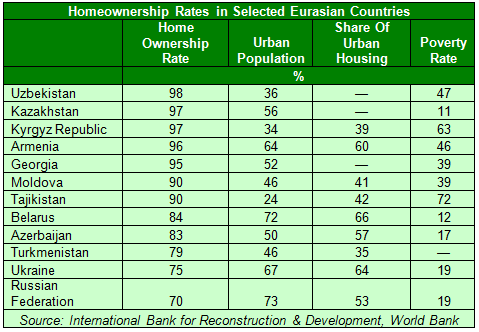
However, the programs have resulted in market rigidities.
"When the housing stock was privatized at the start of the transition, most units went to already established households, despite widespread housing shortages -- leaving young people out of the equation," the report notes.
"They did not have access to housing, and there was no dynamic rental market (a standard feature of cities with market economies). High ownership rates, combined with the continuing inflexibility of the housing construction industry, discouraged a burgeoning rental market."
Another key disadvantage was the concept of mass-scale Soviet-style block apartments which were poorly constructed and failed to legislate on the "common areas" which led to steady deterioration of the apartment buildings in terms of quality and value.
"During the transition years, Soviet neighborhoods have been transforming, responding more closely to residents' needs and desires. But these adjustments have had to be on already existing urban infrastructure, which is hard to alter. Buildings were already in place, with new amenities having to find a way to fit in."
Add issues of poor sanitation and basic utilities to the mix, and you have a recipe for a very complex housing sector.
But change is afoot. In places like Kazakhstan, more than 10,000 homeownerships have cropped up, which have resolved some of the challenges of repairs, basic maintenance and upkeep of the buildings.
Post-Soviet states also have some of the best property registration laws, according to the World Bank's Doing Business report.
Georgia is ranked first among 185 nations in time and cost involved in registering property, according to the World Bank's Doing Business Report 2013.
Armenia is not far behind, ranked fourth globally, while Azerbaijan (9th) and Kyrgyz Republic (11th) also have some of the strongest property registration legislations in the world.
Five ways to transform Central Asia
The World Bank outlines five key areas that could help Central Asian cities prepare for the changing demographic, population and economic transformation taking place in virtually all the states.
Rethinking: Most former Soviet cities were built around manufacturing and industrial bases. As those industries wane and turn into giant eyesores often in the heart of the cities, governments and municipalities need to find creative ways to transform brownfield sites into other, more useful areas such as parks, shopping malls and mixed-use development that cater to the rising urban centers.
Planning: Georgia is leading the region in urban planning and finding easy solutions to help facilitate economic growth.
"Collaboration between local and central governments to modernize land use regulations, solve property issues, and implement strategic public infrastructure can help avoid those problems," the report notes. "Georgia managed to do it with its urban land use planning application system, as an example."
Connecting: Linking Central Asian cities to other parts of the country and the wider region is an ongoing progress, despite major landscape challenges due to rough, mountainous terrains.
"Better interstate cooperation by managing borders better and by introducing less restrictive international aviation policies, encouraging competition in air transport markets and promoting information and communications technology can mean big economic gains," the report notes.
Green development: Sustainable development is a crucial element in the design of new urban centers. This is especially important in Central Asia's harsh, cold climate where some countries suffer from acute power shortages.
Financing: It will be tough to manage these changes without the right amount of financing. The IBRD and World Bank recommend financing urban development by increasing municipal taxes, higher housing taxes and utilities.
"The region is moving towards subnational financing, with transparent systems for revenue sharing and equalization transfers, though some countries are moving at a faster rate than others," the report noted.
"Spending more on urban services can be financed by increasing local taxes, and housing maintenance fees and charges for water, heating, and public transport, helping finance other measures for cities."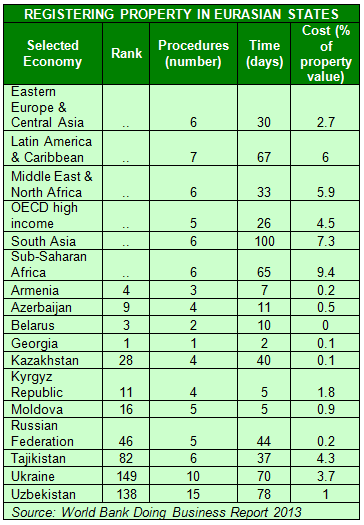
© alifarabia.com 2013