Ground zero of the Arab Spring movement appears to have made very little progress after ousting its ruler Zine El-Abidine Ben Ali in early 2011.
Moderate Islamic party Ennahda had come into power in the country's first free and fair elections in October 2012, but the party has been beset by problems in the largely secular country.
Sporadic fights between Islamic and secular forces has paralyzed decision-making, while the assassination of Chokri Belaid in February and Mohamed Brahmi in July - two oppositions leaders - has wrecked any chance the government will complete its full term.
The presidential and parliamentary elections initially expected in 2013 have been postponed, said Fitch Ratings which downgraded the country's long-term sovereign rating.
In a sign of continuing turmoil, the Tunisian president extended the state of emergency after rival parties failed to agree on a new prime minister, as the deadlock festers and political malaise sets in.
"Elections are unlikely to take place any sooner than H214. Downside risks such as further delays in the political process or escalation in protests and violence are material. In addition, elections are no guarantee of future stability amid risk of social and political fragmentation."
The International Monetary Fund expects the Tunisian GDP to grow 3% this year and 3.7% next year, as the economy continues to move along despite strong political disturbances. The government expects GDP to grow 4% next year.
Growth reached 3% in the first half of the year, driven by chemical and mining activities, while unemployment has fallen to 15.9% compared to 16.7% at the end of 2012.
Inflation has also remained high at just over 6%, but analysts expect it to ease to under 5.5% as food-related inflation subsides.
RISKS TO GROWTH
"A deterioration of the security situation, an escalation of domestic social tensions and a continuation of the political stalemate would increase policy uncertainty, impede foreign investments and tourism receipts, and further undermine the economic recovery," said the IMF in a recent report on the country. "Delaying crucial structural reforms may also lead to a significant shortfall in the associated official external financing expected in 2013."
The country's account deficit is expected to reach 8% of GDP by the end of the year and financed by external sources.
The country also signed a USD 1.7 billion standby loan agreement with the IMF in June, but is under pressure to implement reforms.
In September, Tunisia's government had unveiled austerity measures, cutting expenditures and freezing public sector salaries, but it is unclear whether it will be able to carry out its plans, especially as these policies are unpopular.
The IMF's two-year standby loan comes with certain recommendations, including mobilization of resources for recapitalizing public banks, repaying arrears, completing the audit of public banks and formulating their new strategic orientation, adopting the investment code, and moving ahead with energy subsidy reform.
In response, the government said it would reduce subsidies on energy-dependent companies by 50% and impose a 10% tax on exporting companies. But such policies remain in limbo as the political parties have failed to sew up an agreement.
"Tensions will run high over the issue of subsidies; although periodic increases in fuel prices will be attempted by the government to mitigate the cost of its oil subsidy bill, we expect it to continue to subsidize basic food products," said the Economist Intelligence Unit.
"Donors will probably accept this compromise given the need to keep public resentment to a minimum - especially in 2014, as political stability will remain fragile, and probably also beyond, since even after elections we do not expect a rapid improvement in the economic situation."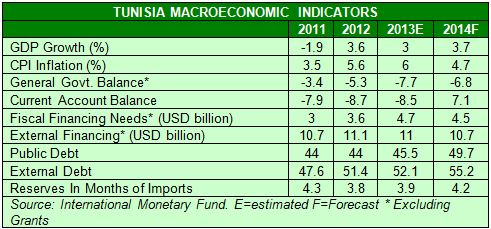
MEDIUM-TERM CHALLENGES
Tunisia will need to work hard to reduce high unemployment and address the issues that brought Tunisians on to the streets three years ago.
The IMF notes that the country must leverage a stronger banking sector and a deeper domestic financial market that will be crucial to bring in foreign direct investment and stimulate private sector activity.
Additionally, reforms should focus on:
1. A more transparent and competitive environment for doing business. For all its problems, Tunisia remains the sixth best place in the MENA region to do business in, and is the 51st business-friendly destination for SMEs - much higher than its North Africa counterparts Morocco (87th), Egypt (128th) and Algeria (153rd).
2. Progress towards better-targeted social safety nets. While the IMF is proposing elimination or reduction of subsidies, the government still needs to keep a check on inflation and building policy measures that include the most vulnerable.
3. Fiscal reforms, improving transparency and strengthening revenue collection.
4. Finding labor market efficiencies.
5. Improving the governance of public enterprises and looking to sell some public entities that are better off in the hands of private companies.
While political uncertainty could derail any progress on the economic front, there are opportunities for Tunisia in the rebuilding of neighboring Libya.
The EIU also expects Tunisia's capital spending to also edge higher increase after the elections, if the fiscal indicators hold up.
"Provided that stability improves, domestic private investment will expand more rapidly from late 2014," the EIU said. "Meanwhile, as the vital European market slowly recovers, external demand will rise and so export growth should pick up. Given these trends, we expect real GDP growth to be stronger in the second half of the forecast period, at 4.7% in 2016 and an average of a little above 5% in 2017-18."
alifarabia.com 2013