Unemployment, corruption and regional inequality: the key issues that plagued Tunisia during President Zine el Abidine Ben Ali's reign, continue to persist. And now the country also has to contend with radical religion elements disrupting the already-inflamed situation.
Tunisia is, of course, ground zero of the Arab revolution that set off a series of political upheavals across the Middle East, leading to the demise of at least four regimes and shook a fair few to their very core.
Since those euphoric days when Tunisians felt they could transform their destiny, the cold-hard facts of economics and politics have brought them back to earth.
The country's newly-elected leaders have failed to move the needle on any of those three key fronts, and that has already led to a new wave of protests and demonstrations in the country.
On May 24, close to a 100 Tunisians with university degrees descended at a government building in Tunis shouting 'work, freedom and dignity'.
"This government has taken no steps to deal with the problem of providing employment," an official with the Union of Unemployed Graduates (UDC), Belgacem Ben Abdallah, told the media, accusing the authorities of "corruption and nepotism". Sounds familiar?
Meanwhile, hundreds of people spilled on the streets to protest against the judiciary, which they believe remains 'servants of Ben Ali'.
As Tunisians become increasingly frustrated with the authorities, they are resorting to the only tool left at their disposal - demonstrations and protests.
"On a daily basis we have demonstrations in front of our Assembly," says
Meherzia Laabidi, Vice-President of the Tunisian National Constituent Assembly. "Sometimes, we are inclined to judge them and say that all the demonstrations are too much. But I think it's better to have too many demonstrators, and too many causes and issues, than a passive civil society."
While that makes for a vibrant and open discourse, has not translated into positive change for the Tunisian society.
The Islamist An-Nahda Party along with its leftwing coalition partners Congress for the Republic and Ettakatol have been unable to address many of the issues.
"Although the unity government led by the Islamist An-Nahda party is aware of these social and economic ills, it so far has been unable to address them rapidly enough and is failing to quell the impatience of workers and unemployed youth who expect to reap the fruits of their involvement in past struggles," notes the International Crisis Group.
RADICAL VIEWS
Lack of economic growth is also affecting the social fabric of the country. Many Tunisians who led secular protests to oust Ben Ali's regime, worry that the dominance of an Islamist party in parliament could change secular Tunisia into something more conservative.
Sporadic violence from radical Salafist groups, who recently burned down shops of alcohol vendors, suggests that a strong religious undercurrent is coming to the fore.
Earlier this week, the authorities arrested nearly 100 Salafists after they defaced paintings that they thought were offensive to Islam and then later attacked courts and government buildings. The authorities called them 'terror attacks'.
"Many here predict that if Tunisia does not use this remarkable post-revolutionary moment to impose accountability, then a frustrated people may truly radicalize, turning to militant, puritanical readings of Islam to afford a recourse the post-revolutionary democracy did not," said Sara Chayes, a resident associate at the Carnegie Endowment for International Peace, in a note.
Indeed, Al-Qaeda's nefarious fingerprints are evident in Tunisia, with no less than its leader Ayman Al-Zawhiri sending out the grim message to his followers that the moderate Islamic party has betrayed the religion.
This is a scary unintended consequence for Tunisians who pride themselves as being one of the most secular people in the region.
THE UNEMPLOYMENT CRISIS
The root of all these ills is unemployment, which has hit nearly 20% according to most accounts, from the 14% reported during Ben Ali's reign. That means close to 738,000 people are unemployed, with seven out of ten under the age of 30.
Of these, 220 000 are young university graduates. These figures, clearly on the rise, are swelled by the return of most Tunisian workers from Libya and the loss of jobs following the 2011 recession.
"The number of graduates coming into the workforce rose by 9% per annum, compared to a rise in the working population of about 2%," notes an African Development Bank Group (ADBG) report. "But since 2004, the number of new jobs for graduates has stagnated at around 30,000 a year, while there are an average of 59,600 entering the workforce. Many have to take jobs below their qualification level for which they are underpaid. This led to social unrest, which was a contributory cause of the revolution."
The problem is worse in the inner regions where the central government remains largely ineffective.
The World Bank, however, notes that the release of government statistics has 'lifted the curtain' on the true magnitude of unemployment, poverty and regional disparities which afflicted Tunisia.
"These cold, hard facts confirm what many Tunisians were experiencing. They were the reasons Tunisians took to the streets, but the causes of the revolution are now potential obstacles to delivering on the revolution's promise," said the Bank.
The ICG is specific in its recommendation for the Tunisian government:
"Create a detailed national registry of unemployed university graduates, specifying - after broad consultation - clear and objective criteria for recruitment in government and public and private businesses and facilitate the creation of new jobs in the private and public sectors for registered unemployed graduates."
THE S&P DOWNGRADE
Meanwhile, ratings agency Standard & Poor's recently downgraded the country's sovereign rating, noting that despite 'overall stability and consensus' since the revolution unfolded, economic, fiscal and external indicators remain weak.
GDP fell 1.8% last year and remains subdued due to the ongoing financial crisis in Europe - its biggest trading partner.
"Lower tourism receipts and a widening trade deficit led to a weaker external liquidity position combined with a rising short-term external debt stock," said S&P. "We anticipate that recovery will be slow, particularly given the weak economic environment in the European Union."
The government's effort to prop up growth has led to a sharp deterioration in public finances, which will be around 7% of GDP in 2012. To meet the shortfall, government debt will rise to 49% by 2012, from 40% in 2010.
"We project Tunisia's 2012 gross external financing needs as a proportion of current account receipts and useable reserves at around 109%, which we anticipate will be financed by public sector borrowing from official creditors, FDI, and an increase in private sector debt," noted the S&P. "We believe about USD5.2 billion of short-term external debt, comprised mostly of non-resident deposits and trade-related credit, will be fully rolled over."
Five Tunisian banks were also downgraded as a result of the sovereign downgrade, making it tougher for the financial services sector to raise funds.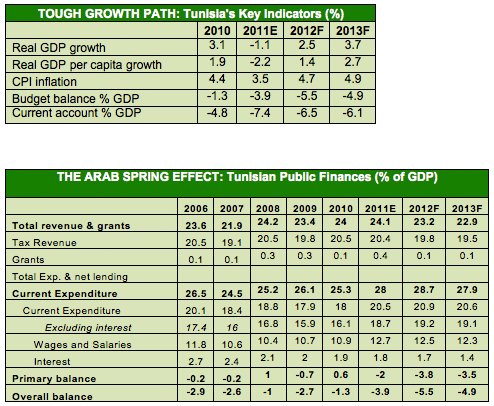
GREAT EXPECTATIONS
But does the world expect too much from Tunisia?
Tunisian PM Hamadi Jebali shot back at S&P's verdict, arguing that the country was being punished for its political reforms.
"Today we're going through a post-revolutionary phase. It is natural that there should be troubles, strikes and sit-ins. But this looks like democracy is being punished," Jebali said on television, adding that "all the economic indicators show that there is progress."
ADBG, which has taken a far more sympathetic tone, notes that despite the difficulties, the country's medium-term outlook remains positive.
"Although investors were reticent in 2011, Tunisia should attract new inflows of capital by stressing transparency and enterprise creation," said ADBG in a report on the African continent.
"The country has a highly qualified local workforce, dynamic private sector and a favourable geographical location at the meeting point of Europe and the African continent. The reform process has speeded up since the revolution, ranging from administration of regional development, not forgetting press freedom and youth employment."
However, agreement on a new constitution and the government's resolve in tackling major issues will be key to economic growth. Instead of relying on fuel and food subsidies - a pet peeve of virtually all multilateral institutions - the government should focus on expanding investments, says ADBG.
LIBYAN RECONSTRUCTION: A BOON?
The Libyan civil war exarcerbated Tunisia's economy as 60,000 of its citizens - which were gainfully employed in the oil-rich state - fled as Colonel Moammer Gaddafi and Libyan revolutionaries fought tooth and nail.
Tunisia exports, which had stood at around TDN1.5-billion worth of exports to Libya in the past two years, also took a beating.
Indeed, the ADBG estimates that Tunisia's economy declined by 0.4% as a direct fallout of the economic paralysis in Libya.
"This was compounded by the cost of the compensation programme for these returning workers, estimated at TND 70-125 million," noted ADB analyst Jacob Kolster, in a special report.
"The return of Tunisian workers from Libya sharply increased the unemployment rate in Tunisia which rose from 13% in May 2010 to 18.3% in May 2011. The suspension of Libyan investments following the freeze on Libyan assets and the decline in tourism revenues also contributed to the downturn of Tunisia's economy. This negative fallout was compounded by the cost of the emergency programme set up by the Tunisian government for refugees fleeing the fighting in Libya."
However, Libya is returning to some kind of normalcy and its oil production has already surpassed expectations and is inching towards its pre-war output.
Libya's return to the oil market and its historically friendly relations with Tunisia, present a viable opportunities for Tunisian businesses and citizens.
As the ADBG puts it: Tunisia has an abundant and diversified workforce that has competence and expertise in specific domains, while Libya has a huge natural resource endowment, especially oil.
Mr. Kolster and his ADBG colleagues believe Libya can absorb between 250,000 to 500,000 Tunisian workers over the next two years, far exceeding the 95,000 Tunisians resident in Libya in 2010.
"Tunisian labour could potentially replace workers of other nationalities present in large numbers before the war and who currently have difficulties returning to Libya due to the imposition of visa restrictions."
More than 1,000 Tunisian companies were present in Libya before the revolution with contracts and investments amounting to TND 3.5 billion, notes the ADBG.
These companies intend to return and resume their activities and to set up new structures in the agriculture and building materials sectors.In May, officials of the two countries met to discuss Libya's need for 3,000 Tunisian workers in telecommunications, tourism, health, housing and construction sectors. In addition, Tunisia agreed to train 5,000 Libyans at its training and rehabilitation centres, highlight the two countries cordial ties.
In light of these positive developments, Tunisian companies could capture the following opportunities in Libya:
1 Construction Materials: Building materials had traditionally been a strong Tunisian export and that's likely to be in favour as Libya's reconstruction needs rise. Iron ore, steel, cement are going to be key exports.
2 Utilities: Tunisia could offer its skills and experience in the repair and modernisation of utilities such as electricity, water, etc.
"As far as the private sector is concerned, Tunisian businesses have already operated in the Libyan market in partnership with local businesses or those involved in sub-contracting operations with foreign partners (the best example is sub-contracting with Brazil for works on Tripoli airport)," notes Mr. Jacob.
"Tunisian public works companies have confirmed that their contracts have been maintained and hope to further develop their activities in Libya. The same applies to consultancy firms that work mainly on the Libyan market."
3 Textiles: Tunisia is already a strong supplier of textiles to EU states and it could expand that industry in Libya.
4 Healthcare: Given Libya's dilapidated healthcare system, Tunisia can serve as a medical hub for Libyan and also help transfer medical skills and infrastructure.
5 ICT: Tunisia's information, communications and technology sector is far more advanced than Libya, which could give it a nice advantage in helping create employment and investment in both countries.
CONCLUSION
The North African state, far less endowed than its other regional counterparts, has been a trailblazer in terms of political reforms. After ousting its dictator, Tunisia held peaceful elections, is working on a constitution in time for the next parliamentary elections in 2013 and remains relatively stable despite bouts of violence.
In addition, there are reports that the Tunisia army has volunteered to come under the purview of the parliament, which may raise eyebrows in neighbouring Egypt's higher military echelons.
Given the lack of infrastructure and institutions under the Ben Ali regime, that's a remarkable accomplishment.
But Tunisia's moderate successes and its daunting challenges shows how difficult the political and economic transition in the region is going to be. It also highlights the overwhelming challenges countries like Libya and Egypt - and eventually Syria - will confront them as they follow Tunisia's lead.
© alifarabia.com 2012