Despite its enormous natural riches and cultivable land, too many Africans go to bed hungry.
The continent is home to half the world's usable uncultivated land (202 million hectares), yet poverty rates of 47.5% are the highest in the world, despite rapid economic growth over the past few years.
Yet feeding Africa is not about offering aid. The continent does not need more charity, but the right legal and business framework to transform the continent, not only to become self-sufficient in food, but also to emerge as an exporter of food products, livestock and grains.
In fact, there is a strong case for investment in Africa's food resources and farms.
"Despite its abundant agricultural land and natural resources, Sub-Saharan Africa is still mostly poor and has been unable to translate its recent robust growth into rapid poverty reduction," said Frank F K Byamugisha, operations adviser and lead land specialist in the Africa Region of the World Bank, in a new book.
"These examples suggest that poor land governance ‑ the manner in which land rights are defined and administered may be the root of the problem."
Instead of showing signs of improvement, the situation is actually worsening, as too many African citizens have been left out of the economic growth story in many Sub-Saharan countries.
The book notes that land ownership inequality and landlessness is actually growing in places like Ivory Coast, Kenya, Liberia and parts of South Africa - mirroring the rapid deterioration that has wrecked the Zimbabwean economy.
In addition, environmental degradation is taking place at an alarming rate, while women - who often lead subsistence-farming initiatives - are often left out of land ownership laws due to gender bias and inequality.
Meanwhile, foreign investors have swooped in to take advantage of the poor governance issues plaguing the continent.
World Bank data notes that more than one million hectares of land was bought up in places like Ethiopia, Liberia, Mozambique and Sudan by large multi-nationals and rich countries to ensure their own food security.
This land grab is due to the fact that a mere 10% of rural land in the region is registered. Poor laws and corruption also hamper efficiency.
"It takes twice as long and costs twice as much to transfer land in Sub-Saharan Africa as in Organization for Economic Cooperation and Development (OECD) countries," Byamugisha wrote in his book.
THE GREAT FOOD OPPORTUNITY
The African food challenge is, in effect, an enormous opportunity. With food resources increasingly becoming scarce and the global population well on its way to reaching nine million people within the space of a few decades, Africa presents a huge opportunity as it sits on half the world's uncultivated land.
"Increased investment in agriculture adds pressure, but also creates opportunities to document land rights and reduce the risk of dispossessing local communities while ensuring investment deals," the author wrote.
The Food & Agriculture Organization of the United Nations (FAO) notes that investment in agricultural research in the region rose by more than 20% in the past decade, but much of the growth occurred in only a few countries.
The regions of the world where hunger and extreme poverty are most widespread today - South Asia and Sub-Saharan Africa - have seen stagnant or declining rates of investment per worker in agriculture for three decades.
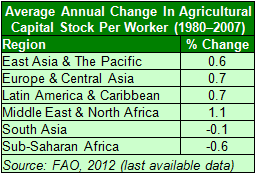
"Smallholders require special attention in order to allow them to overcome the constraints they often face to invest, including poor access to markets and financial services, insecure property rights and vulnerability to risk," the FAO said in a report.
"Supporting the formation of social capital in the form of effective producers' organizations and providing social transfer programs allowing them to build assets can help overcome some of the constraints."
Public-private partnerships are also central to kick-start agricultural investments in the region.
The Southern Agriculture Growth Corridor of the United Republic of Tanzania, the Harvest Plus Challenge Program apart from the Ghana Commercial Agriculture Project are some examples of public-private enterprises.
The FAO estimates that places such as Uganda can yield returns of well over 12% in agricultural R&D, much higher than places like India, China and Thailand.
Countries are also slowly making use of new technologies to reduce costs of land administration by replacing aerial photomaps costing USD 150 per square kilometer with Google Earth.
"At least 26 countries in Sub-Saharan Africa are replacing their geodetic infrastructure with low-cost global positioning systems for conducting uniform, cost-effective surveys and at least 15 countries in the region have ongoing initiatives to computerize their land registries, improving efficiency and reducing costs and corruption," the World Bank said.
There is some movement towards agricultural development. Countries such as Benin, Burkina Faso and Ivory Coast have piloted cost-effective and rural land tenure maps to register individual and communal lands.
"Ghana reduced the number of days to transfer property from 169 in 2005 to 34 in 2011 and increased land-related revenue from USD 12 million in 2003 to USD 132 million in 2010 by decentralizing and computerizing its land registries, merging its land agencies and strengthening property valuation.
"Uganda is about to complete a successful pilot that computerized land records and registration systems, reducing the number of days to transfer property from 227 in 2007 to 48 in 2011."
Improving the legal framework for land use and ownership are crucial for the development of Africa's flourishing fields.
Here are 10 ways to raise land administration in the continent: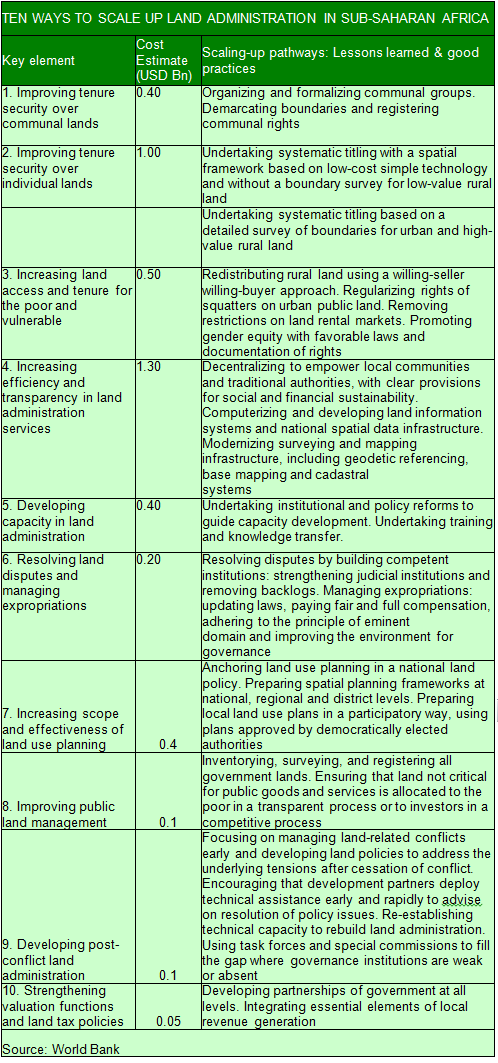
© alifarabia.com 2013