Europe will remain in recession for much of 2013 and 2014, and Greece could well exit the Eurozone, but it will do little to stop broad-based growth in the global economy, according to Citibank.
"We expect consumption and investment will grow rapidly across many emerging markets in coming years, especially in Asia and the Middle East, reflecting policy loosening plus background drivers of rapid growth of middle-income consumers, urbanization, and major infrastructure projects by cash-rich governments and state-linked bodies," says Michael Saunder, analyst at the bank.
Still, don't expect runaway growth in the New Year.
Citibank's global growth forecast stands at 2.6% in 2013 and 3.1% in 2014, lower than the International Monetary Fund's forecast of 2.9% in 2013 and 3.5% in 2014.
Against this backdrop, major central banks probably will continue to keep policy loose near term, and generally loosen further in 2013, with tightening not until 2015 in the US and rather later in Europe and Japan.
Morgan Stanley's Joachim Fels is far-less optimistic about global prospects, suggesting the world will remain 'stuck in the Twilight Zone' of subpar growth.
"More than ever, the economic outlook hinges upon the actions taken or not taken by governments and central banks," Mr. Fels said in a report.
Mark Faber, author of Gloom, Boom & Doom report, says global markets are worried about disappointing corporate results of blue-chips.
"The global economy will hardly grow next year or even contract, and that is the reason why stocks, from the highs of September of 1,470 on the S&P, will drop at least 20%, in my view," the analyst told a business channel in November.
Meanwhile, Nouriel Roubini, the economist with a strong bearish bias, says there are obstacles ahead for the global economy.
In 2013, downside risks to global growth will be exacerbated by the spread of fiscal austerity to most advanced economies, says Mr. Roubini.
"Until now, the recessionary fiscal drag has been concentrated in the eurozone periphery and the UK. But now it is permeating the eurozone's core. And in the U.S., even if President Barack Obama and the Republicans in Congress agree on a budget plan that avoids the looming "fiscal cliff," spending cuts and tax increases will invariably lead to some drag on growth in 2013 - at least 1% of GDP. In Japan, the fiscal stimulus from post-earthquake reconstruction will be phased out, while a new consumption tax will be phased in by 2014."
GULF GROWTH
In the backdrop of such uncertainities, the Gulf's economies will continue to motor along, driven by infrastructure projects and government funds stimulating the regional economies.
Saudi Arabia's oil sector will be a key source of stability for the Kingdom's economy, but the non-oil sector will also drive growth. The bank expects growth of 7% in 2012, followed by 5.2% and 7.8% over the next two years.
"We continue to expect robust growth in the non-oil economy (7.5% in 2012) on the back of continued high government expenditure and increased domestic demand," writes Farouk Soussa, analyst at Citibank. "At the beginning of July, the Saudi Council of Ministers finally approved the long-awaited mortgage law and we believe it will transform the stagnant mortgage market, though some caution is merited given the likely challenges a surge in housing demand could introduce."
Meanwhile, Dubai will play a key role in the UAE's continued economic revival, especially as its real estate and tourism sector picks up. The bank expects growth of 4.6% in 2013 and nearly 5% in 2014, after a more subdued 2.1% growth this year.
"While we had previously expected a continued contraction of the construction and real estate sectors in 2012, we now expect modest growth of 2%-3% in real terms, with the net effect of lifting overall real GDP growth to 5.1% in 2012 (previously 1.9%)," says Mr. Soussa.
While there are few internal risks in places like UAE, Saudi Arabia and Qatar, the wider region has greater uncertainty. Bahrain remains vulnerable to greater dissent, while political tensions have flared up in Kuwait.
Meanwhile, Egypt, Jordan, and the rest of North Africa remain beset with greater internal risk that could turn uglier in the New Year.
The Syrian civil war continues to rage with the rebel armies gaining ground, while the latest episode between Israel and Hamas could be a harbinger of greater conflict to come.
"Indeed, there are now greater geopolitical uncertainties as well," says Mr. Roubini. "The risk of an Iran-Israel military confrontation remains high as negotiations and sanctions may not deter Iran from developing nuclear-weapons capacity; a new war between Israel and Hamas in Gaza is likely; the Arab Spring is turning into a grim winter of economic, social, and political instability."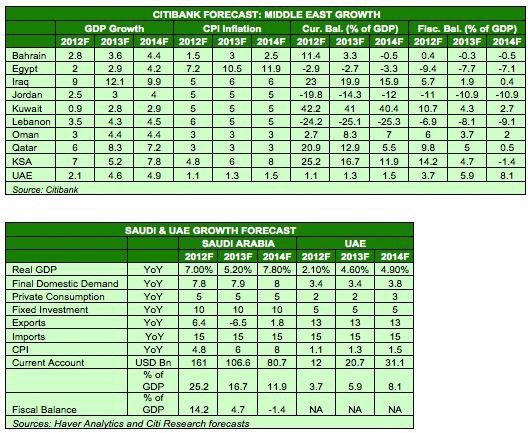
© alifarabia.com 2012