Just 10 days before South Sudan erupted in civil war last December, the government hosted more than 900 investors from 55 countries to showcase the country's investment opportunities.
"Let it be known to our regional countries and the world that the Republic of South Sudan is at last safe and open for business," President Salva Kiir told the investors gathered in the capital city of Juba.
South Sudan Investment Authority had earmarked five key areas for development: agriculture, petroleum, infrastructure, energy and mining. And the World Bank and the International Monetary Fund were poised to engage with the government to help South Sudan stand on its feet, after seceding from Sudan in 2011 after decades of north-south war.
But by December 15, ethnic tensions between two major tribes boiled over. President Kiir, who belongs to the Dinka tribe, accused his vice-president Riek Machar of rival tribe Neur of plotting a coup. A month later, both sides agreed to a peace deal, but that fell apart leading to more bloodshed and violence.
The United States, the biggest donor to the fledgling state, has stepped in to bring the two back to the negotiating table. Secretary of State John Kerry toured the region last week, and warned that the leaders must halt their internecine warfare if they are to avoid U.S. sanctions. Kirr has agreed to resume talks as early as this week, but it is unclear whether Machar will agree.
INVESTMENT OPPORTUNITIES
South Sudan hobbled onto the world stage with poor infrastructure and a plethora of unresolved issues. Still, the country offers a number of investment opportunities if it can manage to resolve its internal security challenges.
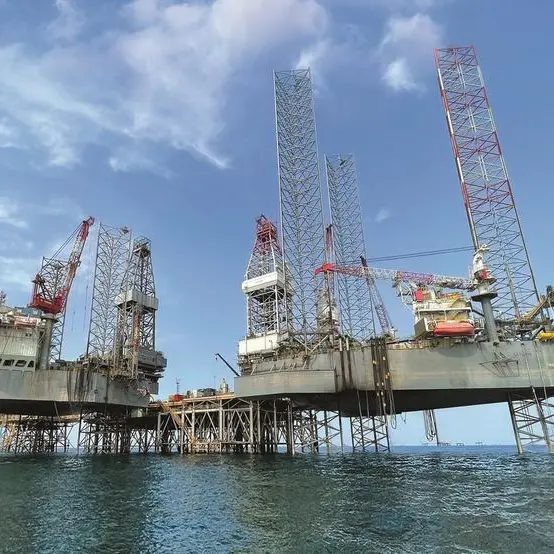
The investment opportunities showcased in December are still relevant. The most lucrative are in petroleum, which accounts for 98% of the country's exports.
Asian investors are already present in South Sudan, with Chinese National Petroleum Company (CNPC), Malaysia's Petronas and India's Oil and Natural Gas Corporation lured by oil reserves of 1.1 billion.
The companies produced 245,000 barrels per day by December 2013, but the International Energy Agency reported that output in South Sudan faced a possible shutdown as rebel militias prepared to capture oilfields in the Upper Nile state, putting in jeopardy nearly 160,000 bpd of new planned production in 2014.
Stephen Dhieu Dau, minister of petroleum, mining and industry, has said that oil production could reach 500,000 bpd by 2018 and just over 800,000 bpd by 2023.
The landlocked country has two export pipelines that run across neighboring Sudan to Port Sudan in the Red Sea, but the government wants to break its dependence on its northern neighbor and is examining pipeline projects either through Kenya or Ethiopia. A refinery is also planned to meet domestic needs.
Tensions with Sudan had impacted the country's ability to earn revenues from oil output in 2012 and 2013, severely hurting economic development. South Sudan has been unable to leverage hydrocarbon resources to benefit its people.
"Oil revenues are associated with poor governance and corruption, which have started to color the population's perceptions of their state and threaten to undermine its legitimacy," the African Development Bank said.
INFRASTRUCTURE NEEDS
South Sudan is roughly the size of France, but infrastructure is virtually non-existent in many places, and more than half of the country's 10.4 million people live below the poverty level.
"Despite its great resource wealth, its population is one of the most deprived, with extremely poor social indicators and dramatic gender disparities," noted the African Development Bank. "Outside a few oil enclaves, South Sudan remains a relatively undeveloped subsistence economy."
The government is keen to develop electricity grids, infrastructure development, roads and bridges and housing.
The population of the capital city Juba has risen from 250,000 in 2005 to 1.5 million last year, making huge demands on housing infrastructure.
The private sector has teamed up with the government to build 500,000 affordable units across the 10 states, but lack of skilled labor, supplies and social unrest has delayed the initiative.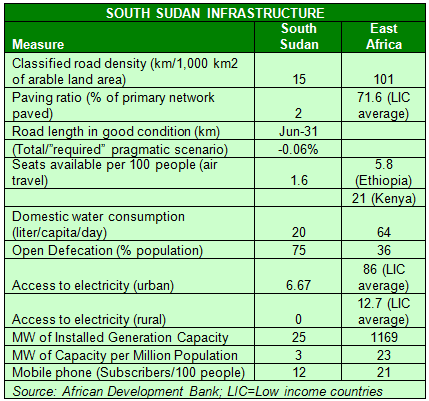
CHRONIC SHORTAGES
South Sudan also faces chronic shortages of potable water and sanitation facilities, despite having Africa's third largest renewable water resources per capita after Ghana and Nigeria.
The government is looking to secure nearly USD 740 million in financing for eight water projects spread across the country, and plans for solar and hydropower projects to generate electricity are also under way.
"A regulatory framework is being put in place to attract investment, guide development, and enhance collaboration with the private sector in the water sector," according to Jemma Nunu Kumba, minister of electricity, dams, irrigation and water resources.
All the development projects will be underpinned by a strong financial services sector. The country has 28 commercial banks but another 70 license applications are pending, according to the Bank of South Sudan, the country's central bank.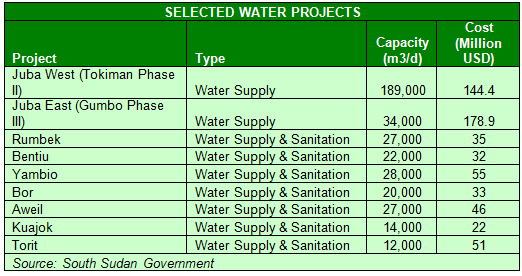
MINING POTENTIAL
In a bid to diversify from oil revenues, the country is looking to exploit its gold, diamonds, rare earth minerals and uranium deposits. In 2012, the government implemented a new mining policy to help attract to foreign investors.
The Ministry of Petroleum, Mining and Industry is also working with the international donor community on a USD 150 million aerial survey and mapping exercise to get a greater sense of its mineral reserves.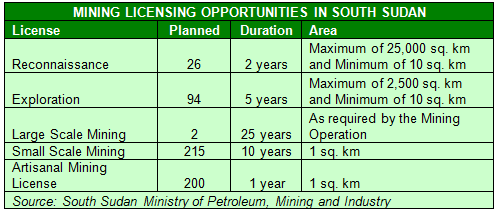
NO QUICK FIX
International companies, especially in oil and gas and mining, are poised to invest in the country, if its leaders can find a way to make peace.
Otherwise, civil war risks tearing the country further apart and is pulling in regional states, warned the International Crisis Group (ICG).
"Resolving the conflict requires not a quick fix but sustained domestic and international commitment. Governance, including SPLM [Sudan Peoples' Liberation Movement] and SPLA [the army] reform and communal relations, must be on the table. Religious and community leaders, civil society and women are critical to this process and must not be excluded."
The United States' effort to engage regional powers such as Ethiopia and Uganda in resolving South Sudan is a welcome move, and provides the key stakeholders an opportunity to reset the country's economic prospects.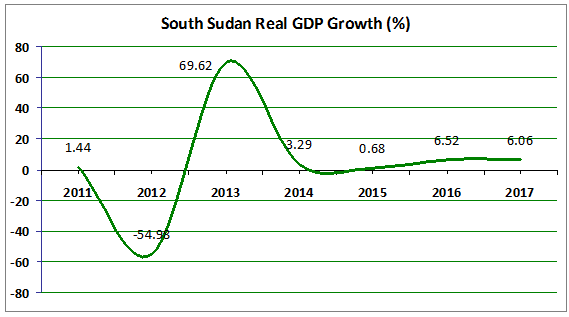
Source: African Development Bank
The feature was produced by alifarabia.com exclusively for zawya.com.
© Zawya 2014