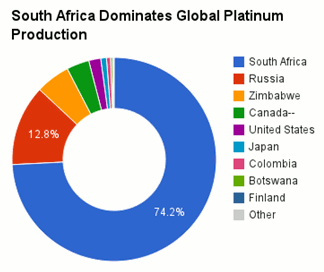
Stalemate at the world's largest platinum producer persists as South Africa's Association of Mineworkers and Construction Union (AMCU) rejected the latest offer by the world's three largest platinum producers' to end the strike.
Anglo American Platinum Limited (Amplats), Impala Platinum Holdings Limited (Implats) and Lonmin Plc -- who estimate the strikes have cost them USD 1 billion -- raised wage rates in their new offer. But the powerful AMCU believes it should hold out for more.
"AMCU leadership appears to have rejected the deal because, after 13-weeks of striking, they felt the offer was not a large enough victory to consolidate the union's dominance in the platinum sector," said Mark Rosenberg of Eurasia Group. "Continued labour unrest in the platinum belt helps reinforce our short-term 'negative' political trajectory for South Africa." The strike is now less likely to end with a sector-wide agreement, further delaying any resumption of production and significantly increasing the risk of violence, the analyst said.
DRAG ON GROWTH
Barclays Capital expects the strike and continued electricity shortages will be drag on growth this year, with GDP growth at 2.2% this year and 2.8% in 2015.
"Meanwhile, domestic demand is subdued, with tepid employment growth and weak confidence levels," said Peter Worthington, analyst at Barclays Capital.
"The biggest downside risks are an intensification of strike action as the wage bargaining season commences and a sharper-than-expected slowdown in China. Upside could come from an intensified reform drive after the 7 May elections."
Some observers believe the AMCU's obstinate stance is to punish the ruling African National Congress (ANC) as it seeks return to power in May, but which is vulnerable in a few regions.
"Given relative ANC weakness in North West province (which includes the platinum belt) and the mounting economic costs of the strike therein, AMCU leaders know that the election has increased pressure on the ANC to push a deal...," said Eurasia's Rosenburg.
Raising the stakes, the producers' group has decided to take their offer directly to workers, which could lead to greater violence as AMCU looks to retain control of negotiations. But many of its 90,000 workers are keen to return to their jobs and the union is worried a resumption of service would weaken its bargaining hand.
"In this case, police and other government forces could well be drawn into the conflict, increasing tensions further and heightening headline risks around South African rand and sovereign bonds," Eurasia said.
WEAK RAND
The strikes come at a time when the government is looking to raise GDP growth and build some momentum so close to the elections.
"The government is seeking to steer a course between fiscal consolidation that would stabilise the debt ratio, and supporting the subdued economy, which is growing below potential and being buffeted by shocks," according to Ed Parker, managing director of sovereigns at Fitch Ratings.
The country's exporters have also been robbed off a chance to benefit from a weak rand. Manufacturers have to contend with the impact of costlier import inputs
"Statistics South Africa's measurement for imported commodity prices increased 7.1% y-o-y during November 2013 of which more expensive mining and quarrying products contributed 5.4 percentage points," according to KPMG, management consultant.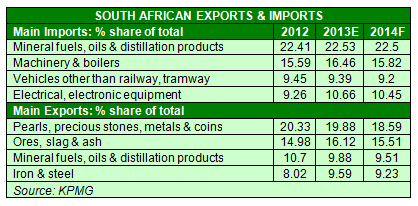
COST OF LABOR
The mining strikes and labor issues is also souring international metal companies' attitude towards South Africa. Amplat has threatened massive layoffs and mechanisation of its operations to reduce dependence on labor.
An Ernst & Young study on South African mining sector last year noted that the country's cost of labour was rising while labour productivity was declining compared to its peers.
It said low-cost electricity sector, once one of South Africa's key competitive advantages, is now rife with shortages. Availability of transportation remains a significant challenge for the sector despite commitments from government to allocate resources.
The opening up of frontier African states such as Mozambique, Democratic Republic of Congo, Namibia and Botswana is also driving metal and mineral companies away from South Africa.
South Africa needs to tackle these issues head on. Once the elections are over, the ANC - which is certain to win, according to most analysts - would do well to focus its energies on mending the relationship between the unions and the metals industry.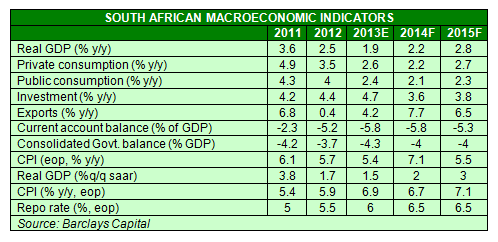
The feature was produced by alifarabia.com exclusively for zawya.com.
© Zawya 2014