Tunisia, ground zero of the Arab Spring, is struggling under the weight of expectations as the economy fails to boost the living standards of millions of Tunisians who expected much after the departure of dictator Zine El-Abidine Ben Ali in early 2011.
But two years later, Tunisians were back on the street demanding the ouster of the elected Islamic government after the assassination of popular secular politician Chokri Belaïd.
While Tunisia has managed its revolution better than Libya and Egypt, the country continues to suffer from a new identity crisis where the secular and Islamist forces seem to be at odds over the country's future path.
In the midst of the social tensions and political crisis, the economy has suffered.
The Institute of International Finance (IIF) says the country's external current account deficit and fiscal deficit are a major "source of concern."
The current account deficit rose to 8.5% of GPD last year as the trade balance deteriorated, partially due to the economic crisis in the euro zone. Exports fell 5% in 2012, while imports grew 2%.
Higher energy bills and imports of capital good saw capital expenditure rise in the year - as a result trade deficit widened to 14% of GDP in 2012 from 10% the previous year.
"Fiscal deficit was pushed to 5.2% of GDP due to high increase in transfer and subsidies. Hence, comprehensive reform of transfer and subsidies, accounting for 7% of GDP in 2012, are necessary to a much needed fiscal consolidation over the medium term," the IIF noted. Inflation jumped to 6.5% as food and fuel prices soared.
Meanwhile, official reserves stood at USD 8.3 billion at end-2012 after a helping hand from multilateral institutions.
Tourism, which fetched USD 2.1 billion for the economy last year and played a key role in the 3.6% GDP growth, is also showing signs of faltering.
Latest government data shows tourism revenues fell 7.5% in the first quarter of 2013, generating USD 259 million in revenues as Western tourists kept away after the assassination of Belaïd.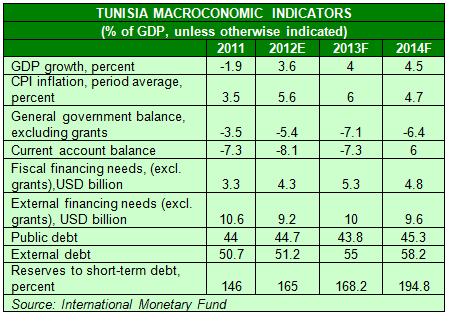
Financial injection from IMF
In this vulnerable state, the country needs USD 3.5 billion in external financing for 2013, according to the IIF's forecast. On April 19, the country secured a USD 1.75 billion loan from the International Monetary Fund (IMF) to get its fiscal house in order, jumpstart growth and address the banking sector's weaknesses.
"The SBA [Stand-by arrangement] will support the implementation of the Tunisian authorities' reform program to promote private investment, foster sustainable job-creation, reduce economic and social regional disparities, and strengthen social policies to protect the most vulnerable," said Christine Lagarde, IMF managing director, at the announcement. The loan is subject to approval from the IMF board next month.
The loan will be crucial to secure other forms of funding as well.
"Contrary to our expectations, the SBA facility extended to Tunisia will not be precautionary," said Amelie Roux, analyst at Fitch Ratings. "This is in contrast with the Precautionary Liquidity Line (PLL) signed with Morocco in August 2012, which the Moroccan authorities do not intend to use unless necessary."
In return, the Tunisian authorities have agreed to a number of structural reforms, including strengthening the weak banking sector, streamlining public expenditures (including subsidies), reforming monetary and exchange rate policies, and promoting private investment, said Fitch.
The government has also pledged to cut budget deficit to 5.1% this year compared to its earlier target of 5.9%.
Moving towards democracy
Much will depend on political stability and Tunisia's elected officials are hoping that a draft constitution by April and elections by December will help bring greater democratic reform.
Indeed the political stakes are high. An escalation of domestic social tensions fuelled by continuing high unemployment and rising political uncertainty could undermine the economic recovery and impede investment, said the IMF.
In addition, deteriorating economic conditions in Europe - its biggest trading partner - could hurt tourism, foreign direct investment and exports, curtailing Tunisia's GDP which is forecast to rise 4% this year and 4.5% in 2014.
There is also the threat of Islamic fundamentalism that is threatening to transform the traditionally secular and tolerant Tunisian society.
"While the 'Salafist threat' should not be under-estimated, neither can the 'counter-revolutionary' challenge that Belaïd and other secular leaders warned of," wrote Jon Marks, associate fellow Middle East and North Africa at Chatham House in a note.
"While Ennahda prime minister Hamadi Jebali tries to form a consensual government of technocrats ahead of elections planned for later this year, threats from within the old 'deep state' as well as from the Islamist fringe, pose a challenge that politicians cannot ignore."
© alifarabia.com 2013