Under pressure from a resurgent American petrochemicals industry and natural gas shortages at home, major Saudi petrochemicals companies are fighting back with massive expansion plans of their own.
While Saudi Arabia saw a 7.5% jump in petrochem capacity last year, there are worries that the kingdom is losing its natural advantage in the face of rising threats.
Going forward, Global Investment House expects "things to be more nervy" for the regional, and particularly Saudi, petrochemicals sector, due to a number of factors including US shale-backed petrochemicals sector, commodity price volatility and continued troubles in Europe.
To arrest the decline, King Abdullah Bin Abdulaziz Al Saud, laid the foundation for a number of projects at the Royal Commission for Jubail and Yanbu, including Saudi Aramco, SABIC and other private sector companies at a total cost of SAR 327 billion (USD 87.18 billion), according to the Saudi Press Agency.
While details remains sketchy, Saudi media reported the projects include an industrial rubber plant in Saudi Jubail Petrochemical Co. (Kemya), apart from polyoxymethylene project by the National Methanol Company (Ibn Sina), another project in Arabian Petrochemical Co. (Petrokemya), and a fifth plant at the Saudi Arabian Fertilizer Company (SAFCO).
MORE PROJECTS IN PIPELINE
Saudi companies have unveiled a number of projects lately. Saudi mining firm Maaden is looking to raise funding for a SAR 28 billion new phosphates project, known as the Waad Al-Shamal phosphates city, which is being built at Umm Waal on the northern border with Jordan.
Meanwhile, SABIC subsidiary Hadeed is looking to build two steel plants at a cost of SAR 16 billion, a 1.5 million ton per year project in Jubail and another 1 million ton per year development in Rabigh.
Sadara Chemicals Company, a joint venture between Saudi Aramco and Dow Chemicals Company, issued a sukuk recently to build a USD 20 billion integrated chemicals complex in Jubail Industrial City II, in Saudi's Eastern Province.
In addition, Petro Rabigh, a joint venture between Japan's Sumitomo Chemical and Saudi Aramco, is making a USD 5 billion investment to expand the project. SABIC and ExxonMobil Corp. have also teamed up to expand the Kemya project at a cost of USD 3.5 billion.
The two industrial cities Jubail and Yanbu are home to the country's oil and related industry, and account for 85% of all non-oil exports from the kingdom, 12% of its GDP and support 175,000 jobs.
The sector is a major plank of Saudi's diversification policy, which is why the government is keen to maintain the industry's global prominence.
AMERICAN RESURGENCE
The massive outlay for new developments valued at USD 90 billion is a direct response to huge investments being poured into the American petrochemicals sector, thanks to cheap and abundant shale gas.
The Middle East traditionally held the advantage in the global petrochemicals industry as it had access to cheap natural gas - a vital feedstock for petrochemicals. But this advantage is slowly eroding as the region's natural gas production has not matched domestic demand and the American shale gas revolution is weakening the price advantage.
"Recent shifts in both supply and demand have led to growing gas shortages of natural gas in the region," said Global. "At the same time, feedstock developments in other parts of the world pose threats as well as provide opportunities to GCC players.
"Adapting to this, GCC petrochemical companies have shifted to more liquid feedstock. Most new major projects across the region (such as the Saudi Aramco-Dow Chemical venture, Sadara) are expected to use mostly liquid feedstock. This move to liquid feedstock will pose grave challenges to GCC players, as they do not offer the same cost advantages as gas feedstock."
The American Chemistry Council notes that access to cheap US shale gas has been directly responsible for 115 new chemicals and plastic projects in America worth a combined USD 80 billion by the end of the decade.
"The United States has become a magnet for chemical industry investment, a testament to the favorable environment created by America's shale gas as well as a vote of confidence in a bright natural gas outlook for decades to come," said ACC president and CEO Cal Dooley. "What's especially exciting is that half of the announced investments are from firms based outside the US, which means our country is poised to capture market share from the rest of the world."
USD4.1TRN INDUSTRY
The development is all the more remarkable as only recently, major American petrochemical companies were looking to shut down their operations and tying up with Middle East companies due to greater returns and proximity to key markets such as Asia Pacific, Europe and Africa.
"The US has become a highly cost effective place to invest in new petrochemical plants, even if the market for that new production is in emerging economies," said Global Investment House in a report.
"Ethylene capacity is poised to increase almost 33% by 2017, pending completion of all new plants, expansions, enhancements and restarts of shutdown facilities that have been announced in the US."
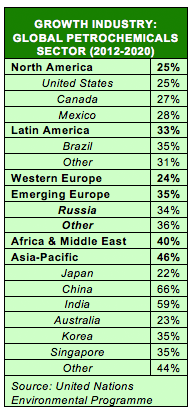
The global petrochemicals industry has come a long way from USD 170 billion enterprise in 1970 to a USD 4.1 trillion industry today, and is used in products as diverse as personal computers to toys.
The United Nations Environment Programme estimates the industry is set to grow at 3% per annum till 2050, with the largest growth in Asia Pacific and Middle East North Africa region.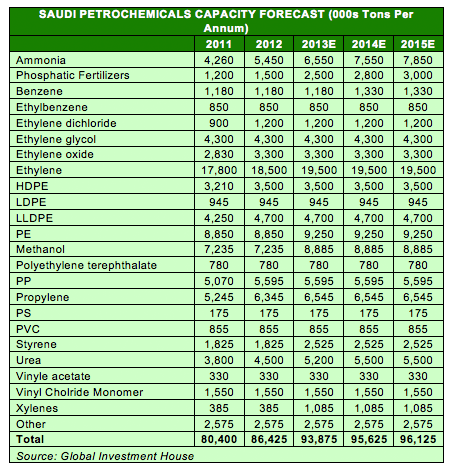
MOVING QUICKLY
The Saudi authorities are moving on a number of fronts to maintain their advantage. Sahara Petrochemicals and Saudi International Petrochemicals Company recently agreed to explore a merger, as the industry looks at consolidation.
"In our view, if both the companies agree on the merger, the combined entity is likely to have a more balanced basic chemicals and downstream exposure," said SICO in a note on the merger.
Despite the challenges, the region and particularly Saudi Arabia will continue to remain an important part of the global supply chain. Its close proximity to the hungry Asian markets and heavy investments will ensure that the region will play a crucial role in the global petrochemicals industry especially as its own demand for the product is rising, too.
But it is true that the regional industry's golden era is at an end, and its natural advantages as a petrochemicals hub are fast eroding.
© alifarabia.com 2013