With the Saudi oil sector expected to generate less revenues this year, the non-oil sector will need to step up and carry the burden of generating growth for the economy.
The kingdom's oil sector generated USD 46.2 billion for the first two months of the year, 8.8% lower than the same period last year. Saudi Arabia has been steadily cutting crude production this year on account of lower global demand, and its average output in the first quarter was 6.8% lower than last year.
Meanwhile, Brent crude prices have fallen 10.5% since the start of the year, which does not bode well for the Saudi oil sector, especially as most analysts expect oil prices to trend lower for the remainder of the year.
"Lower net demand for Saudi Arabian [oil] exports is expected to result in slightly reduced production," said the International Monetary Fund, which expects the kingdom to post a 4.4% growth in 2013 and 4.2% in 2012.
A recent Reuters poll of 19 analysts forecast economic growth in Saudi Arabia would ease to 4.1% in 2013 and 4% in 2014.
The Saudi non-oil sector has been outperforming the hydrocarbons sector over the past few quarters, and grew 7.16% last year. Meanwhile, the oil sector grew 5.54% in the last year, and contracted in the last quarter of 2012 (see table below).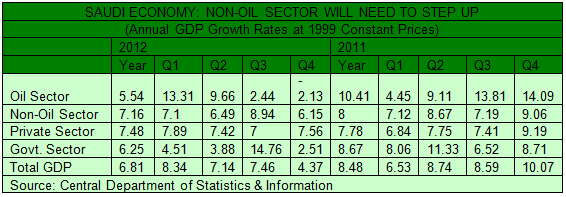
The current robust business cycle was boosted by sharp rise in oil production and government spending since early 2011, said Rahmatullah Khan, economic analyst at Al Rajhi Bank, but growth in both sectors has already peaked.
"Oil sector growth peaked in the Q4-2011 whereas non-oil government sector growth remained on moderating trend since Q2-2011, except a spike in Q3-2012. Notwithstanding the slowdown in these sectors, non-oil private sector growth reflects remarkable stability in the last eight quarters."
Pinning hopes on non-oil GDP
The non-oil sector now makes up 78% of the country's GDP, which is a heartening fact and shows Saudi Arabia is slowly moving away from crippling dependence on global energy markets.
Still, the oil sector's performance is very important to the economic health of the country.
"Although the private sector's contribution to GDP rose to 58.2% in 2012 from 50.9% a decade earlier, the economy remains largely dependent on hydrocarbons for growth of the oil sector, funding for public sector investments, and low-cost feedstock for certain large-scale manufacturing industries," wrote Global Investment House in a new report.
"The government has leveraged the recent surge in oil revenues to fast track domestic developmental objectives. It announced new initiatives in 2011 to accelerate addressing social issues, including employment, availability of affordable housing and SME financing."
The non-oil sector rose strongly last year. Transportation, storage and communication grew 10.65%, construction grew 10.26%, non-petroleum manufacturing grew 8.25% and wholesale and retail grew 8.33%.
But 2013 is seeing uneven growth.
"Net new credit to private sector slowed to SAR 11 billion in February compared with SAR 12.3 billion in the previous month," noted Jadwa Investment bank, although credit to the government rose.
Non-oil exports in January contracted from the all-time high in December of last year, but remained 4.8% higher than their level in January 2012.
Growth in the banking sector, however, suggests economic activity remains robust. Saudi banks collectively posted better-than-expected first quarter results, with net income rising nearly 4% year-on-year.
Much of the growth came on the back of non-interest income, which grew 6.2% year-on-year, according to NCB Capital.
"We were forecasting a non-interest income decline of 10% year-on-year due to our expectation of lower banking fees as well as the decline in Tadawul volumes," said NCB Capital.
"We attribute the better-than-expected figures to good growth in loans and thus loan fees, trade finance and trading income, which we believe is driven in part by the strong global stock market performance."
The retail sector also underlined strong domestic consumption. Retailer Fawaz Al Hokair posted a 41% increase in gross income driven by organic growth, new stores and acquisitions.
Meanwhile, Al Othaim saw net income rise 20.5% year-on-year. NCB Capital notes that growth in sales at existing as well as new stores were key drivers for the company's growth.
"We believe organic growth was 4-5%, up from 1-2% in 2012; it opened two supermarkets in the first quarter and five in the fourth quarter, thus seven more year-on-year," said the bank.
Real estate returns to form
While traditional oil and petrochemicals sector will get their fair share of investments, the government is increasingly focused on social sectors, including healthcare and education as the government looks to negate pressure for political reforms, according to Global.
"Anticipated capital expenditure for 2013 includes construction of 539 schools, 19 hospitals and development of 3,700-km roads across the kingdom... Ongoing government spending on transport and social services is expected to keep the services sector vibrant," said Global. "Under the Ninth Development Plan, the government intends to invest USD 30 billion in the transport and communications sector, and USD 74 billion in social and health services."
With inflation reined in at 3.8% this year, the Saudi authorities will be keen to further massage the non-oil sector and extract growth for the economy, as the oil sector take a breather after a few years of robust growth.
© alifarabia.com 2013