Saudi Arabia was the world's eighth biggest spender on military expenditure in 2011, as the country braced for external and internal threats by bolstering its defences.
Indeed, Saudi Arabia bucked the global trend as large military cuts were initiated by some of the world's biggest spenders.
The Kingdom spent USD46-billion last year, according to the latest Stockholm International Peace Research Institute (SIPRI) yearbook, a tad higher than the USD45-billion spent in 2010.
"The Middle East is the only region where a clear increasing pattern was discernible for most countries, although the lack of data for key players such as Iran and the United Arab Emirates makes the regional total highly uncertain," noted SIPRI in the report.
The SIPRI data shows that Middle East states collectively spent USD98-billion on defence in 2011, but missing figures from the UAE and Iran - which are major spenders on arms - understates the actual number.
Iran, is of course, under tremendous strain to abandon its nuclear programme. It would be no surprise to imagine that the country is beefing up its defences as it prepares for a potential conflict with Western and Western-backed forces.
Lack of figures from the two crucial Middle East countries mean the figure is much lower than the USD108.5-billion spent by Middle East states (which includes data from the UAE) by 2010 (see table).
Other Middle East states were also on a massive spending spree, despite the economic and social upheavals - or perhaps because of it.
Algeria spent USD8-billion last year, compared to USD5.6-billion in 2010, while Iraq and Kuwait also saw a spike in military spending last year.
Meanwhile, Syria, which is in the middle of massacring its civilian population, increased its military spending to an all-time record of USD2.5-billion, while Egypt managed to raise spending slightly despite tremendous economic hardship facing the country.
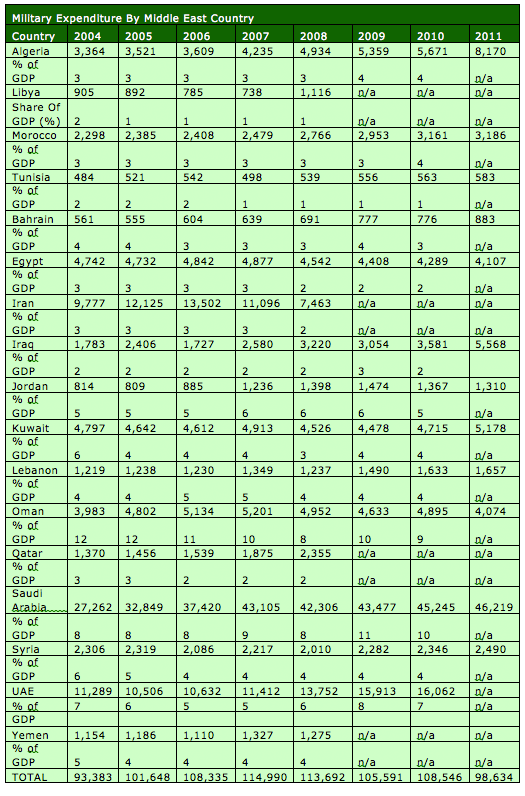
Source: SIPRI; figures are in USD Mn, at constant 2010 prices and exchange rates.
HIGHEST SPEND AS % OF GDP
Middle East states are also the biggest spenders on defence as a percentage of their GDP, according to the latest available figures from SIPRI.
According SIPRI data, Saudi Arabia spent 10% of its GDP on military spending in 2010 - the highest in the world.
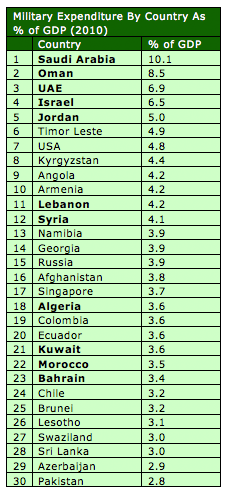
Source: SIPRI
In fact, Arab Spring has added a new complexity in the region, as governments fought against civilians in Syria, Egypt and Bahrain to suppress unrest.
"The events of the Arab Spring demonstrate the growing complexity of armed conflict. While the various uprisings shared a number of traits--including large demonstrations, non-violent actions, the absence of single leaders and the use of central squares in major cities--they also differed in certain respects," noted SIPRI in the report. The extent of the demands made by the protesters varied, ranging from improved economic situations to regime change, as did the level of violence.
The events of last year were not isolated in terms of contemporary conflict trends, notes Dr Neil Melvin, Director of the SIPRI Armed Conflict programme.
"In fact, they echoed changes that have been occurring in armed conflict for decades. Taken together, these changes suggest that there's a new kind of conflict environment emerging, one in which international interventions become far more difficult to carry out."
GLOBAL TREND
Middle East military spending is in sharp contrast to global trend, which levelled out, rising a paltry 0.3% last year to reach USD1.74-trillion.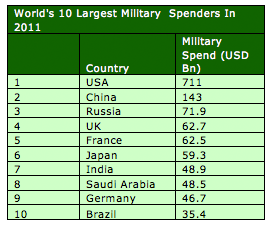
Source: SIPRI
Six of the world's top military spenders--Brazil, France, Germany, India, the United Kingdom and the United States--made cuts in their military budgets in 2011, in most cases as part of attempts to reduce budget deficits. Meanwhile other states, notably China and Russia, increased their military spending markedly.
"The after-effects of the global economic crisis, especially deficit-reduction measures in the USA and Europe, have finally brought the decade-long rise in military spending to a halt--at least for now," stated Dr Sam Perlo-Freeman, head of the SIPRI Military Expenditure Project.
"It is too early to say whether the flattening of military spending in 2011 represents a long-term change of trend," said Dr Perlo-Freeman. "While we are likely to see some further falls in the USA and Europe in the next few years, trends in Asia, Africa and the Middle East continue to be upward for now, and any major new war could change the picture dramatically."
In other developments, Russia, which has become increasingly confrontational with Western countries echoing the Cold War era, saw its military spending rise 9.3% last year in 2011, reaching a total of $71.9 billion, which now makes the country the third largest military spender worldwide, overtaking the UK and France.
The U.S. - the world's biggest spender on defence - saw its expenditure fall 1.3% as its military activities in Iraq came to an end.
Meanwhile, China, the world's second largest military spender, saw a 6.7% increase in spending last year.
© alifarabia.com 2012